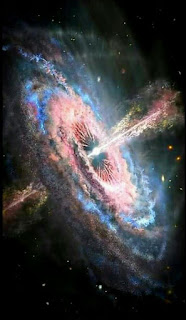
Quasars are very bright, distant and active supermassive black holes that are millions to billions of times the mass of the Sun. Typically located at the centers of galaxies, they feed on infalling matter and unleash fantastic torrents of radiation.
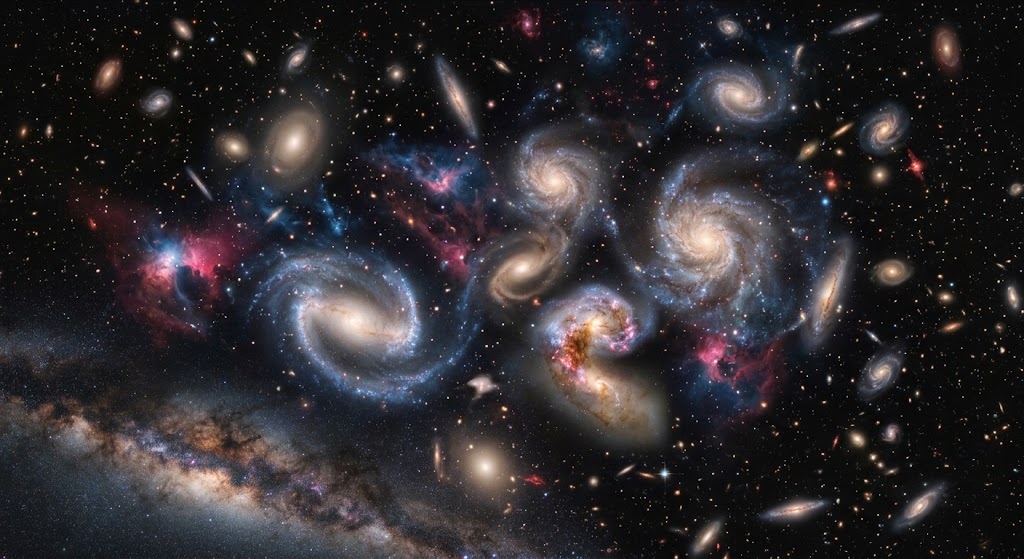
Among the brightest objects in the universe, a quasar’s light outshines that of all the stars in its host galaxy combined, and its jets and winds shape the galaxy in which it resides. Shortly after its launch later this year, a team of scientists will train NASA’s James Webb Space Telescope on six of the most distant and luminous quasars.
They will study the properties of these quasars and their host galaxies, and how they are interconnected during the first stages of galaxy evolution in the very early universe. The team will also use the quasars to examine the gas in the space between galaxies, particularly during the period of cosmic reionization, which ended when the universe was very young. They will accomplish this using Webb’s extreme sensitivity to low levels of light and its superb angular resolution.
Gerd Dani — Founder & Director Gerd Dani is the visionary in a wheelchair behind FreeAstroScience. An astronomy graduate and a master's in physics, he founded this blog in June 2020, driven by a passion for breaking down complex scientific and philosophical concepts into bite-sized, digestible pieces. As President, he is dedicated to making science accessible to everyone, from students to seasoned academics.
var astra = {"break_point":"921","isRtl":"","is_scroll_to_id":"1","is_scroll_to_top":"1","is_header_footer_builder_active":"1","responsive_cart_click":"flyout","is_dark_palette":"","revealEffectEnable":"","edit_post_url":"https://freeastroscience.com/wp-admin/post.php?post={{id}}&action=edit","ajax_url":"https://freeastroscience.com/wp-admin/admin-ajax.php","infinite_count":"2","infinite_total":"0","pagination":"number","infinite_scroll_event":"scroll","no_more_post_message":"No more posts to show.","grid_layout":{"desktop":3,"tablet":1,"mobile":1},"site_url":"https://freeastroscience.com","blogArchiveTitleLayout":"layout-2","blogArchiveTitleOn":"1","show_comments":"Show Comments","enableHistoryPushState":"1","masonryEnabled":"","blogMasonryBreakPoint":"0"};
//# sourceURL=astra-theme-js-js-extra