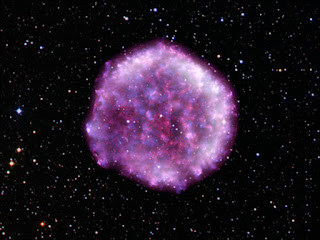
Approximately 450 years after its discovery, NASA has uncovered the mysteries of an historical supernova. The analysis of the data collected by the Imaging X-ray Polarimetry Explorer (IXPE) provided new clues as to how the shock waves generated by supernovae accelerate particles almost at the speed of light. The main player in this research is the famous Tycho supernova remnant.
The image was composed using observations from NASA’s X-ray Polarimetry Explorer (IXPE) imaging (dark purple and white), NASA’s Chandra X-ray Observatory (red and blue) and, as for the stars in the background, the Ized digitsky survey. Credit: X-ray (IXPE: NASA/ASI/MSFC/INAF/R. Ferrazzoli, et al.), (Chandra: NASA/CXC/RIKEN & GSFC/T. Sato et al.) Optical: DSS Image Processing: NASA/CXC/SAO/K. Arcand, L.Frattare & N.Wolk.
Tycho remnant name comes from Danish astronomer Tycho Brahe, who observed it in 1572. It was so bright that it has now released as much energy as the Sun will emit over a dozen billion years.
NASA lets us know that, thanks to IXPE, they were able to detect for the first time the geometry of the magnetic fields near the shock wave caused by the stellar explosion.
In particular, the direction of polarization from X-rays can be traced back to the direction of the magnetic fields at the point where the X-rays were generated. Tycho’s magnetic field shape has been mapped at scales less than a parsec (approximately 3.26 light-years).
The Tycho supernova is classified as type Ia, which occurs when the white dwarf of a binary system feeds on the mass of its companion star to trigger a violent explosion. At present, most cosmic rays of galactic origin, including those that continuously bombard our planet, are believed to originate from such events.
Gerd Dani — Founder & Director Gerd Dani is the visionary in a wheelchair behind FreeAstroScience. An astronomy graduate and a master's in physics, he founded this blog in June 2020, driven by a passion for breaking down complex scientific and philosophical concepts into bite-sized, digestible pieces. As President, he is dedicated to making science accessible to everyone, from students to seasoned academics.
(()=>{async function handleCredentialResponse(response){try{const res=await fetch('https://freeastroscience.com/wp-login.php?action=googlesitekit_auth',{method:'POST',headers:{'Content-Type':'application/x-www-form-urlencoded'},body:new URLSearchParams(response)});/* Preserve comment text in case of redirect after login on a page with a Sign in with Google button in the WordPress comments. */ const commentText=document.querySelector('#comment')?.value;const postId=document.querySelectorAll('.googlesitekit-sign-in-with-google__comments-form-button')?.[0]?.className?.match(/googlesitekit-sign-in-with-google__comments-form-button-postid-(\d+)/)?.[1];if(!! commentText?.length){sessionStorage.setItem(`siwg-comment-text-${postId}`,commentText);}location.reload();}catch(error){console.error(error);}}if(typeof google !=='undefined'){google.accounts.id.initialize({client_id:'251104905146-eghigrtua82ec7aan4em9fle9u5f0ilc.apps.googleusercontent.com',callback:handleCredentialResponse,library_name:'Site-Kit'});}const defaultButtonOptions={"theme":"outline","text":"signin_with","shape":"rectangular"};document.querySelectorAll('.googlesitekit-sign-in-with-google__frontend-output-button').forEach((siwgButtonDiv)=>{const buttonOptions={shape:siwgButtonDiv.getAttribute('data-googlesitekit-siwg-shape')|| defaultButtonOptions.shape,text:siwgButtonDiv.getAttribute('data-googlesitekit-siwg-text')|| defaultButtonOptions.text,theme:siwgButtonDiv.getAttribute('data-googlesitekit-siwg-theme')|| defaultButtonOptions.theme,};if(typeof google !=='undefined'){google.accounts.id.renderButton(siwgButtonDiv,buttonOptions);}});/* If there is a matching saved comment text in sessionStorage,restore it to the comment field and remove it from sessionStorage. */ const postId=document.body.className.match(/postid-(\d+)/)?.[1];const commentField=document.querySelector('#comment');const commentText=sessionStorage.getItem(`siwg-comment-text-${postId}`);if(commentText?.length && commentField && !! postId){commentField.value=commentText;sessionStorage.removeItem(`siwg-comment-text-${postId}`);}})();
var astra = {"break_point":"921","isRtl":"","is_scroll_to_id":"1","is_scroll_to_top":"1","is_header_footer_builder_active":"1","responsive_cart_click":"flyout","is_dark_palette":"","revealEffectEnable":"","edit_post_url":"https://freeastroscience.com/wp-admin/post.php?post={{id}}&action=edit","ajax_url":"https://freeastroscience.com/wp-admin/admin-ajax.php","infinite_count":"2","infinite_total":"0","pagination":"number","infinite_scroll_event":"scroll","no_more_post_message":"No more posts to show.","grid_layout":{"desktop":3,"tablet":1,"mobile":1},"site_url":"https://freeastroscience.com","blogArchiveTitleLayout":"layout-2","blogArchiveTitleOn":"1","show_comments":"Show Comments","enableHistoryPushState":"1","masonryEnabled":"","blogMasonryBreakPoint":"0"};
//# sourceURL=astra-theme-js-js-extra