
With seismic data from the InSight mission
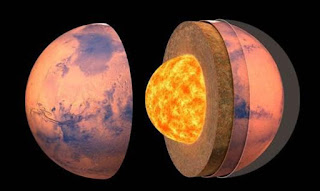
Researchers from various institutions, including the CSIC, have analyzed the earthquakes recorded on the red planet by the NASA module and have mapped, for the first time, the Martian interior. The data, published in three studies in Science, confirm that it has a liquid and metallic core. They also give information on its size, the structure of the crust and the mantle.
The first direct seismic observations from NASA’s InSight lander on Martian soil were featured this week in the journal Science. The results provide clues about the composition of Mars. The international team has analyzed data from a dozen ‘marsquakes’ recorded by the ultrasensitive broadband seismometer SEIS (Seismic Experiment for Interior Structure), deployed by this mission.
“These three studies provide important clues about the structure of Mars and are also key to improving our understanding of how this planet formed billions of years ago and evolved over time,” write seismologists Sanne Cottaar of the University of Cambridge, and Paula Koelemeijer, of the Royal Holloway of the University of London (both in the United Kingdom), in a related opinion piece in the same magazine.
These three studies provide important clues about the structure of Mars and are key to improving our understanding of how this planet formed billions of years ago and evolved over time.
The study and analysis of seismic data recorded by SEIS has allowed scientists to determine the thickness and structure of the crust of Mars. This is the focus of one of the studies, the first author of which is Brigitte Knapmeyer-Endrun, a geophysicist at the University of Cologne (Germany). Martin Schimmel, a researcher at Geosciences Barcelona (GEO3BCN-CSIC) has collaborated in this work.
Thus, Knapmeyer-Endrun and her colleagues have used Martian earthquakes and ambient seismic noise to image the structure of the planet’s crust under the InSight landing site.
Multilayer bark
The team found evidence of a multi-layered crust, which could have two or three levels. Extrapolating these data to the entire planet, the researchers showed that the average thickness of the crust of Mars could be between 24 and 72 kilometers.
Artistic illustration representing the internal structure of Mars. / © IPGP / D. Ducros