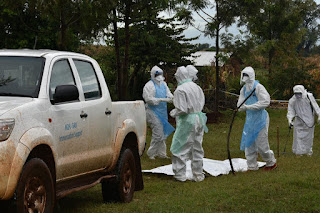
Following the detection of the first Marburg virus case on January 7th, the World Health Organization (WHO) has reported eight additional instances of this severe hemorrhagic illness, closely related to the Ebola virus. With a heightened risk of mortality, the Marburg virus outbreak has raised concerns for public health, especially within Equatorial Guinea.
Experts believe the epidemic is mainly contained within Equatorial Guinea, though new cases have emerged approximately 150 kilometers away, close to the borders of Cameroon and Gabon. This suggests that the virus is spreading further, prompting calls for intensified response efforts.
Matshidiso Moeti, the WHO’s Regional Director for Africa, highlights the need to “swiftly halt the transmission chain and avert a potential large-scale outbreak and loss of human lives.” According to Moeti, implementing a wide range of epidemic response measures can effectively control and stop the highly virulent Marburg virus.
The zoonotic virus originates from the Egyptian fruit bat, Rousettus aegyptiacus, a species widespread in Africa, the Middle East, the Mediterranean, and the Indian subcontinent. Being in close contact with these animals increases the risk of Marburg virus infection.
Symptoms of the Marburg virus include high fever, headache, muscle aches, and chills, with an incubation period ranging from 2 to 21 days. Additional symptoms such as diarrhea, vomiting, abdominal pain, and rash may appear within a few days. Severe symptoms encompass liver failure, multiorgan dysfunction, and extensive hemorrhaging.
Unfortunately, there are currently no vaccines or treatments available for the Marburg virus. However, some potential treatments are under development and have recently advanced beyond Phase 1 trials. Intravenous fluid therapy and symptom management can improve survival rates, but the Marburg virus still causes a mortality rate of up to 88%.
Efficient monitoring and response efforts are crucial to control the spread of the Marburg virus outbreak and minimize its impact on public health. As experts continue to investigate and understand the virus, it is essential to remain vigilant and take necessary precautions.
Gerd Dani — Founder & Director Gerd Dani is the visionary in a wheelchair behind FreeAstroScience. An astronomy graduate and a master's in physics, he founded this blog in June 2020, driven by a passion for breaking down complex scientific and philosophical concepts into bite-sized, digestible pieces. As President, he is dedicated to making science accessible to everyone, from students to seasoned academics.
(()=>{async function handleCredentialResponse(response){try{const res=await fetch('https://freeastroscience.com/wp-login.php?action=googlesitekit_auth',{method:'POST',headers:{'Content-Type':'application/x-www-form-urlencoded'},body:new URLSearchParams(response)});/* Preserve comment text in case of redirect after login on a page with a Sign in with Google button in the WordPress comments. */ const commentText=document.querySelector('#comment')?.value;const postId=document.querySelectorAll('.googlesitekit-sign-in-with-google__comments-form-button')?.[0]?.className?.match(/googlesitekit-sign-in-with-google__comments-form-button-postid-(\d+)/)?.[1];if(!! commentText?.length){sessionStorage.setItem(`siwg-comment-text-${postId}`,commentText);}location.reload();}catch(error){console.error(error);}}if(typeof google !=='undefined'){google.accounts.id.initialize({client_id:'251104905146-eghigrtua82ec7aan4em9fle9u5f0ilc.apps.googleusercontent.com',callback:handleCredentialResponse,library_name:'Site-Kit'});}const defaultButtonOptions={"theme":"outline","text":"signin_with","shape":"rectangular"};document.querySelectorAll('.googlesitekit-sign-in-with-google__frontend-output-button').forEach((siwgButtonDiv)=>{const buttonOptions={shape:siwgButtonDiv.getAttribute('data-googlesitekit-siwg-shape')|| defaultButtonOptions.shape,text:siwgButtonDiv.getAttribute('data-googlesitekit-siwg-text')|| defaultButtonOptions.text,theme:siwgButtonDiv.getAttribute('data-googlesitekit-siwg-theme')|| defaultButtonOptions.theme,};if(typeof google !=='undefined'){google.accounts.id.renderButton(siwgButtonDiv,buttonOptions);}});/* If there is a matching saved comment text in sessionStorage,restore it to the comment field and remove it from sessionStorage. */ const postId=document.body.className.match(/postid-(\d+)/)?.[1];const commentField=document.querySelector('#comment');const commentText=sessionStorage.getItem(`siwg-comment-text-${postId}`);if(commentText?.length && commentField && !! postId){commentField.value=commentText;sessionStorage.removeItem(`siwg-comment-text-${postId}`);}})();
var astra = {"break_point":"921","isRtl":"","is_scroll_to_id":"1","is_scroll_to_top":"1","is_header_footer_builder_active":"1","responsive_cart_click":"flyout","is_dark_palette":"","revealEffectEnable":"","edit_post_url":"https://freeastroscience.com/wp-admin/post.php?post={{id}}&action=edit","ajax_url":"https://freeastroscience.com/wp-admin/admin-ajax.php","infinite_count":"2","infinite_total":"0","pagination":"number","infinite_scroll_event":"scroll","no_more_post_message":"No more posts to show.","grid_layout":{"desktop":3,"tablet":1,"mobile":1},"site_url":"https://freeastroscience.com","blogArchiveTitleLayout":"layout-2","blogArchiveTitleOn":"1","show_comments":"Show Comments","enableHistoryPushState":"1","masonryEnabled":"","blogMasonryBreakPoint":"0"};
//# sourceURL=astra-theme-js-js-extra