Messier 83 or M83 (also designated NGC 5236) is a spiral galaxy in the constellation Hydra. It has an apparent visual magnitude of 7.6 and its angular diameter is 11×10 arc-minutes. M83 lies at an estimated distance of 15 million light years. The Equinox 2000 coordinates are RA= 13h 37m, Dec= -29° 52´ which makes M83 best seen during the spring. The Messier Spring Star Chart shows the position of all Messier objects visible during that season. As one of the more famous objects in the Messier Catalog, it is commonly known as the Southern Pinwheel Galaxy.
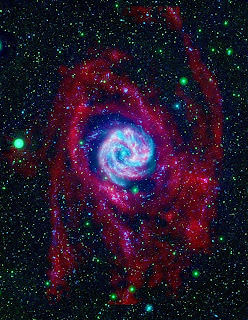
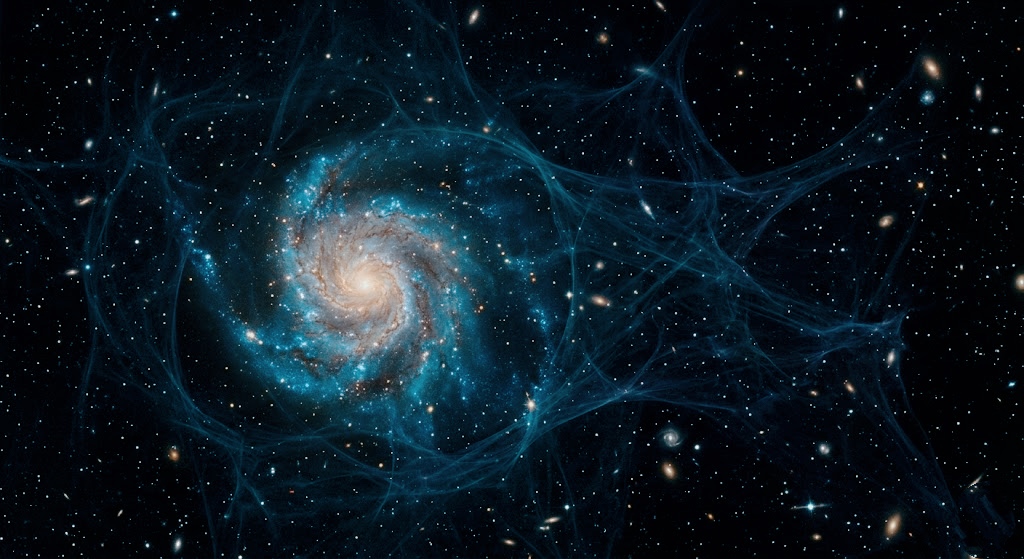
In this image, The outlying regions around the Southern Pinwheel galaxy are highlighted in this composite image from NASA’s Galaxy Evolution Explorer and the National Science Foundation’s Very Large Array in New Mexico. The blue and pink pinwheel in the center is the galaxy’s main stellar disk, while the flapping, ribbon-like structures are its extended arms.
The Galaxy Evolution Explorer is an ultraviolet survey telescope. Its observations, shown here in blue and green, highlight the galaxy’s farthest-flung clusters of young stars up to 140,000 light-years from its center. The Very Large Array observations show the radio emission in red. They highlight gaseous hydrogen atoms, or raw ingredients for stars, which make up the lengthy, extended arms.
Astronomers are excited that the clusters of baby stars match up with the extended arms, because this helps them better understand how stars can be created out in the “backwoods” of a galaxy.
In this image, far-ultraviolet light is blue, near-ultraviolet light is green and radio emission at a wavelength of 21 centimeters is red.
This spiral galaxy was discovered by N. L. Lacaille in 1752. The Southern Pinwheel Galaxy is the southernmost galaxy in the Messier Catalog. It is well known for its distinct spiral arms. According to Stoyan et al. (2010), the distance of M83 is 14.7 million light years and its diameter is 55,000 light years.
Gerd Dani — Founder & Director Gerd Dani is the visionary in a wheelchair behind FreeAstroScience. An astronomy graduate and a master's in physics, he founded this blog in June 2020, driven by a passion for breaking down complex scientific and philosophical concepts into bite-sized, digestible pieces. As President, he is dedicated to making science accessible to everyone, from students to seasoned academics.
(()=>{async function handleCredentialResponse(response){try{const res=await fetch('https://freeastroscience.com/wp-login.php?action=googlesitekit_auth',{method:'POST',headers:{'Content-Type':'application/x-www-form-urlencoded'},body:new URLSearchParams(response)});/* Preserve comment text in case of redirect after login on a page with a Sign in with Google button in the WordPress comments. */ const commentText=document.querySelector('#comment')?.value;const postId=document.querySelectorAll('.googlesitekit-sign-in-with-google__comments-form-button')?.[0]?.className?.match(/googlesitekit-sign-in-with-google__comments-form-button-postid-(\d+)/)?.[1];if(!! commentText?.length){sessionStorage.setItem(`siwg-comment-text-${postId}`,commentText);}location.reload();}catch(error){console.error(error);}}if(typeof google !=='undefined'){google.accounts.id.initialize({client_id:'251104905146-eghigrtua82ec7aan4em9fle9u5f0ilc.apps.googleusercontent.com',callback:handleCredentialResponse,library_name:'Site-Kit'});}const defaultButtonOptions={"theme":"outline","text":"signin_with","shape":"rectangular"};document.querySelectorAll('.googlesitekit-sign-in-with-google__frontend-output-button').forEach((siwgButtonDiv)=>{const buttonOptions={shape:siwgButtonDiv.getAttribute('data-googlesitekit-siwg-shape')|| defaultButtonOptions.shape,text:siwgButtonDiv.getAttribute('data-googlesitekit-siwg-text')|| defaultButtonOptions.text,theme:siwgButtonDiv.getAttribute('data-googlesitekit-siwg-theme')|| defaultButtonOptions.theme,};if(typeof google !=='undefined'){google.accounts.id.renderButton(siwgButtonDiv,buttonOptions);}});/* If there is a matching saved comment text in sessionStorage,restore it to the comment field and remove it from sessionStorage. */ const postId=document.body.className.match(/postid-(\d+)/)?.[1];const commentField=document.querySelector('#comment');const commentText=sessionStorage.getItem(`siwg-comment-text-${postId}`);if(commentText?.length && commentField && !! postId){commentField.value=commentText;sessionStorage.removeItem(`siwg-comment-text-${postId}`);}})();
var astra = {"break_point":"921","isRtl":"","is_scroll_to_id":"1","is_scroll_to_top":"1","is_header_footer_builder_active":"1","responsive_cart_click":"flyout","is_dark_palette":"","revealEffectEnable":"","edit_post_url":"https://freeastroscience.com/wp-admin/post.php?post={{id}}&action=edit","ajax_url":"https://freeastroscience.com/wp-admin/admin-ajax.php","infinite_count":"2","infinite_total":"0","pagination":"number","infinite_scroll_event":"scroll","no_more_post_message":"No more posts to show.","grid_layout":{"desktop":3,"tablet":1,"mobile":1},"site_url":"https://freeastroscience.com","blogArchiveTitleLayout":"layout-2","blogArchiveTitleOn":"1","show_comments":"Show Comments","enableHistoryPushState":"1","masonryEnabled":"","blogMasonryBreakPoint":"0"};
//# sourceURL=astra-theme-js-js-extra