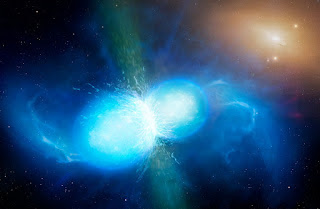
Kilonovas, celestial fireworks of cosmic proportions, have become a hot topic in the realm of astrophysics. These massive explosions, triggered by colliding neutron stars, create the perfect conditions for the synthesis of heavy elements like gold and platinum.
The Discovery and Study of Kilonovas:
The discovery of Kilonovas can be attributed to the diligent work of two independent teams of astronomers. In 2021, while studying the aftermath of a long gamma-ray burst (GRB), these teams stumbled upon evidence of a kilonova, challenging the prevailing theory that long GRBs exclusively originate from supernovae[1]. The researchers utilized telescopes such as the Gemini North and Gemini South to detect the near-infrared afterglow of the GRB. The observations revealed signs of a neutron-star merger rather than the expected signal of a supernova, marking the first time a kilonova has been associated with a long GRB[1].
The Significance of Kilonovas:
The true marvel of a kilonova lies in its ability to create heavy elements. When neutron stars collide, the resulting explosions are perfectly spherical, contradicting earlier theories that suggested they would be flattened discs[3]. The reason for this spherical shape remains a mystery, but it could provide insights into the physics of neutron star mergers and even help explain phenomena like dark energy[3].
Recent Developments:
Recent research highlights the role of neutrinos in kilonovas, suggesting that lighter elements are evenly distributed throughout space in these massive explosions[3]. This discovery adds another piece to the cosmic puzzle, enhancing our understanding of these celestial events.
Conclusion:
The study of kilonovas is an ongoing journey, and with advancements in technology and observational methods, our grasp of these celestial explosions will continue to evolve. As we delve deeper, we are not just learning about kilonovas, but also unveiling the secrets of our universe. The world of kilonovas is a testament to the wonders that lie beyond our planet, offering a glimpse into the complex and fascinating workings of the cosmos.
Gerd Dani — Founder & Director Gerd Dani is the visionary in a wheelchair behind FreeAstroScience. An astronomy graduate and a master's in physics, he founded this blog in June 2020, driven by a passion for breaking down complex scientific and philosophical concepts into bite-sized, digestible pieces. As President, he is dedicated to making science accessible to everyone, from students to seasoned academics.
(()=>{async function handleCredentialResponse(response){try{const res=await fetch('https://freeastroscience.com/wp-login.php?action=googlesitekit_auth',{method:'POST',headers:{'Content-Type':'application/x-www-form-urlencoded'},body:new URLSearchParams(response)});/* Preserve comment text in case of redirect after login on a page with a Sign in with Google button in the WordPress comments. */ const commentText=document.querySelector('#comment')?.value;const postId=document.querySelectorAll('.googlesitekit-sign-in-with-google__comments-form-button')?.[0]?.className?.match(/googlesitekit-sign-in-with-google__comments-form-button-postid-(\d+)/)?.[1];if(!! commentText?.length){sessionStorage.setItem(`siwg-comment-text-${postId}`,commentText);}location.reload();}catch(error){console.error(error);}}if(typeof google !=='undefined'){google.accounts.id.initialize({client_id:'251104905146-eghigrtua82ec7aan4em9fle9u5f0ilc.apps.googleusercontent.com',callback:handleCredentialResponse,library_name:'Site-Kit'});}const defaultButtonOptions={"theme":"outline","text":"signin_with","shape":"rectangular"};document.querySelectorAll('.googlesitekit-sign-in-with-google__frontend-output-button').forEach((siwgButtonDiv)=>{const buttonOptions={shape:siwgButtonDiv.getAttribute('data-googlesitekit-siwg-shape')|| defaultButtonOptions.shape,text:siwgButtonDiv.getAttribute('data-googlesitekit-siwg-text')|| defaultButtonOptions.text,theme:siwgButtonDiv.getAttribute('data-googlesitekit-siwg-theme')|| defaultButtonOptions.theme,};if(typeof google !=='undefined'){google.accounts.id.renderButton(siwgButtonDiv,buttonOptions);}});/* If there is a matching saved comment text in sessionStorage,restore it to the comment field and remove it from sessionStorage. */ const postId=document.body.className.match(/postid-(\d+)/)?.[1];const commentField=document.querySelector('#comment');const commentText=sessionStorage.getItem(`siwg-comment-text-${postId}`);if(commentText?.length && commentField && !! postId){commentField.value=commentText;sessionStorage.removeItem(`siwg-comment-text-${postId}`);}})();
var astra = {"break_point":"921","isRtl":"","is_scroll_to_id":"1","is_scroll_to_top":"1","is_header_footer_builder_active":"1","responsive_cart_click":"flyout","is_dark_palette":"","revealEffectEnable":"","edit_post_url":"https://freeastroscience.com/wp-admin/post.php?post={{id}}&action=edit","ajax_url":"https://freeastroscience.com/wp-admin/admin-ajax.php","infinite_count":"2","infinite_total":"0","pagination":"number","infinite_scroll_event":"scroll","no_more_post_message":"No more posts to show.","grid_layout":{"desktop":3,"tablet":1,"mobile":1},"site_url":"https://freeastroscience.com","blogArchiveTitleLayout":"layout-2","blogArchiveTitleOn":"1","show_comments":"Show Comments","enableHistoryPushState":"1","masonryEnabled":"","blogMasonryBreakPoint":"0"};
//# sourceURL=astra-theme-js-js-extra