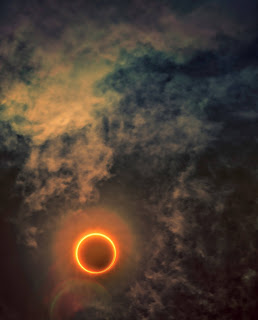
Solar eclipses on Earth, though somewhat infrequent occurrences happening just two to five times annually, are mesmerizing events. They take place when the Moon aligns flawlessly between the Earth and the Sun during its orbit near either of its two nodes.
Contrary to popular belief, the spectacular experience of solar eclipses isn’t exclusive to Earth. Any planet within the Solar System with moons, except Mercury and Venus, can witness this celestial phenomenon.
Take Mars, for instance, blessed with two moons, Phobos and Deimos. These moons intermittently pass across the solar disk, as illustrated in the second image captured by the Curiosity rover from Mars’s surface. However, due to their small size, Phobos and Deimos can’t entirely obscure the solar disk, leading to only partial eclipses. Deimos is so minuscule and distant from Mars that its sun-crossings are labeled as transits instead of eclipses.
As we shift our focus to the outer Solar System, the four gas giants – Jupiter, Saturn, Uranus, and Neptune, all boasting multiple moons, make solar eclipses relatively common. The type of eclipse (total, partial, annular) largely depends on the satellite’s size and its distance from the planet. For instance, Uranus has twelve satellites sufficiently proximate and large enough to generate an eclipse.
Solar eclipses are also a sight to behold from Pluto. From this vantage point, the Sun resembles a very bright star, sharing the same angular size as how Jupiter appears from Earth. Conversely, Charon, as observed from Pluto, has an angular diameter four times that of the full Moon as seen from Earth. Due to this significant size difference between the Sun’s disk and Charon’s disk, a solar eclipse observed from Pluto is more akin to a star’s occultation by a lunar disk rather than a typical eclipse.
Gerd Dani — Founder & Director Gerd Dani is the visionary in a wheelchair behind FreeAstroScience. An astronomy graduate and a master's in physics, he founded this blog in June 2020, driven by a passion for breaking down complex scientific and philosophical concepts into bite-sized, digestible pieces. As President, he is dedicated to making science accessible to everyone, from students to seasoned academics.
(()=>{async function handleCredentialResponse(response){try{const res=await fetch('https://freeastroscience.com/wp-login.php?action=googlesitekit_auth',{method:'POST',headers:{'Content-Type':'application/x-www-form-urlencoded'},body:new URLSearchParams(response)});/* Preserve comment text in case of redirect after login on a page with a Sign in with Google button in the WordPress comments. */ const commentText=document.querySelector('#comment')?.value;const postId=document.querySelectorAll('.googlesitekit-sign-in-with-google__comments-form-button')?.[0]?.className?.match(/googlesitekit-sign-in-with-google__comments-form-button-postid-(\d+)/)?.[1];if(!! commentText?.length){sessionStorage.setItem(`siwg-comment-text-${postId}`,commentText);}location.reload();}catch(error){console.error(error);}}if(typeof google !=='undefined'){google.accounts.id.initialize({client_id:'251104905146-eghigrtua82ec7aan4em9fle9u5f0ilc.apps.googleusercontent.com',callback:handleCredentialResponse,library_name:'Site-Kit'});}const defaultButtonOptions={"theme":"outline","text":"signin_with","shape":"rectangular"};document.querySelectorAll('.googlesitekit-sign-in-with-google__frontend-output-button').forEach((siwgButtonDiv)=>{const buttonOptions={shape:siwgButtonDiv.getAttribute('data-googlesitekit-siwg-shape')|| defaultButtonOptions.shape,text:siwgButtonDiv.getAttribute('data-googlesitekit-siwg-text')|| defaultButtonOptions.text,theme:siwgButtonDiv.getAttribute('data-googlesitekit-siwg-theme')|| defaultButtonOptions.theme,};if(typeof google !=='undefined'){google.accounts.id.renderButton(siwgButtonDiv,buttonOptions);}});/* If there is a matching saved comment text in sessionStorage,restore it to the comment field and remove it from sessionStorage. */ const postId=document.body.className.match(/postid-(\d+)/)?.[1];const commentField=document.querySelector('#comment');const commentText=sessionStorage.getItem(`siwg-comment-text-${postId}`);if(commentText?.length && commentField && !! postId){commentField.value=commentText;sessionStorage.removeItem(`siwg-comment-text-${postId}`);}})();
var astra = {"break_point":"921","isRtl":"","is_scroll_to_id":"1","is_scroll_to_top":"1","is_header_footer_builder_active":"1","responsive_cart_click":"flyout","is_dark_palette":"","revealEffectEnable":"","edit_post_url":"https://freeastroscience.com/wp-admin/post.php?post={{id}}&action=edit","ajax_url":"https://freeastroscience.com/wp-admin/admin-ajax.php","infinite_count":"2","infinite_total":"0","pagination":"number","infinite_scroll_event":"scroll","no_more_post_message":"No more posts to show.","grid_layout":{"desktop":3,"tablet":1,"mobile":1},"site_url":"https://freeastroscience.com","blogArchiveTitleLayout":"layout-2","blogArchiveTitleOn":"1","show_comments":"Show Comments","enableHistoryPushState":"1","masonryEnabled":"","blogMasonryBreakPoint":"0"};
//# sourceURL=astra-theme-js-js-extra