How Advanced Are We, Really? The Kardashev Scale Explained
Have you ever stopped to wonder just how far we’ve come as a species — and how far we still have to go? Not in terms of politics or culture, but in raw, cosmic terms. If an alien civilization were watching us from across the galaxy, would they be impressed? Or would we look like toddlers playing with matches?
Welcome to FreeAstroScience.com, where we break down complex scientific ideas into language anyone can enjoy. Today, we’re tackling one of the most thought-provoking frameworks in all of astronomy: the Kardashev Scale. It’s a way to measure how advanced a civilization is — not by its art or philosophy, but by how much energy it can command.

Stay with us through the end. By the time you finish reading, you’ll see our place in the universe through completely different eyes. And trust us, the view is both humbling and thrilling.
📑 Table of Contents
- 1. What Is the Kardashev Scale and Why Does It Matter?
- 2. Who Was Nikolai Kardashev?
- 3. What Are the Three Types of Civilizations?
- 4. Where Does Earth Stand on the Scale Right Now?
- 5. How Did Carl Sagan Refine This Framework?
- 6. What Lies Beyond Type III?
- 7. Is the Kardashev Scale Perfect?
- 8. What Does This Mean for Humanity’s Future?
- 9. Final Thoughts: Our Cosmic Journey Continues
What Is the Kardashev Scale and Why Does It Matter?
Picture this: a cosmic report card — but instead of grading math or reading, it grades an entire civilization. The test? How much energy you can capture and use.
That’s the Kardashev Scale in a nutshell. It’s a method of measuring a civilization’s level of technological advancement based on the total amount of energy it can harness . The more energy a society commands, the more power it holds over its environment. Simple as that.
And here’s what makes it personal. This scale doesn’t just apply to hypothetical aliens. Earth sits on it, too. We can plot ourselves right there on the chart, measure our progress, and ask the big question: Where are we headed?
The concept has become a staple of modern astronomy, SETI research, and even science fiction. Whenever someone asks “how advanced could an alien civilization really be?” — the Kardashev Scale is the answer that keeps coming up.
Who Was Nikolai Kardashev?
The man behind the scale was Nikolai Kardashev (1932–2019), a Soviet astronomer with a sharp mind and an even sharper curiosity about life beyond Earth.
In 1964, Kardashev presented a paper titled “Transmission of Information by Extraterrestrial Civilizations” at the Byurakan Conference in the Armenian SSR. The paper appeared first in Russian in the Astronomicheskii Zhurnal, then in English in the Soviet Astronomical Journal later that year .
His idea was straightforward. If alien civilizations exist — and many scientists believed they did — how powerful would their radio transmissions be? The answer depended on how much energy they could produce. So Kardashev proposed a classification system: three types of civilization, each separated by staggering leaps in energy use .
He wasn’t just theorizing in the abstract, either. Kardashev examined real cosmic radio sources — including CTA-21 and CTA-102, discovered by the California Institute of Technology in 1963 — wondering if their unusual characteristics might match what an artificial transmission would look like .
Over the next three decades, he published follow-up papers: “Strategies of Searching for Extraterrestrial Intelligence” (1980), “On the Inevitability and the Possible Structure of Super Civilizations” (1985), and “Cosmology and Civilizations” (1997) . Each one refined his thinking about advanced civilizations and gave SETI researchers new directions to explore.
He also offered a beautifully broad definition of civilization itself: “a highly stable state of matter capable of acquiring, making abstract analysis of, and utilizing information to obtain qualitatively new information about its environment and about itself” . That definition still resonates today.
What Are the Three Types of Civilizations?
Here’s where it gets exciting. Kardashev’s original framework lays out three stages of technological evolution. Each one represents a giant leap — not just in energy, but in what a civilization can do with it.
Type I — Masters of Their Planet
A Type I civilization has figured out how to capture and use all the energy available on its home planet. Every watt of solar radiation that hits the surface, every bit of geothermal, wind, and tidal energy — it’s all theirs .
In Kardashev’s original 1964 paper, he pegged this at about 4 × 10¹² watts — the estimated power consumption of Earth at the time he wrote it. Later refinements by Carl Sagan placed the benchmark higher, at around 10¹⁶ watts .
Think of it as a civilization that has fully graduated from fossil fuels, figured out energy storage, and runs its entire world with elegant efficiency. We’re not there yet. Not even close. But we’re working on it .
Type II — Harvesting a Star
Now the stakes jump by a jaw-dropping factor. A Type II civilization can harness the entire energy output of its host star .
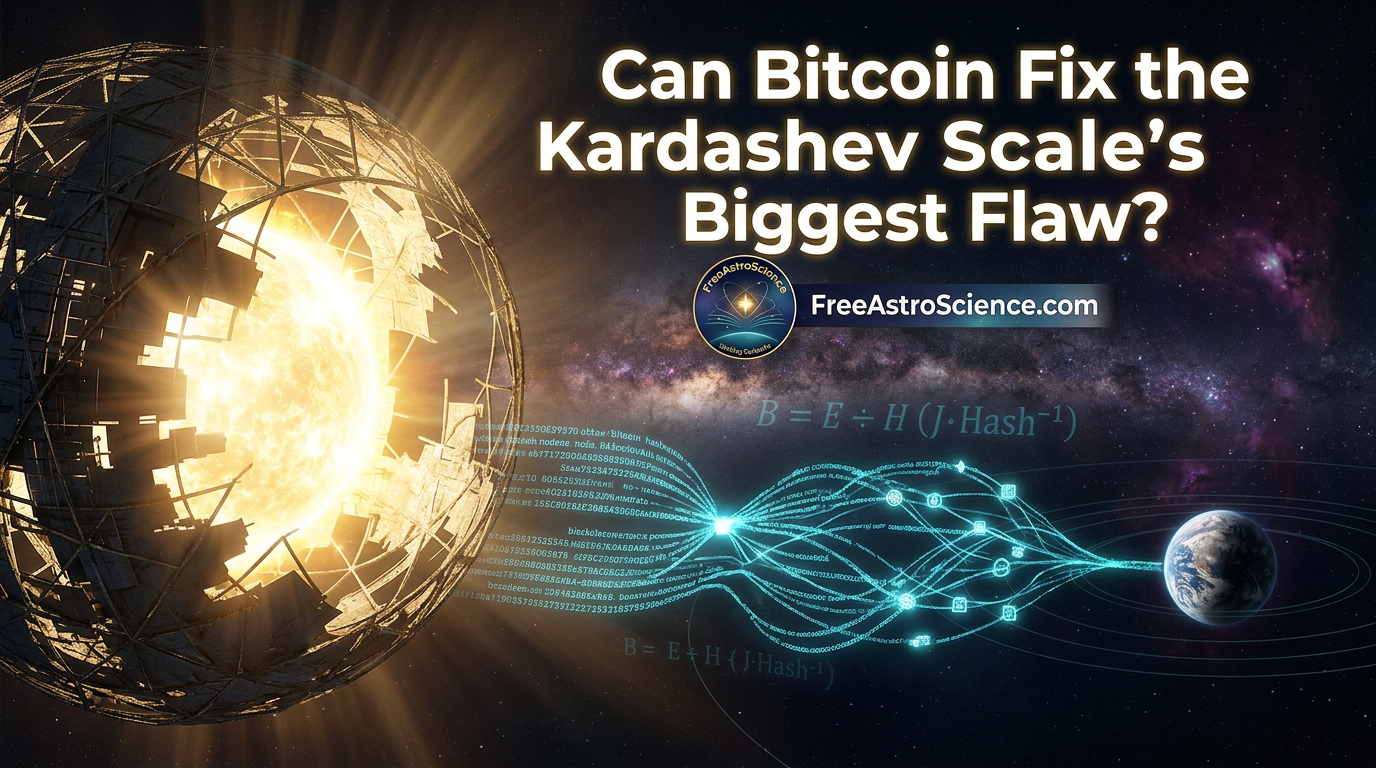
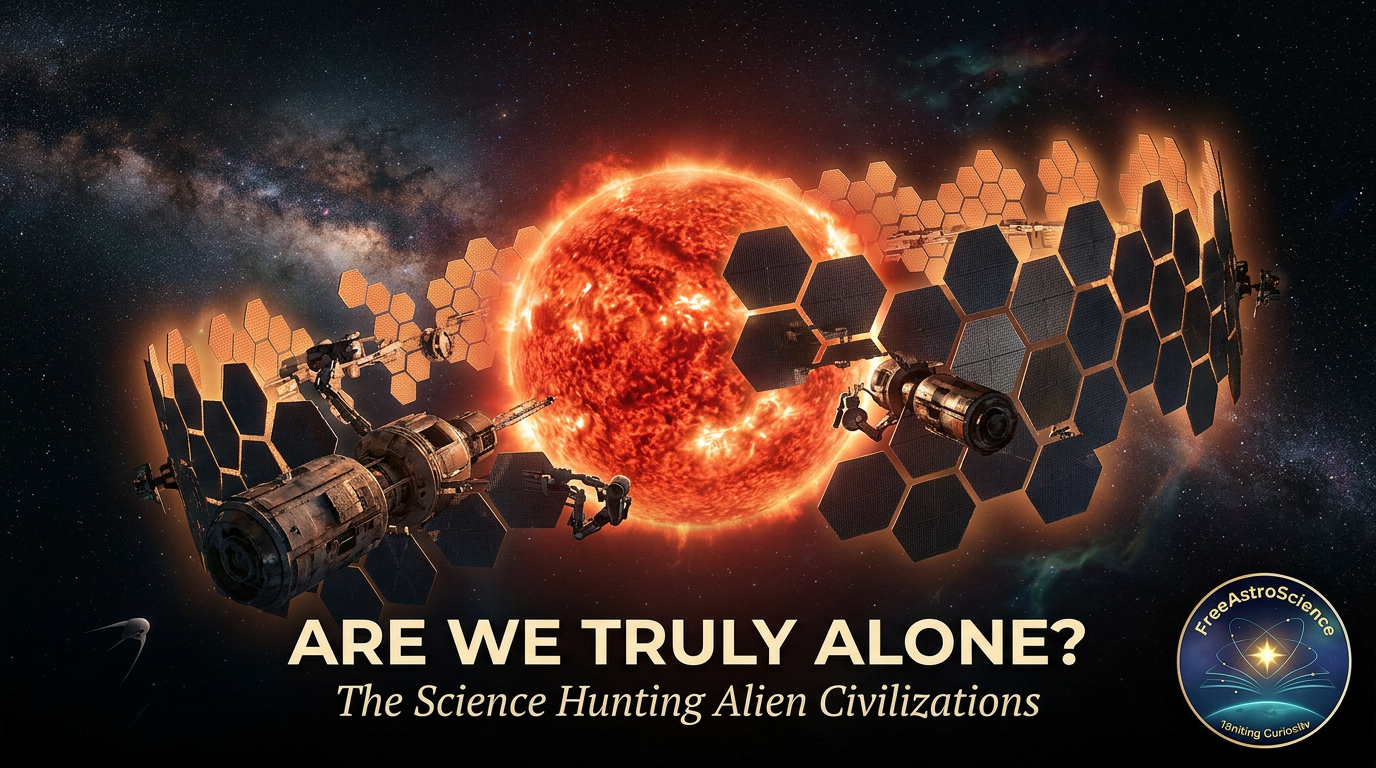
The most famous idea for how this might work is the Dyson Sphere — a megastructure that surrounds a star and captures most or all of its radiation. Astronomer Freeman Dyson proposed the concept in 1960, and it’s been a favorite of science fiction writers ever since much energy are we talking about? Around 4 × 10²⁶ watts — that’s the luminosity of a Sun-like star. In Sagan’s version of the scale, a Type II society commands roughly 10 billion times more energy than a Type I .
As astronomer Guillermo Lemarchand put it, this level means commanding the full power of the Sun . The sheer scale is staggering. Our entire global energy infrastructure, all our power plants and solar farms combined, would look like a candle next to a bonfire.
Type III — Galactic Titans
At the summit of Kardashev’s original scale sits the Type III civilization — a society that has harnessed the energy of an entire galaxy .
Every star, every black hole, every energetic object in the galaxy — all tapped, all used. The estimated energy output: approximately 4 × 10³⁷ watts . That’s another factor of 10 billion beyond Type II .
We’re deep into territory that strains the imagination. A Type III civilization could, in theory, rearrange stars, engineer galactic structures, and send signals across intergalactic distances. If they’re out there, they’d be very, very hard to miss.
| Type | Scope | Energy (Watts) | Example Concept |
|---|---|---|---|
| Type I | Planetary | ~1016 W | Total solar energy hitting a planet |
| Type II | Stellar | ~1026 W | Dyson Sphere around a star |
| Type III | Galactic | ~1037 W | Harnessing every star in a galaxy |
| Earth (2020) | Sub-planetary | ~1.8 × 10¹³ W | Score ≈ 0.728 on the Sagan scale |
Where Does Earth Stand on the Scale Right Now?
Here’s the humbling part. On the Kardashev Scale, we haven’t even reached Type I.
Studies put Earth at a level of approximately 0.676 in 1965, rising to about 0.728 by 2020. Jason Wright, director of the Penn State Extraterrestrial Intelligence Center, places us at roughly 0.72 .
It’s like we’ve learned how to build a campfire but haven’t yet figured out how to light up the whole forest .
But here’s the encouraging news: we’re climbing. Every new power plant, every new solar farm, every wind turbine — they all nudge us a tiny bit higher. According to Wright, we move up by about 0.01 on the scale every time we increase our total energy supply by 26%, which happens roughly every 5 years .
Assuming global energy consumption grows at about 2.3 percent per year — a linear projection — Earth could become a Type I civilization around 2347 . That’s about 320 years from now. Distant, sure, but not impossible. And far closer than many people imagine.
Futurist Michio Kaku has been more optimistic, suggesting we could reach Type I in 100 to 200 years . The timeline depends on our choices — especially around renewable energy and how we handle climate change.
How Did Carl Sagan Refine This Framework?
Kardashev’s original scale had a problem: it only defined three types. What about the gaps between them? That’s where Carl Sagan stepped in.
In his 1973 book The Cosmic Connection, Sagan modified the scale by adding decimal values between the major types. This allowed a much finer measurement of civilizational progress .
He did this with a clever formula:
SAGAN’S KARDASHEV FORMULA
K = (log10 P − 6) / 10
Where K = Kardashev rating
and P = power consumed (in watts)
Example: Earth uses ~1.8 × 10¹³ W → K ≈ 0.73
Thanks to Sagan’s interpolation, we can now assign meaningful values between the three original types. Type I corresponds to 10¹⁶ watts, Type II to 10²⁶ watts, and Type III to 10³⁶ watts on this refined version.
This was a game-changer. Without it, Earth would just be “below Type I” — an unranked student. With Sagan’s formula, we get a precise score: roughly 0.73. And we can track our progress year by year, decade by decade .
What Lies Beyond Type III?
Kardashev stopped at three types. Other thinkers didn’t.
Over the decades, scientists, physicists, and futurists have proposed extensions that push the scale into territory that reads more like mythology than science — but isn’t. These are extrapolations based on the same logic Kardashev used, just taken further .
Type IV civilizations could harness the energy of an entire universe. Every galaxy, every star cluster, every quasar — all of it. We’re talking about engineering on a scale that makes Type III look modest .
Type V civilizations might command energy across multiple universes — assuming the multiverse hypothesis is correct. At this level, a civilization wouldn’t just live in a universe; it would treat the multiverse like a toolbox .
Type VI and the “Omega” level, as proposed by physicist John Barrow, represent civilizations that can manipulate the fundamental fabric of reality — space, time, and the laws of physics themselves .
Barrow also introduced an alternative scale that measures how small a civilization can manipulate things. On his version, level one involves building structures and mining; level two includes genetic engineering; and level three means manipulating individual molecules. Earth currently sits at about Barrow Level Three .
These extensions are speculative, yes. But they’re grounded in the same principle: energy mastery equals technological growth. And they remind us that the cosmic ceiling — if it exists at all — is far, far above our heads.
Is the Kardashev Scale Perfect?
No framework is flawless, and the Kardashev Scale has its share of critics.
The most common objection: it’s too narrowly focused on energy consumption. A civilization might be extraordinarily advanced in information technology, social organization, or biological engineering — and still rank low on the Kardashev Scale simply because it uses energy efficiently rather than in enormous quantities .
It’s a bit like judging a chef only by the size of their kitchen. A brilliant cook working in a small space might produce better meals than someone with an aircraft-hangar-sized facility.
Some researchers have proposed alternative metrics. Computational growth, for instance, or the ability to process and store information. Others suggest that a truly advanced civilization might reduce its energy footprint rather than expand it — choosing efficiency and sustainability over brute-force consumption .
Kardashev himself seemed to acknowledge this tension. In his 1980 paper, he broadened his definition of civilization to include the quality of information a society acquires and how it uses that information — not just how much energy it burns .
So while the Kardashev Scale remains the most widely referenced classification system, it’s best understood as one lens, not the only one. It tells us something real and measurable about technological capacity. But it doesn’t tell the whole story.
What Does This Mean for Humanity’s Future?
This is where things get personal.
Every time you flip a light switch, charge your phone, or drive an electric car, you’re contributing — in the tiniest way — to humanity’s climb up the Kardashev Scale . Our collective energy use, growing steadily decade after decade, is the engine of that progress.
But here’s the catch. Growth has to be sustainable. Jason Wright puts it plainly: generating more than about 10 times our current energy output on Earth will start to alter the climate directly — even with renewables. Solar panels absorb light that would otherwise reflect back into space .
The path forward? Space-based solar energy. If our descendants want to climb much higher on the scale, they’ll need to collect energy out where it won’t affect the biosphere. Orbital solar farms. Lunar installations. Eventually, perhaps, structures approaching a Dyson swarm around the Sun .
And this vision isn’t just theoretical dreaming. Space agencies and private companies are already exploring the economics and engineering of space-based solar power. The journey from Type 0.73 to Type I is long, but it’s a journey we’ve already started.
Some estimates say we’ll reach Type I in 100 to 200 years (Kaku’s optimistic view) . Others project around 2347 at current growth rates. Type II might take thousands of years. Type III? Over 100,000 years .
Those numbers sound daunting. But consider how far we’ve come in just the last century — from horse-drawn carts to spacecraft orbiting other planets. The pace of change isn’t slowing down.
Final Thoughts: Our Cosmic Journey Continues
The Kardashev Scale does something remarkable. It gives us perspective. Not the comfortable kind — the kind that stretches your mind until it aches a little, then fills you with a strange sense of wonder.
We’re a Type 0.73 civilization on a small rocky planet, orbiting an ordinary star, in one arm of a galaxy containing hundreds of billions of stars. By the measure Nikolai Kardashev proposed in 1964, we’re barely getting started .
And yet — look at what we’ve already done. We’ve split atoms, decoded DNA, put footprints on the Moon, and built machines that can think. We’re not powerless. We’re not small. We’re young.
The Kardashev Scale isn’t just an abstract ranking system. It’s a mirror. It shows us who we are today and whispers about who we might become tomorrow.
At FreeAstroScience.com, we exist to explain complex scientific ideas in simple, honest terms — because we believe the sleep of reason breeds monsters. Keep your mind active. Keep asking questions. Keep looking up.
Come back to FreeAstroScience whenever you need a reminder that the universe is bigger than your problems — and that understanding it is one of the most human things you can do.
We’ll see you among the stars. 🌌
📚 References & Further Reading
- Kardashev, N.S. (1964). “Transmission of Information by Extraterrestrial Civilizations.” Soviet Astronomical Journal, 8(2). — Wikipedia: Kardashev Scale
- Wright, J. — Penn State Extraterrestrial Intelligence Center. Interview via BBC Science Focus
- Sagan, C. (1973). The Cosmic Connection: An Extraterrestrial Perspective. — Kardashev Scale Wiki
- “Kardashev Scale.” Encyclopædia Britannica. — Britannica
- Kardashev, N.S. (1980). “Strategies of Searching for Extraterrestrial Intelligence.” Acta Astronautica, 6(1-2).
Written for you by FreeAstroScience.com — where complex science becomes simple conversation. Because the sleep of reason breeds monsters, and we’d rather breed wonder.