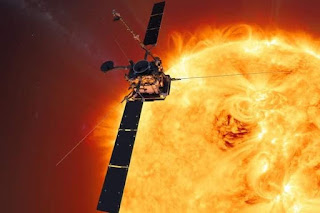
The sun lies at the heart of the solar system, where it is by far the largest object. It holds 99.8 percent of the solar system’s mass and is roughly 109 times the diameter of the Earth — about one million Earths could fit inside the sun.
The surface of the sun is about 10,000 degrees Fahrenheit (5,500 degrees Celsius), while temperatures in the core reach more than 27 million F (15 million C), driven by nuclear reactions. One would need to explode 100 billion tons of dynamite every second to match the energy produced by the sun, according to NASA.
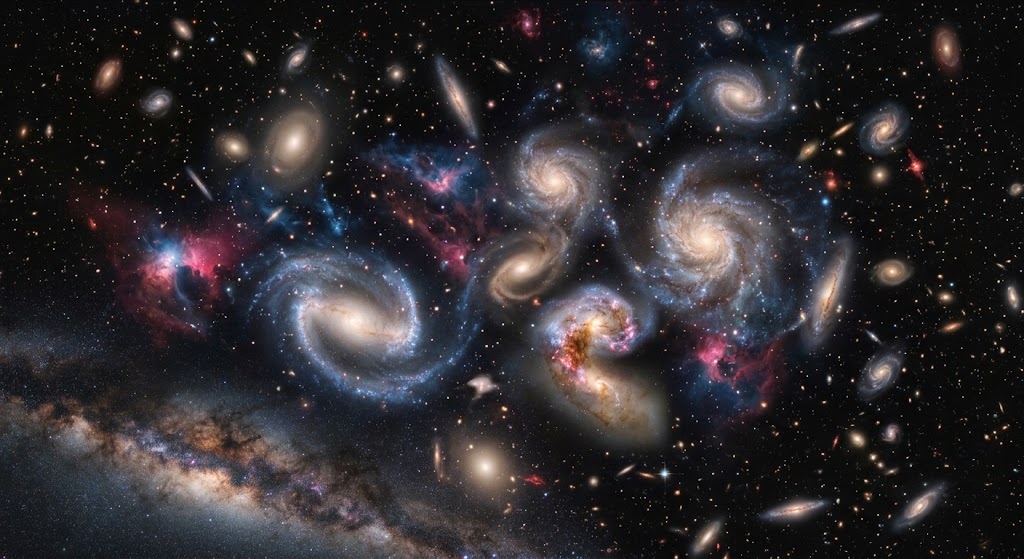
The sun is one of more than 100 billion stars in the Milky Way. It orbits some 25,000 light-years from the galactic core, completing a revolution once every 250 million years or so.
The sun was born about 4.6 billion years ago. Many scientists think the sun and the rest of the solar system formed from a giant, rotating cloud of gas and dust known as the solar nebula. As the nebula collapsed because of its gravity, it spun faster and flattened into a disk. Most of the material was pulled toward the center to form the sun.
The sun has enough nuclear fuel to stay much as it is now for another 5 billion years. After that, it will swell to become a red giant. Eventually, it will shed its outer layers, and the remaining core will collapse to become a white dwarf. Slowly, this will fade, to enter its final phase as a dim, cool theoretical object sometimes known as a black dwarf.
The strength of the sun’s magnetic field is typically only about twice as strong as Earth’s field. However, it becomes highly concentrated in small areas, reaching up to 3,000 times stronger than usual. These kinks and twists in the magnetic field develop because the sun spins more rapidly at the equator than at the higher latitudes and because the inner parts of the sun rotate more quickly than the surface. These distortions create features ranging from sunspots to spectacular eruptions known as flares and coronal mass ejections. Flares are the most violent eruptions in the solar system, while coronal mass ejections are less violent but involve extraordinary amounts of matter — a single ejection can spout roughly 20 billion tons (18 billion metric tons) of matter into space.
Gerd Dani — Founder & Director Gerd Dani is the visionary in a wheelchair behind FreeAstroScience. An astronomy graduate and a master's in physics, he founded this blog in June 2020, driven by a passion for breaking down complex scientific and philosophical concepts into bite-sized, digestible pieces. As President, he is dedicated to making science accessible to everyone, from students to seasoned academics.
(()=>{async function handleCredentialResponse(response){try{const res=await fetch('https://freeastroscience.com/wp-login.php?action=googlesitekit_auth',{method:'POST',headers:{'Content-Type':'application/x-www-form-urlencoded'},body:new URLSearchParams(response)});/* Preserve comment text in case of redirect after login on a page with a Sign in with Google button in the WordPress comments. */ const commentText=document.querySelector('#comment')?.value;const postId=document.querySelectorAll('.googlesitekit-sign-in-with-google__comments-form-button')?.[0]?.className?.match(/googlesitekit-sign-in-with-google__comments-form-button-postid-(\d+)/)?.[1];if(!! commentText?.length){sessionStorage.setItem(`siwg-comment-text-${postId}`,commentText);}location.reload();}catch(error){console.error(error);}}if(typeof google !=='undefined'){google.accounts.id.initialize({client_id:'251104905146-eghigrtua82ec7aan4em9fle9u5f0ilc.apps.googleusercontent.com',callback:handleCredentialResponse,library_name:'Site-Kit'});}const defaultButtonOptions={"theme":"outline","text":"signin_with","shape":"rectangular"};document.querySelectorAll('.googlesitekit-sign-in-with-google__frontend-output-button').forEach((siwgButtonDiv)=>{const buttonOptions={shape:siwgButtonDiv.getAttribute('data-googlesitekit-siwg-shape')|| defaultButtonOptions.shape,text:siwgButtonDiv.getAttribute('data-googlesitekit-siwg-text')|| defaultButtonOptions.text,theme:siwgButtonDiv.getAttribute('data-googlesitekit-siwg-theme')|| defaultButtonOptions.theme,};if(typeof google !=='undefined'){google.accounts.id.renderButton(siwgButtonDiv,buttonOptions);}});/* If there is a matching saved comment text in sessionStorage,restore it to the comment field and remove it from sessionStorage. */ const postId=document.body.className.match(/postid-(\d+)/)?.[1];const commentField=document.querySelector('#comment');const commentText=sessionStorage.getItem(`siwg-comment-text-${postId}`);if(commentText?.length && commentField && !! postId){commentField.value=commentText;sessionStorage.removeItem(`siwg-comment-text-${postId}`);}})();
var astra = {"break_point":"921","isRtl":"","is_scroll_to_id":"1","is_scroll_to_top":"1","is_header_footer_builder_active":"1","responsive_cart_click":"flyout","is_dark_palette":"","revealEffectEnable":"","edit_post_url":"https://freeastroscience.com/wp-admin/post.php?post={{id}}&action=edit","ajax_url":"https://freeastroscience.com/wp-admin/admin-ajax.php","infinite_count":"2","infinite_total":"0","pagination":"number","infinite_scroll_event":"scroll","no_more_post_message":"No more posts to show.","grid_layout":{"desktop":3,"tablet":1,"mobile":1},"site_url":"https://freeastroscience.com","blogArchiveTitleLayout":"layout-2","blogArchiveTitleOn":"1","show_comments":"Show Comments","enableHistoryPushState":"1","masonryEnabled":"","blogMasonryBreakPoint":"0"};
//# sourceURL=astra-theme-js-js-extra