The stars that twinkle in the night sky are not just beautiful specks of light but are fascinating galaxies, each with its unique story. One such cosmic wonder is Messier 64, also known as the Black Eye Galaxy.
Unfolding the Mystery of Messier 64
Resting in the Coma Berenices constellation, about 24 million light-years away from Earth, Messier 64 was first identified by Edward Pigott in 1779. Its inclusion in Charles Messier’s catalog of astronomical objects further enriched its popularity.
Why the “Black Eye” Moniker? The Dust Lane Explained:
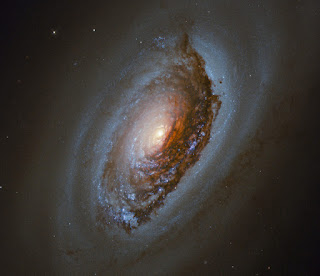
The Black Eye Galaxy’s name can be attributed to a dense band of gas and dust obscuring its bright center, giving it the appearance of a black eye. This dark dust lane amidst its luminous light adds a unique appeal.
Delve into Messier 64’s Structure:
Messier 64, a spiral galaxy, is akin to a swirling pinwheel with star-studded arms radiating from its core. One of its intriguing features is its large central bulge, presumably a consequence of past inter-galactic interactions and mergers.
The Hidden Secret – A Supermassive Black Hole:
Beneath its captivating features, Messier 64 conceals a supermassive black hole at its core. This dense space area, while potentially intimidating, poses no threat to our galaxy due to its vast distance.
Theories on Formation and Evolution:
The evolution and formation of galaxies like Messier 64 continue to intrigue astronomers. They hypothesize that past collisions and gravitational interactions could account for its unique characteristics and massive central bulge.
Peering into Messier 64:
Messier 64 presents an enticing view for amateur astronomers. For the best observation experience, a dark location devoid of light pollution and a powerful telescope are recommended.
Wrap Up:
Messier 64, the Black Eye Galaxy, has been a source of curiosity and awe for centuries. Its unique features and structure provide crucial insights into the workings of galaxies and the cosmos at large. As we continue our cosmic exploration, Messier 64 stands as a beacon of the breathtaking marvels that lie beyond our own galaxy. So, the next time you’re stargazing, remember the wonders like Messier 64 that await discovery by curious minds. Happy observing!
Gerd Dani — Founder & Director Gerd Dani is the visionary in a wheelchair behind FreeAstroScience. An astronomy graduate and a master's in physics, he founded this blog in June 2020, driven by a passion for breaking down complex scientific and philosophical concepts into bite-sized, digestible pieces. As President, he is dedicated to making science accessible to everyone, from students to seasoned academics.
(()=>{async function handleCredentialResponse(response){try{const res=await fetch('https://freeastroscience.com/wp-login.php?action=googlesitekit_auth',{method:'POST',headers:{'Content-Type':'application/x-www-form-urlencoded'},body:new URLSearchParams(response)});/* Preserve comment text in case of redirect after login on a page with a Sign in with Google button in the WordPress comments. */ const commentText=document.querySelector('#comment')?.value;const postId=document.querySelectorAll('.googlesitekit-sign-in-with-google__comments-form-button')?.[0]?.className?.match(/googlesitekit-sign-in-with-google__comments-form-button-postid-(\d+)/)?.[1];if(!! commentText?.length){sessionStorage.setItem(`siwg-comment-text-${postId}`,commentText);}location.reload();}catch(error){console.error(error);}}if(typeof google !=='undefined'){google.accounts.id.initialize({client_id:'251104905146-eghigrtua82ec7aan4em9fle9u5f0ilc.apps.googleusercontent.com',callback:handleCredentialResponse,library_name:'Site-Kit'});}const defaultButtonOptions={"theme":"outline","text":"signin_with","shape":"rectangular"};document.querySelectorAll('.googlesitekit-sign-in-with-google__frontend-output-button').forEach((siwgButtonDiv)=>{const buttonOptions={shape:siwgButtonDiv.getAttribute('data-googlesitekit-siwg-shape')|| defaultButtonOptions.shape,text:siwgButtonDiv.getAttribute('data-googlesitekit-siwg-text')|| defaultButtonOptions.text,theme:siwgButtonDiv.getAttribute('data-googlesitekit-siwg-theme')|| defaultButtonOptions.theme,};if(typeof google !=='undefined'){google.accounts.id.renderButton(siwgButtonDiv,buttonOptions);}});/* If there is a matching saved comment text in sessionStorage,restore it to the comment field and remove it from sessionStorage. */ const postId=document.body.className.match(/postid-(\d+)/)?.[1];const commentField=document.querySelector('#comment');const commentText=sessionStorage.getItem(`siwg-comment-text-${postId}`);if(commentText?.length && commentField && !! postId){commentField.value=commentText;sessionStorage.removeItem(`siwg-comment-text-${postId}`);}})();
var astra = {"break_point":"921","isRtl":"","is_scroll_to_id":"1","is_scroll_to_top":"1","is_header_footer_builder_active":"1","responsive_cart_click":"flyout","is_dark_palette":"","revealEffectEnable":"","edit_post_url":"https://freeastroscience.com/wp-admin/post.php?post={{id}}&action=edit","ajax_url":"https://freeastroscience.com/wp-admin/admin-ajax.php","infinite_count":"2","infinite_total":"0","pagination":"number","infinite_scroll_event":"scroll","no_more_post_message":"No more posts to show.","grid_layout":{"desktop":3,"tablet":1,"mobile":1},"site_url":"https://freeastroscience.com","blogArchiveTitleLayout":"layout-2","blogArchiveTitleOn":"1","show_comments":"Show Comments","enableHistoryPushState":"1","masonryEnabled":"","blogMasonryBreakPoint":"0"};
//# sourceURL=astra-theme-js-js-extra