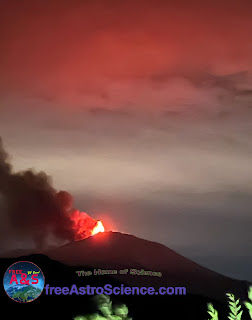

December began with a magnificent natural fireworks display as Mount Etna erupted, transforming the Sicilian sky into a radiant canvas. The eruption, captured and shared across social media, painted the night sky with hues of red and orange visible even from urban centers like Catania and Taormina.
Etna’s Awakening: A Volcanic Ballet
Europe’s tallest active volcano signaled Strombolian activity from its southeast crater at precisely 5:05 PM. The magma ascended through a central conduit, releasing gases that resulted in breathtaking lava fountains. Notably, this dramatic display left operations at Catania’s Fontanarossa airport unaffected.
Etna’s Eruptions: A Pulse of Nature
The recent eruption isn’t an isolated event. From November 19th to the present, the National Institute of Geophysics and Volcanology (INGV) has documented over 250 mini-eruption episodes. These Strombolian events, characterized by lava spouts reaching up to 150 meters high, exhibit a cyclical pattern akin to Swiss watch precision.
Analyzing Etna’s Impact
Despite the awe-inspiring visual spectacle, no significant ground deformation has been detected. Nevertheless, rapid fluctuations in the average amplitude of volcanic tremor and a substantial increase in infrasonic activity were observed. This increased activity caused tremors felt in residences on the mountain’s slopes.
Etna’s Significance in Volcanology Studies
Always under close scrutiny, Etna continues to provide invaluable data for volcanologists and earth scientists. The study of these eruptions aids in enhancing our understanding of volcanic activity and refining hazard mitigation strategies.
The eruption of Mount Etna on December 1, 2023, serves as a testament to the potent beauty of nature and the vital role of science in comprehending and monitoring such occurrences.