Nearly 414 years ago, in January 1610, the realm of astronomy and the philosophical comprehension of the cosmos stood on the cusp of a monumental transformation. This radical change was propelled by a Tuscan astronomer teaching at the University of Padua – the legendary Galileo Galilei.
For several months leading up to this, Galileo had been meticulously constructing one of the era’s earliest telescopes. Upon its completion, he began observing the moon’s surface and the celestial bodies of the Milky Way. Contrary to popular belief at that time, his observations revealed that the lunar surface was rugged with mountains and craters, not smooth. Moreover, his telescope unveiled stars previously hidden to the naked eye, inaugurating an entirely new perspective on the universe.
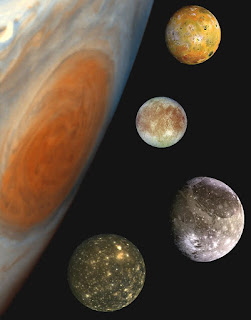
However, Galileo’s observations in January 1610 set the stage for a paradigm shift. On January 11, he pointed his telescope towards Jupiter, and noticed three bright dots adjacent to the planet, which he initially misinterpreted as stars. As he continued his observations, he discovered that there were now four dots, and their positions had altered. This led him to the groundbreaking realization that these dots were not stars, but moons orbiting Jupiter. This was a historical first – objects were found not to orbit Earth, challenging the universally accepted Ptolemaic model.
During Galileo’s era, the prevailing belief was that Earth was the universe’s center, orbited by the Sun and all other planets. However, Galileo’s observations of Jupiter’s moons presented irrefutable evidence contradicting this geocentric model. Instead, his findings supported the Copernican theory, placing the Sun at the Solar System’s center and the Earth, along with other planets, as its orbiting bodies. This was a revolutionary leap toward our modern understanding of the cosmos.
Gerd Dani — Founder & Director Gerd Dani is the visionary in a wheelchair behind FreeAstroScience. An astronomy graduate and a master's in physics, he founded this blog in June 2020, driven by a passion for breaking down complex scientific and philosophical concepts into bite-sized, digestible pieces. As President, he is dedicated to making science accessible to everyone, from students to seasoned academics.
(()=>{async function handleCredentialResponse(response){try{const res=await fetch('https://freeastroscience.com/wp-login.php?action=googlesitekit_auth',{method:'POST',headers:{'Content-Type':'application/x-www-form-urlencoded'},body:new URLSearchParams(response)});/* Preserve comment text in case of redirect after login on a page with a Sign in with Google button in the WordPress comments. */ const commentText=document.querySelector('#comment')?.value;const postId=document.querySelectorAll('.googlesitekit-sign-in-with-google__comments-form-button')?.[0]?.className?.match(/googlesitekit-sign-in-with-google__comments-form-button-postid-(\d+)/)?.[1];if(!! commentText?.length){sessionStorage.setItem(`siwg-comment-text-${postId}`,commentText);}location.reload();}catch(error){console.error(error);}}if(typeof google !=='undefined'){google.accounts.id.initialize({client_id:'251104905146-eghigrtua82ec7aan4em9fle9u5f0ilc.apps.googleusercontent.com',callback:handleCredentialResponse,library_name:'Site-Kit'});}const defaultButtonOptions={"theme":"outline","text":"signin_with","shape":"rectangular"};document.querySelectorAll('.googlesitekit-sign-in-with-google__frontend-output-button').forEach((siwgButtonDiv)=>{const buttonOptions={shape:siwgButtonDiv.getAttribute('data-googlesitekit-siwg-shape')|| defaultButtonOptions.shape,text:siwgButtonDiv.getAttribute('data-googlesitekit-siwg-text')|| defaultButtonOptions.text,theme:siwgButtonDiv.getAttribute('data-googlesitekit-siwg-theme')|| defaultButtonOptions.theme,};if(typeof google !=='undefined'){google.accounts.id.renderButton(siwgButtonDiv,buttonOptions);}});/* If there is a matching saved comment text in sessionStorage,restore it to the comment field and remove it from sessionStorage. */ const postId=document.body.className.match(/postid-(\d+)/)?.[1];const commentField=document.querySelector('#comment');const commentText=sessionStorage.getItem(`siwg-comment-text-${postId}`);if(commentText?.length && commentField && !! postId){commentField.value=commentText;sessionStorage.removeItem(`siwg-comment-text-${postId}`);}})();
var astra = {"break_point":"921","isRtl":"","is_scroll_to_id":"1","is_scroll_to_top":"1","is_header_footer_builder_active":"1","responsive_cart_click":"flyout","is_dark_palette":"","revealEffectEnable":"","edit_post_url":"https://freeastroscience.com/wp-admin/post.php?post={{id}}&action=edit","ajax_url":"https://freeastroscience.com/wp-admin/admin-ajax.php","infinite_count":"2","infinite_total":"0","pagination":"number","infinite_scroll_event":"scroll","no_more_post_message":"No more posts to show.","grid_layout":{"desktop":3,"tablet":1,"mobile":1},"site_url":"https://freeastroscience.com","blogArchiveTitleLayout":"layout-2","blogArchiveTitleOn":"1","show_comments":"Show Comments","enableHistoryPushState":"1","masonryEnabled":"","blogMasonryBreakPoint":"0"};
//# sourceURL=astra-theme-js-js-extra