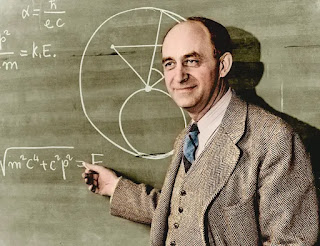

Enrico Fermi, a renowned physicist of the 20th century, significantly contributed to the field of nuclear physics. His groundbreaking experiments on uranium nuclei splitting laid the foundation for controlled nuclear fission reactions and the development of the first atomic bomb. As a member of the Manhattan Project, he witnessed the first nuclear test, Trinity, in 1945. Fermi estimated the bomb’s power by dropping paper fragments and measuring their travel distance under the shock wave. Despite his estimate of 10 thousand tons of TNT being lower than the more accurate 19 kilotons, Fermi demonstrated his remarkable ability to approximate numerical estimates.
Fermi problems, named after Enrico Fermi, involve making estimates using minimal assumptions, such as the distance traveled by paper fragments to estimate a bomb’s energy. These problems allow scientists to gain an initial understanding of what to expect from more precise calculations.
One example of a Fermi problem involves estimating the number of piano tuners in Chicago, using only the city’s population. Fermi’s solution is as follows:
- Chicago’s population: 3 million people
- Average family size: 4 members, resulting in approximately 750,000 households
- Piano ownership: Assume one in five households owns a piano, leading to 150,000 pianos
- Tuner workload: Estimate a tuner works on four pianos per day for five days a week, rests on weekends, and takes a two-week summer vacation
- Annual pianos tuned per tuner: 1,000 pianos (52 weeks/year)
- Estimated piano tuners: 150,000 pianos / (4 x 5 x 50) = 150 tuners
While Fermi’s method doesn’t guarantee perfect accuracy, it provides a rough estimate of the magnitude in question. For instance, we would not expect to find 15 or 1,500 piano tuners in that era.
To practice solving a Fermi problem, try estimating the total number of hairs on your head.
Source: NASA