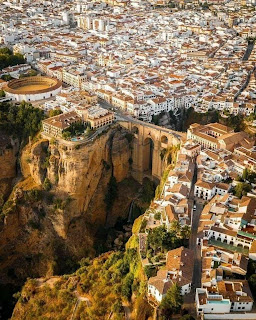
Welcome to another enriching journey brought to you exclusively by FreeAstroScience.com. Today, we delve into the engrossing tale of Ronda – a city sitting atop a deep abyss in Spain’s Málaga province, shrouded in layers of historical wonderment and remarkable architectural beauty.
Discover Ronda: A City Perched on History
Ronda, widely revered as one of the oldest and most enchanting towns within Andalusia, retains an architectural charm reminiscent of its Arab ancestry. In its surroundings lie prehistoric treasures harking back to the Neolithic era, including the mesmerizing cave paintings nestled within the Cueva de la Pileta.
The City of Runda: From Celts to Romans
Ronda, initially christened as Arunda by the Celts in the 6th century BC, transformed with each passing civilization. From the Phoenician community of Acinipo to the Roman municipium under Julius Caesar, this city evolved during the Second Punic War and the consequent Roman stronghold on the Iberian Peninsula.
The city oscillated between Byzantine, Visigothic, and Suevi periods following the decline of the Roman Empire. Ultimately, it was the Muslim invasion in the 7th century that led to Ronda’s rechristening as Izn-Rand Onda, marking its significance as the provincial capital of the Andalusian Takurunna.
The Catholic Redemption and the Birth of Modern Ronda
The Islamic imprint on the city transitioned when King Ferdinand the Catholic wrested control on May 22, 1485, from the Sultanate of Granada. The city underwent a Renaissance, embellishing its Islamic monuments with a Christian makeover and expanding into new neighborhoods like Mercadillo and San Francisco.
In the centuries following, Ronda experienced major architectural shifts, including the foundation of the Real Maestranza de Ronda Cavalry, the construction of the potent Ponte Nuevo, and the iconic Plaza de toros. Ronda’s fabulous romantic myths of bandoleros and bullfighters took shape during this time. Despite being predominantly rural in the nineteenth and twentieth centuries, the rise of the railroad ignited the city’s prosperous phase.
The Contemporary Chronicles of Ronda
In 1918, the Assembly of Ronda etched the flag design, anthem, and coat of arms of Andalusia, further solidifying Ronda’s standing in Spanish history. The city’s economic engine was further fueled by the Caja Ahorros of Ronda until its merger into Unicaja in 1990. Even today, Ronda stands as a testament to the layers of civilization it has been home to, making it a must-visit destination for any history enthusiast.
Gerd Dani — Founder & Director Gerd Dani is the visionary in a wheelchair behind FreeAstroScience. An astronomy graduate and a master's in physics, he founded this blog in June 2020, driven by a passion for breaking down complex scientific and philosophical concepts into bite-sized, digestible pieces. As President, he is dedicated to making science accessible to everyone, from students to seasoned academics.
(()=>{async function handleCredentialResponse(response){try{const res=await fetch('https://freeastroscience.com/wp-login.php?action=googlesitekit_auth',{method:'POST',headers:{'Content-Type':'application/x-www-form-urlencoded'},body:new URLSearchParams(response)});/* Preserve comment text in case of redirect after login on a page with a Sign in with Google button in the WordPress comments. */ const commentText=document.querySelector('#comment')?.value;const postId=document.querySelectorAll('.googlesitekit-sign-in-with-google__comments-form-button')?.[0]?.className?.match(/googlesitekit-sign-in-with-google__comments-form-button-postid-(\d+)/)?.[1];if(!! commentText?.length){sessionStorage.setItem(`siwg-comment-text-${postId}`,commentText);}location.reload();}catch(error){console.error(error);}}if(typeof google !=='undefined'){google.accounts.id.initialize({client_id:'251104905146-eghigrtua82ec7aan4em9fle9u5f0ilc.apps.googleusercontent.com',callback:handleCredentialResponse,library_name:'Site-Kit'});}const defaultButtonOptions={"theme":"outline","text":"signin_with","shape":"rectangular"};document.querySelectorAll('.googlesitekit-sign-in-with-google__frontend-output-button').forEach((siwgButtonDiv)=>{const buttonOptions={shape:siwgButtonDiv.getAttribute('data-googlesitekit-siwg-shape')|| defaultButtonOptions.shape,text:siwgButtonDiv.getAttribute('data-googlesitekit-siwg-text')|| defaultButtonOptions.text,theme:siwgButtonDiv.getAttribute('data-googlesitekit-siwg-theme')|| defaultButtonOptions.theme,};if(typeof google !=='undefined'){google.accounts.id.renderButton(siwgButtonDiv,buttonOptions);}});/* If there is a matching saved comment text in sessionStorage,restore it to the comment field and remove it from sessionStorage. */ const postId=document.body.className.match(/postid-(\d+)/)?.[1];const commentField=document.querySelector('#comment');const commentText=sessionStorage.getItem(`siwg-comment-text-${postId}`);if(commentText?.length && commentField && !! postId){commentField.value=commentText;sessionStorage.removeItem(`siwg-comment-text-${postId}`);}})();
var astra = {"break_point":"921","isRtl":"","is_scroll_to_id":"1","is_scroll_to_top":"1","is_header_footer_builder_active":"1","responsive_cart_click":"flyout","is_dark_palette":"","revealEffectEnable":"","edit_post_url":"https://freeastroscience.com/wp-admin/post.php?post={{id}}&action=edit","ajax_url":"https://freeastroscience.com/wp-admin/admin-ajax.php","infinite_count":"2","infinite_total":"0","pagination":"number","infinite_scroll_event":"scroll","no_more_post_message":"No more posts to show.","grid_layout":{"desktop":3,"tablet":1,"mobile":1},"site_url":"https://freeastroscience.com","blogArchiveTitleLayout":"layout-2","blogArchiveTitleOn":"1","show_comments":"Show Comments","enableHistoryPushState":"1","masonryEnabled":"","blogMasonryBreakPoint":"0"};
//# sourceURL=astra-theme-js-js-extra