
What if the universe quietly broke one of its own rules — and we only just noticed?
Welcome, curious minds, to FreeAstroScience.com — the place where big science gets explained in plain language. Whether you’re a seasoned physics enthusiast or someone who just saw “toponium” trending and needed answers, we’re thrilled you’re here. Pull up a chair.
We just witnessed a landmark moment in particle physics. The CMS Collaboration at CERN has confirmed the existence of toponium — a fleeting, impossibly heavy particle that physicists once thought could never exist. Presented at the 60th Rencontres de Moriond conference in the Italian Alps on 23 March 2026, this result crossed the all-important five-sigma threshold that earns the word “discovery” in particle physics.
This article walks you through everything — from the basics of what a quark is, to why this discovery rewrites a chapter of the Standard Model. Stay with us until the end. We promise it’s worth every second.
The Particle That Wasn’t Supposed to Exist — and Why Its Discovery Changes Everything
What Exactly Is Toponium?
Let’s start at the beginning. Toponium is a composite particle made of a top quark and its antimatter twin, the top antiquark. They don’t fuse permanently — they pair up for an impossibly brief instant and then vanish. Think of it as a cosmic handshake that lasts less than a heartbeat.
In the language of particle physics, this type of particle belongs to a category called quarkonium — a family name for particles made when a heavy quark and its antiparticle briefly bind together through the strong nuclear force. The other members of this family, charmonium and bottomonium, were discovered decades ago. Toponium was the missing piece — the one everyone debated but nobody could catch.
Until now. And we at FreeAstroScience find that absolutely extraordinary.
The Top Quark: Nature’s Most Restless Particle
To understand why this discovery matters, you need to know the main character: the top quark. Discovered in 1995 at the Tevatron accelerator near Chicago, it’s the heaviest known elementary particle — with a mass of roughly 172.5 GeV/c². To put that in perspective, it’s about as heavy as an entire atom of tungsten, yet it’s a point-like fundamental particle with no internal structure.
But sheer mass isn’t what makes the top quark special. It’s its speed. The top quark decays in approximately 5 × 10⁻²⁵ seconds — that’s 0.0000000000000000000000005 seconds. Roughly twenty times faster than the timescale at which the strong force normally operates. It’s gone before the universe even “knows” it was there.
Why Did Physicists Call a Top-Quark Bound State Impossible?
Every other quark — up, down, strange, charm, bottom — forms bound states. Protons, neutrons, mesons: they’re all examples of quarks that have time to interact and settle into stable or semi-stable arrangements. The top quark was always the loner at the party, decaying before the strong force could pull it into a partnership.
The standard textbook answer was clear: top quarks don’t form hadrons. The decay width of the top quark is approximately Γt ≈ 1.33 GeV, which corresponds to a lifetime far shorter than the typical hadronization timescale of ~10⁻²⁴ seconds. A bound state needs time to form. The top quark doesn’t give it any.
Yet nature, as always, had one more trick up its sleeve.
Key Formula — Top Quark Decay Width
τt = ℏ / Γt ≈ (6.582 × 10⁻²⁵ eV·s) / (1.33 × 10⁹ eV) ≈ 5 × 10⁻²⁵ s
Where ℏ is the reduced Planck constant and Γt is the decay width of the top quark (~1.33 GeV at mt = 172.5 GeV/c²). The lifetime is so short that strong-force hadronization, which requires ~10⁻²⁴ s, simply cannot complete.
How Did CMS Actually Catch the Signal?
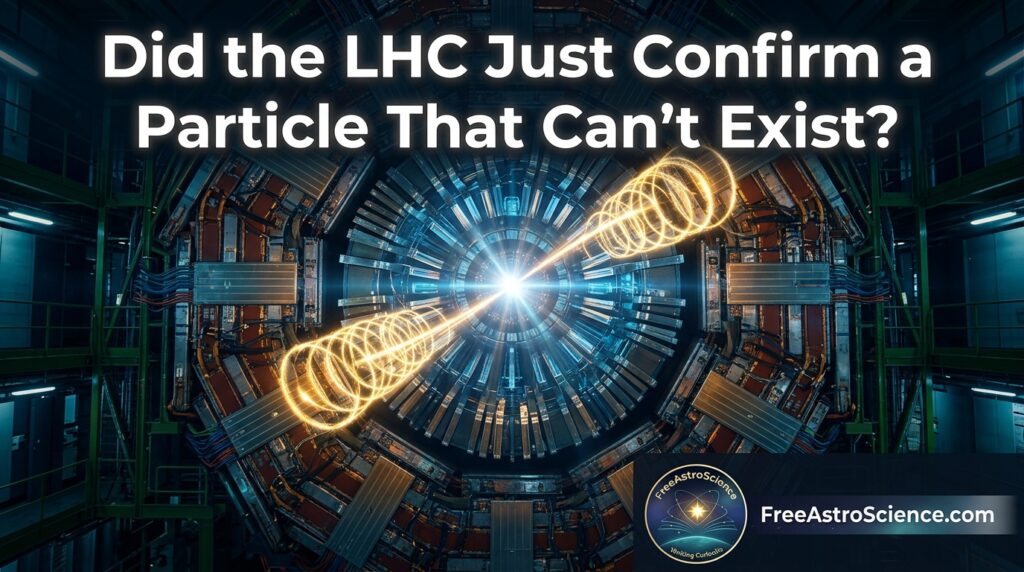
The CMS detector at CERN’s Large Hadron Collider is, to put it bluntly, a marvel of human engineering. It weighs 14,000 tonnes and records the debris from proton-proton collisions at almost the speed of light. The LHC has produced hundreds of millions of top quark–antiquark pairs, making it the world’s most productive top-quark factory.
The key to detecting toponium wasn’t looking for the particle directly. The top quark and antiquark vanish too fast for that. Instead, researchers focused on the production threshold — the energy region where the two quarks are produced with very low relative velocity. According to nonrelativistic quantum chromodynamics (NRQCD), if a bound state forms, the quarks slow down relative to each other. Their relative velocity drops sharply. That’s the fingerprint investigators were hunting.
Physicist Yu-Heng Yu, a graduate student involved in the analysis, explained it well: “If they form a bound state, their relative velocity should be much smaller than when they are produced independently.” That single insight guided the entire search strategy.
Two Independent Channels — One Clear Answer
Science doesn’t accept a result from just one direction. The story of toponium’s confirmation is actually a three-act drama spanning nearly two years.
Act One (2024): CMS first reported an unexpected excess of top quark–antiquark pairs produced near the energy threshold. The data came from the dilepton channel — events where both the top quark and its antiquark each decay into a lepton. The excess was striking. The measured cross section came in at 8.8 +1.2/−1.4 picobarns (pb). Statistically compelling, but one measurement alone doesn’t make a discovery.
Act Two (July 2025): ATLAS — CMS’s independent sister detector at the same accelerator — confirmed the signal at the European Physical Society’s High-Energy Physics conference in Marseille. Two separate detectors, two separate teams, same result. That’s when the physics world started paying very close attention.
Act Three (March 2026): CMS struck again with a completely new analysis — the lepton plus jets channel. In this approach, one top quark decays into a lepton, while the other decays into a spray of hadrons called “jets.” It’s a noisier environment, which is exactly why it needed the ingenious work of Otto Hindrichs from the University of Rochester, who developed an AI-assisted event reconstruction technique to isolate the signal from the noise. The result confirmed a cross section of 5.1 ± 0.9 pb — consistent with the dilepton result and fully statistically independent from it.
The Numbers That Speak for Themselves
Numbers tell the most honest story in science. Here’s a clean look at the key measurements from the three major observations:
| Experiment | Year | Channel | Cross Section (pb) | Conference/Venue |
|---|---|---|---|---|
| CMS | 2024 | Dilepton | 8.8 +1.2/−1.4 | Initial CMS result |
| ATLAS | July 2025 | Independent | Consistent with CMS | EPS-HEP, Marseille |
| CMS | March 2026 | Lepton + Jets | 5.1 ± 0.9 | Moriond 2026, Italian Alps |
The two CMS analyses are statistically independent — they look at completely different types of collision events. That independence is what makes the combined evidence so persuasive. Two channels, same detector, same signal. Three experiments total. All pointing in the same direction.
What Does “Five-Sigma” Actually Mean?
You’ve probably heard the phrase before. In particle physics, a five-sigma result (written as 5σ) is the gold standard for claiming a discovery. But what does that number really mean for the rest of us?
Sigma (σ) is a measure of statistical probability. A one-sigma result could easily be a fluke. A two-sigma result is interesting. A five-sigma result means there’s only a 1-in-3.5-million chance the signal is random noise. At that level, physicists stop calling it an “anomaly” and start calling it a “discovery.”
Both CMS and ATLAS independently cleared this bar. That’s not luck. That’s physics.
Completing the Quarkonium Family — Fifty Years in the Making
The quarkonium family is one of the most elegant stories in particle physics. It spans half a century of discovery, from the labs of the United States to the giant ring of the LHC buried 100 meters beneath the Swiss–French border.
| Particle | Composition | Year Discovered | Discovery Location | Quark Mass (approx.) | Stability |
|---|---|---|---|---|---|
| Charmonium (J/ψ) | Charm + Anticharm (cc̄) | 1974 | SLAC & BNL, USA | ~1.3 GeV/c² | Short-lived meson |
| Bottomonium (Υ) | Bottom + Antibottom (bb̄) | 1977 | Fermilab, USA | ~4.2 GeV/c² | Short-lived meson |
| Toponium (ηt) | Top + Antitop (tt̄) | 2024–2026 | CERN LHC | ~172.5 GeV/c² | Quasi-bound state only |
Charmonium’s 1974 discovery triggered what physicists still call the “November Revolution” — it reshaped our understanding of matter in a matter of days. Bottomonium, three years later, cemented the pattern. Toponium was always the final, missing page. We finally turned it in 2026, more than four decades later.
As Regina Demina, leader of the University of Rochester research group, powerfully put it: “Toponium is heavier than the heaviest known atomic nucleus, Oganesson, making it the most massive quasi-bound state ever observed. Its discovery deepens our understanding of the strong nuclear force and its ability to bind the fundamental constituents of matter.”
Let that sink in. Heavier than Oganesson — element 118 on the periodic table. And it’s not an atom. It’s a single pair of quarks.
Could It Still Be Something Else?
Good science never shouts “case closed” prematurely. CERN itself has struck a measured tone: alternative explanations still exist. The most prominent alternative is a new elementary boson resembling an additional Higgs-type particle — a resonance that would sit right at the same mass region and produce a similar-looking excess in the data.
The current experimental resolution of the invariant mass isn’t sharp enough to fully rule this out. More refined calculations from nonrelativistic QCD (NRQCD) theory, combined with a substantially larger dataset, will be needed to distinguish between “top quark quasi-bound state” and “new boson.” Either answer, frankly, would be extraordinary.
This is what real science looks like — not definitive proclamations, but carefully weighted evidence, honestly reported. And that’s exactly why we find this work so intellectually thrilling.
What Comes Next for Particle Physics?
The current Run 3 of the LHC is already collecting data at higher luminosity than ever before. But the real game-changer on the horizon is the High-Luminosity LHC (HL-LHC), scheduled to begin operations in the early 2030s. It will produce roughly 10 times more collisions per second than today’s LHC. That means 10 times more top quark pairs, 10 times more chances to study the threshold region in exquisite detail.
Researchers like Hindrichs and Yu are already developing next-generation analysis tools — AI-powered reconstruction algorithms that can wring signal from noise in the noisiest collision environments imaginable. The goal: measure the top quark’s properties through its toponium interactions with precision never before possible, potentially cracking open tiny windows where new physics hides.
Proposed next-generation lepton colliders, like the Future Circular Collider (FCC-ee), could go even further — operating electron-positron collisions right at the top-quark pair production threshold, effectively creating a dedicated “toponium factory.” The science ahead is genuinely breathtaking.
A Particle That Changed the Story
Let’s take a breath and look at what we’ve covered. We started with a particle that was never supposed to exist. A top quark that decays in half a trillionth of a trillionth of a second. A bound state that forms and vanishes before the universe can even blink. And yet — there it is. Three independent confirmations, from two different detectors, using two different analysis channels, all pointing to the same extraordinary conclusion: toponium is real.
We went from “impossible” in every textbook to “confirmed” in two years. That’s not just a scientific result. That’s a reminder of something deeper: the universe doesn’t owe us easy answers, but it rewards those who keep asking the right questions.
Here at FreeAstroScience, we believe knowledge is the best armor against confusion and fear. In a world flooded with misinformation, we stand as your trusted guide through the cosmos — checking every claim, citing every source, and never dumbing science down so much that it loses its soul. We protect you from misinformation by explaining science the way it deserves to be explained: honestly, carefully, and with genuine passion.
Never stop thinking. Never switch off your curiosity. As Goya once warned, the sleep of reason breeds monsters. FreeAstroScience exists to keep your mind wide awake. Come back soon — we’ll have more discoveries waiting for you.
References & Sources
- CERN — CMS strengthens the case for toponium (March 23, 2026)
- CMS Collaboration — CMS observes another indication of a momentary union of the heaviest quarks — now in the lepton+jets final state (March 24, 2026)
- ATLAS Collaboration — Elusive romance of top-quark pairs observed at the LHC (July 8, 2025)
- CMS at Moriond 2026 — CMS Highlights at the 60th Rencontres de Moriond
- arXiv — Observation of a pseudoscalar excess at the top quark pair production threshold (CMS)
- Big Think / Ethan Siegel — The top quark isn’t a loner after all: ‘toponium’ is real! (July 2025)
- Particle Data Group — Top Quark Review, PDG 2024
- arXiv — New physics in toponium’s shadow? (Flacke et al., 2025)