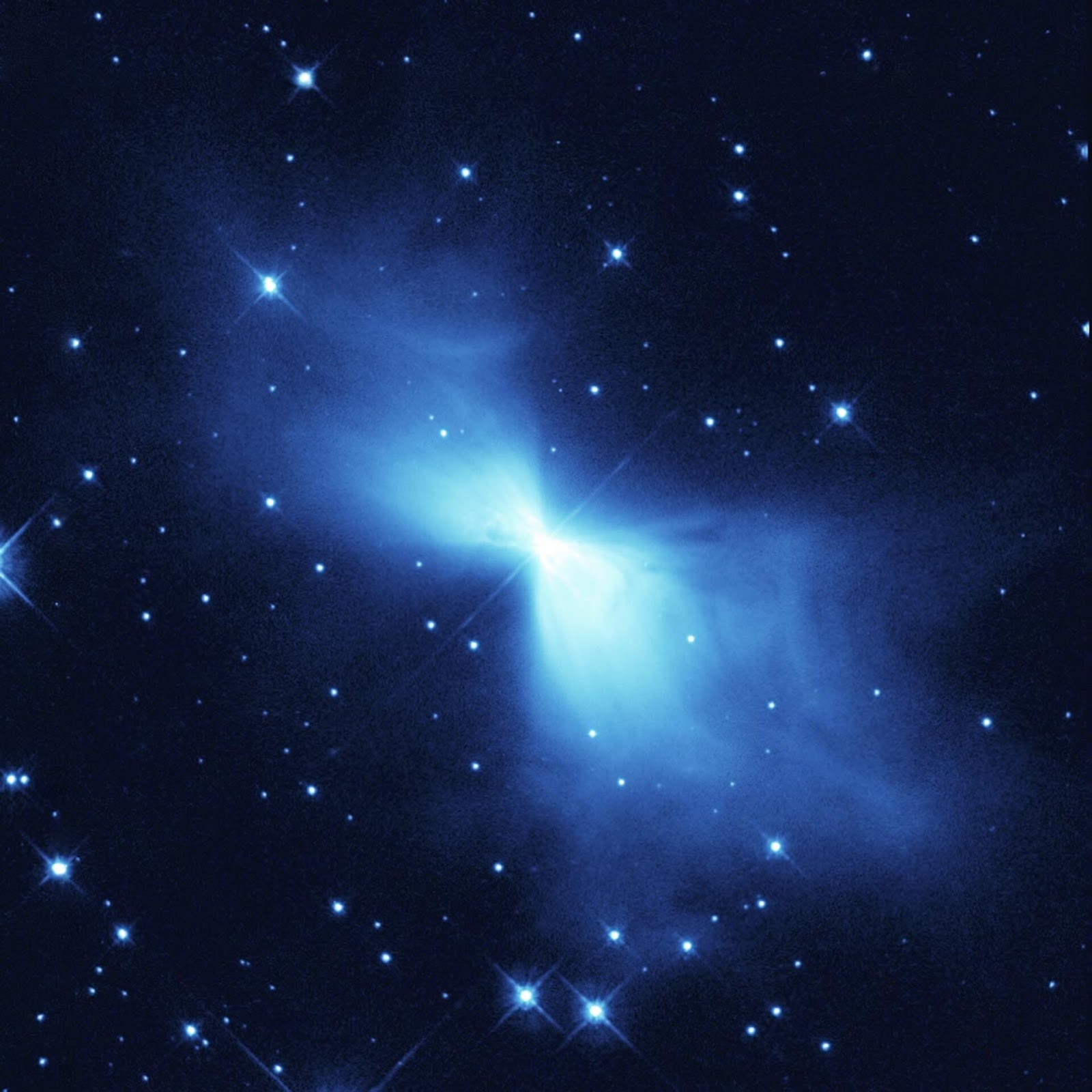
Boomerang Nebula is 5,000 light-years from Earth. Its temperature is -272ºC, just above absolute zero.
Astronomers at the Alma Observatory in Chile have seen a new shape of the Boomerang Nebula, a cloud of gas and dust that is the coldest known place in the Universe, with a temperature of -272°C. The images captured reveal that it has an elongated shape. , similar to the drawing of a ghost.
According to the researchers, what is seen in the new images of Alma is a trick of light. Planetary nebulae, such as the Boomerang, are stars at the end of their existence. In the center, you can see white dwarf stars, which emit intense ultraviolet radiation that makes the gas around them glow and emit vibrantly colored light.
The first images of the nebula, taken with ground-based telescopes, showed a curved shape, which gave rise to its name. Other photographs, taken by the Hubble Space Telescope in 2003, showed a profile more similar to a bow tie.
“This ultracold object is extremely intriguing, and we’re learning a lot about its true nature,” said Raghvendra Sahai, researcher and lead scientist at NASA’s Jet Propulsion Laboratory in Pasadena, Calif., in a statement released by the States’ National Radio Astronomy Observatory. United. “What looked like a double-lobed or boomerang shape is actually a much larger structure that is rapidly expanding into space.”
The Boomerang Nebula is 5,000 light-years away from Earth, in the constellation Centaur. According to astronomers at Alma, it is a pre-planetary nebula, in which the central star is not yet hot enough to emit the ultraviolet radiation that produces its characteristic glow.
This star’s cloud of gas and dust is expanding and cooling rapidly, in a process similar to that of refrigerators that use expanded gas to produce cold temperatures. Scientists measured the temperature of the gas in the nebula by observing how it absorbs cosmic microwave radiation, which have a temperature of -270°C.
The research also reveals that the outer fringes of the Boomerang Nebula are starting to heat up, despite /being cooler than cosmic radiation. According to scientists, the heating must happen due to the photoelectric effect, in which light is absorbed by the solid material, which in turn re-emits electrons.

Gerd Dani — Founder & Director Gerd Dani is the visionary in a wheelchair behind FreeAstroScience. An astronomy graduate and a master's in physics, he founded this blog in June 2020, driven by a passion for breaking down complex scientific and philosophical concepts into bite-sized, digestible pieces. As President, he is dedicated to making science accessible to everyone, from students to seasoned academics.
(()=>{async function handleCredentialResponse(response){try{const res=await fetch('https://freeastroscience.com/wp-login.php?action=googlesitekit_auth',{method:'POST',headers:{'Content-Type':'application/x-www-form-urlencoded'},body:new URLSearchParams(response)});/* Preserve comment text in case of redirect after login on a page with a Sign in with Google button in the WordPress comments. */ const commentText=document.querySelector('#comment')?.value;const postId=document.querySelectorAll('.googlesitekit-sign-in-with-google__comments-form-button')?.[0]?.className?.match(/googlesitekit-sign-in-with-google__comments-form-button-postid-(\d+)/)?.[1];if(!! commentText?.length){sessionStorage.setItem(`siwg-comment-text-${postId}`,commentText);}location.reload();}catch(error){console.error(error);}}if(typeof google !=='undefined'){google.accounts.id.initialize({client_id:'251104905146-eghigrtua82ec7aan4em9fle9u5f0ilc.apps.googleusercontent.com',callback:handleCredentialResponse,library_name:'Site-Kit'});}const defaultButtonOptions={"theme":"outline","text":"signin_with","shape":"rectangular"};document.querySelectorAll('.googlesitekit-sign-in-with-google__frontend-output-button').forEach((siwgButtonDiv)=>{const buttonOptions={shape:siwgButtonDiv.getAttribute('data-googlesitekit-siwg-shape')|| defaultButtonOptions.shape,text:siwgButtonDiv.getAttribute('data-googlesitekit-siwg-text')|| defaultButtonOptions.text,theme:siwgButtonDiv.getAttribute('data-googlesitekit-siwg-theme')|| defaultButtonOptions.theme,};if(typeof google !=='undefined'){google.accounts.id.renderButton(siwgButtonDiv,buttonOptions);}});/* If there is a matching saved comment text in sessionStorage,restore it to the comment field and remove it from sessionStorage. */ const postId=document.body.className.match(/postid-(\d+)/)?.[1];const commentField=document.querySelector('#comment');const commentText=sessionStorage.getItem(`siwg-comment-text-${postId}`);if(commentText?.length && commentField && !! postId){commentField.value=commentText;sessionStorage.removeItem(`siwg-comment-text-${postId}`);}})();
var astra = {"break_point":"921","isRtl":"","is_scroll_to_id":"1","is_scroll_to_top":"1","is_header_footer_builder_active":"1","responsive_cart_click":"flyout","is_dark_palette":"","revealEffectEnable":"","edit_post_url":"https://freeastroscience.com/wp-admin/post.php?post={{id}}&action=edit","ajax_url":"https://freeastroscience.com/wp-admin/admin-ajax.php","infinite_count":"2","infinite_total":"0","pagination":"number","infinite_scroll_event":"scroll","no_more_post_message":"No more posts to show.","grid_layout":{"desktop":3,"tablet":1,"mobile":1},"site_url":"https://freeastroscience.com","blogArchiveTitleLayout":"layout-2","blogArchiveTitleOn":"1","show_comments":"Show Comments","enableHistoryPushState":"1","masonryEnabled":"","blogMasonryBreakPoint":"0"};
//# sourceURL=astra-theme-js-js-extra