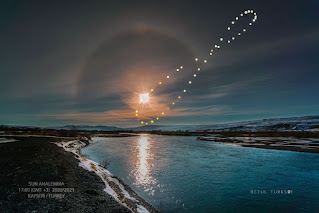
The analemma is a captivating geometric curve that illustrates the position of the Sun in the sky throughout the year as observed from a fixed location on Earth. This intriguing pattern, which resembles the figure eight or an elongated “∞,” occurs due to a combination of factors, primarily the Earth’s axial tilt and its elliptical orbit around the Sun.
The Earth’s axial tilt, which is approximately 23.5 degrees, causes the Sun’s position to vary in the sky throughout the year, resulting in the changing seasons. This tilt is responsible for the height variation in the analemma curve. Additionally, the Earth’s orbit is not perfectly circular but slightly elliptical, meaning its distance from the Sun fluctuates throughout the year. This causes the Earth to move at varying speeds, leading to changes in the Sun’s east-west position and contributing to the width of the analemma.
Another important factor in the analemma’s shape is the equation of time, which is the difference between solar time (measured by the Sun’s position in the sky) and mean solar time (an average time that does not account for the Earth’s axial tilt and elliptical orbit). The equation of time causes the analemma’s figure-eight shape to be slightly asymmetrical, with the lower loop being wider and shorter than the upper loop.
To capture the analemma, multiple photographic exposures can be taken from the same location, at the same time of day, and facing the same direction throughout the year. By superimposing these images, the analemma’s characteristic pattern emerges, revealing the Sun’s annual path across the sky.
In summary, the analemma is a fascinating geometric curve that results from the interplay of the Earth’s axial tilt, elliptical orbit, and the equation of time. This beautiful figure-eight pattern can be captured through a series of carefully timed photographs and serves as a striking visual representation of the Sun’s annual journey across the sky.
Gerd Dani — Founder & Director Gerd Dani is the visionary in a wheelchair behind FreeAstroScience. An astronomy graduate and a master's in physics, he founded this blog in June 2020, driven by a passion for breaking down complex scientific and philosophical concepts into bite-sized, digestible pieces. As President, he is dedicated to making science accessible to everyone, from students to seasoned academics.
(()=>{async function handleCredentialResponse(response){try{const res=await fetch('https://freeastroscience.com/wp-login.php?action=googlesitekit_auth',{method:'POST',headers:{'Content-Type':'application/x-www-form-urlencoded'},body:new URLSearchParams(response)});/* Preserve comment text in case of redirect after login on a page with a Sign in with Google button in the WordPress comments. */ const commentText=document.querySelector('#comment')?.value;const postId=document.querySelectorAll('.googlesitekit-sign-in-with-google__comments-form-button')?.[0]?.className?.match(/googlesitekit-sign-in-with-google__comments-form-button-postid-(\d+)/)?.[1];if(!! commentText?.length){sessionStorage.setItem(`siwg-comment-text-${postId}`,commentText);}location.reload();}catch(error){console.error(error);}}if(typeof google !=='undefined'){google.accounts.id.initialize({client_id:'251104905146-eghigrtua82ec7aan4em9fle9u5f0ilc.apps.googleusercontent.com',callback:handleCredentialResponse,library_name:'Site-Kit'});}const defaultButtonOptions={"theme":"outline","text":"signin_with","shape":"rectangular"};document.querySelectorAll('.googlesitekit-sign-in-with-google__frontend-output-button').forEach((siwgButtonDiv)=>{const buttonOptions={shape:siwgButtonDiv.getAttribute('data-googlesitekit-siwg-shape')|| defaultButtonOptions.shape,text:siwgButtonDiv.getAttribute('data-googlesitekit-siwg-text')|| defaultButtonOptions.text,theme:siwgButtonDiv.getAttribute('data-googlesitekit-siwg-theme')|| defaultButtonOptions.theme,};if(typeof google !=='undefined'){google.accounts.id.renderButton(siwgButtonDiv,buttonOptions);}});/* If there is a matching saved comment text in sessionStorage,restore it to the comment field and remove it from sessionStorage. */ const postId=document.body.className.match(/postid-(\d+)/)?.[1];const commentField=document.querySelector('#comment');const commentText=sessionStorage.getItem(`siwg-comment-text-${postId}`);if(commentText?.length && commentField && !! postId){commentField.value=commentText;sessionStorage.removeItem(`siwg-comment-text-${postId}`);}})();
var astra = {"break_point":"921","isRtl":"","is_scroll_to_id":"1","is_scroll_to_top":"1","is_header_footer_builder_active":"1","responsive_cart_click":"flyout","is_dark_palette":"","revealEffectEnable":"","edit_post_url":"https://freeastroscience.com/wp-admin/post.php?post={{id}}&action=edit","ajax_url":"https://freeastroscience.com/wp-admin/admin-ajax.php","infinite_count":"2","infinite_total":"0","pagination":"number","infinite_scroll_event":"scroll","no_more_post_message":"No more posts to show.","grid_layout":{"desktop":3,"tablet":1,"mobile":1},"site_url":"https://freeastroscience.com","blogArchiveTitleLayout":"layout-2","blogArchiveTitleOn":"1","show_comments":"Show Comments","enableHistoryPushState":"1","masonryEnabled":"","blogMasonryBreakPoint":"0"};
//# sourceURL=astra-theme-js-js-extra