
What does it take to send four human beings around the Moon — and what happens
when a single tiny seal nearly derails the whole thing?
Welcome to FreeAstroScience.com, where complex scientific
principles are explained in simple, honest language — because you deserve
better than jargon. We’re Gerd Dani, and we’re genuinely excited you stopped
by today. If you’ve been watching NASA’s Artemis program with one eye open,
you know this journey has never been smooth. But the latest chapter —
a dislodged helium seal, a dramatic midnight rollback, and a swift repair
deep inside the world’s largest building — deserves the full story.
So stay with us. By the end, you’ll know exactly what went wrong, what
engineers did about it, and why April 2026 could go down in the history
books right alongside July 1969.
The Moon Mission That Refused to Quit
What Is Artemis II, and Why Does It Matter?
We haven’t sent human beings beyond low Earth orbit since
December 1972. That was Apollo 17 — the last time
astronaut Gene Cernan looked back at the lunar surface before climbing
into the ascent stage. More than 50 years have passed since that moment.
Half a century of Earth-bound ambitions, budget cuts, and shifting
priorities. Now, with Artemis II, we’re on the edge
of ending that extraordinary pause.
Let’s be clear about what Artemis II is — and isn’t. It’s not a Moon
landing. The mission follows a free-return trajectory,
looping four astronauts around the Moon and returning them safely to
Earth in roughly 10 days, without touching the surface.
Think of it as the full dress rehearsal before Artemis III attempts
the actual landing. But don’t let the word “rehearsal” fool you. This
is humanity’s return to deep space — and it’s carrying
four historic firsts in a single flight.
Victor Glover will become the first person of color
to travel around the Moon.
Christina Koch will be the first woman to leave
Earth orbit.
Jeremy Hansen will be the first Canadian — and the
first person not from the United States — to venture beyond
low Earth orbit.
One rocket. One crew. Four milestones that took 50 years to arrive.
What Exactly Does Helium Do in a Rocket?
Helium doesn’t get much glory in space coverage. It’s not the propellant.
It doesn’t produce thrust. But inside NASA’s
Space Launch System (SLS), helium is quietly essential —
particularly in the
Interim Cryogenic Propulsion Stage (ICPS), the upper
stage responsible for the final burn that sends Orion toward the Moon.
The ICPS burns liquid hydrogen and liquid oxygen, stored at extreme
temperatures — around −253 °C and −183 °C respectively. As propellants
drain during flight, tank pressure drops. Helium fills that void,
maintaining the correct pressure so the propellants flow at the right
rate. Helium also purges residual propellant from engine
nozzles before ignition — a safety step you absolutely
don’t skip.
Picture a pressurized garden hose connected to a valve. If that valve
gets blocked, nothing moves downstream. The rocket looks fine from the
outside. The plumbing just doesn’t work. That’s essentially what happened
on the night of February 20–21, 2026.
The Night a Seal Stopped the Moon Mission
The trouble started hours after a textbook performance. On
February 19, 2026, the Artemis II stack — the SLS
rocket with Orion mounted on top — completed its second wet dress
rehearsal at Launch Complex 39B, Kennedy Space Center, without
any significant issues. Engineers were finally exhaling. A
March 6 launch target was on the table.
Then, in the early hours of February 21, routine repressurization of
the ICPS hit a wall. Helium flow stopped. Not reduced — stopped.
The same system that had sailed through both wet dress rehearsals
had suddenly gone silent, and nobody could explain why. Not yet.
NASA Administrator Jared Isaacman confirmed the
severity that same night: “Last evening, the team was unable to
get helium flow through the vehicle. This occurred during a routine
operation to repressurise the system.” He added that any fix
would require the rocket to return to the Vehicle Assembly Building —
meaning the March launch window was gone.
physical connection point between ground supply lines and the rocket
itself — designed for fast, clean attachment and detachment. It must
maintain airtight seals under enormous pressure differentials.
When even one seal inside this assembly shifts out of position,
the helium pathway can be partially or fully blocked.
Once inside the VAB, technicians found the culprit quickly: a single
seal inside the quick disconnect interface had become
dislodged. It sat there, unassuming and invisible from the outside,
blocking the entire helium pathway. NASA confirmed the finding on
March 3, 2026. Engineers also began assessing what caused the seal
to move in the first place, to prevent any repeat.
The 4-Mile Retreat: Rolling Back to Safety
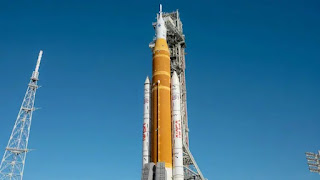
On February 25, 2026, the 322-foot-tall SLS rocket —
Orion capsule riding on top — began its slow four-mile journey back
from Pad 39B to the VAB aboard NASA’s
Crawler-Transporter 2. When loaded, the crawler moves
at roughly 1.6 km/h (1 mph). There’s no faster
option when you’re hauling the most expensive vehicle ever built.
It’s a strange sight — something that tall, moving that slowly, under
flood lights in the Florida night. But the VAB is the only place at
KSC where every level of the rocket can be accessed simultaneously.
Multiple work platforms extend around the vehicle, reaching the ICPS,
the core stage, the solid rocket boosters, and the Orion spacecraft
all at once. Engineers can’t reach the ICPS connections from the
launch pad gantry. Inside the VAB, nothing is out of reach.
The rollback stung. The March window was lost. But NASA made the
right call — the only call, really. A sealed sea change in mission
safety matters more than any calendar date.
Inside the VAB: How Engineers Solved It
Once the stack was secured, the team moved fast and methodically.
Technicians accessed the launch vehicle stage adapter
and went directly to the quick disconnect. They removed it, inspected
the dislodged seal, reassembled the entire assembly, and ran helium
at a reduced flow rate to validate the fix. The confirmation came
through cleanly. The pathway was clear.
At the same time, NASA used the unplanned VAB time to tick off
other maintenance items — because when the rocket is inside and
accessible, you fix everything on the list:
- Replaced flight batteries across the core stage, ICPS, and solid rocket boosters
- Recharged Orion’s emergency launch abort system batteries
- Activated a new set of flight termination system batteries ahead of end-to-end retesting
- Began addressing a separate liquid oxygen feed line seal on the core stage
- Refreshed certain stowed items inside the Orion crew module
None of those secondary items were critical emergencies. But each one
strengthens the mission. Engineers don’t walk past a known issue just
because the calendar is tight. That philosophy — fix it while you can —
has kept astronauts alive since the earliest days of human spaceflight.
Meet the Four People Making History
Four highly experienced astronauts will sit atop the SLS when it
finally lifts off. Each carries the weight of history — not just as
symbols of progress, but as skilled professionals who have spent years
preparing for this specific mission.
| Role | Astronaut | Agency | Historic Significance |
|---|---|---|---|
| Commander | Reid Wiseman | NASA (2nd flight) | Leads the first crewed deep-space mission since Apollo 17, December 1972 |
| Pilot | Victor Glover | NASA (2nd flight) |
First First person of color to travel around the Moon |
| Mission Specialist 1 | Christina Koch | NASA (2nd flight) |
First First woman to leave Earth orbit; holds record (328 days) for longest single spaceflight by a woman |
| Mission Specialist 2 | Jeremy Hansen | CSA — Canada (1st flight) |
First First Canadian and first non-American to venture beyond low Earth orbit |
Commander Wiseman will oversee a spacecraft venturing farther from
Earth than any human since 1972. Victor Glover, who already spent
six months aboard the International Space Station, will become a
landmark figure in the democratization of space. Christina Koch will
shatter yet another barrier after her record-breaking ISS stay.
And Jeremy Hansen — flying his very first spaceflight — will look
down at Earth from the Moon’s vicinity, becoming the first person
outside the United States to ever do so. One crew. Four firsts.
Every seat matters.
10 Days Around the Moon: The Mission Profile
After liftoff from Pad 39B, the SLS will place Orion into Earth orbit.
The ICPS upper stage then performs a trans-lunar injection
burn — a carefully timed engine firing that sends the
spacecraft on a precise arc toward the Moon. Unlike Artemis III,
Orion won’t brake into lunar orbit. Instead, the spacecraft follows
a free-return trajectory: the Moon’s gravity bends
the flight path, and Earth’s gravity pulls the crew home.
No additional burns required. Physics does the steering.
This approach has a beautiful built-in safety margin. If Orion’s
propulsion system fails after the trans-lunar injection burn, the crew
will still return to Earth automatically along the free-return path.
It’s the same principle that saved the Apollo 13 crew in April 1970,
after an oxygen tank explosion crippled their spacecraft 330,000 km
from Earth. The Moon’s gravity bent their broken trajectory right back
toward home.
The Mission at a Glance
- Duration: approximately 10 days
- Trajectory type: free-return around the Moon
- Farthest distance from Earth: farther than any crewed mission since Apollo 17 in 1972
- Re-entry speed: approximately 25,000 mph (40,234 km/h)
- Splashdown zone: Pacific Ocean
- Launch vehicle: Space Launch System (SLS) Block 1 — 322 feet tall
- Spacecraft: Orion Crew Module + European Service Module
The Physics of Coming Home at 25,000 mph
Re-entry is the most violent act in human spaceflight. Returning from
the Moon, the Orion crew module plunges into Earth’s atmosphere at
roughly 25,000 mph (≈ 11,176 m/s). To understand
what that means physically, consider the kinetic energy the heat
shield must absorb.
Kinetic Energy at Atmospheric Entry:
[ E_k = frac{1}{2},m,v^2 ]
Where (m approx 8{,}500,text{kg}) (Orion crew module mass)
and (v approx 11{,}176,text{m/s}) (25,000 mph entry speed):
[
E_k = frac{1}{2} times 8{,}500 times (11{,}176)^2
approx 5.31 times 10^{11},text{J}
]
≈ 531 gigajoules — roughly equivalent to the energy released by
127 metric tons of TNT. Every joule of that energy must be shed
through the Orion heat shield before splashdown.
NASA’s Orion heat shield is the largest ever built for a
crewed spacecraft — 5 meters in diameter, using an ablative
material called Avcoat that chars and erodes away, carrying thermal
energy with it. The uncrewed Artemis I mission in November 2022
already validated the heat shield at lunar return speeds. But
Artemis II will be the first time four lives depend on it performing
perfectly. No pressure.
There’s one more twist. Scientists discovered after Artemis I that
the heat shield eroded in an unexpected, uneven pattern — more than
predicted. NASA has since analyzed that data and confirmed it doesn’t
affect crew safety for Artemis II. But it’s a reminder that re-entry
physics holds surprises even for the best engineers on the planet.
When Could Artemis II Actually Launch?
Launch windows for Moon missions aren’t chosen freely. They’re
dictated by the precise alignment of Earth and Moon, the orbital
geometry needed for the free-return path, and safe Pacific Ocean
re-entry conditions on the return leg. Miss a window by a few days,
and the next one might be weeks away.
| Date | Day | Status | Notes |
|---|---|---|---|
| April 1, 2026 | Wednesday | ✅ Primary target | Earliest available date; “No fooling” said Ars Technica |
| April 3, 2026 | Friday | ✅ Available | Second window in the early-April cluster |
| April 4, 2026 | Saturday | ✅ Available | Third window in cluster |
| April 5, 2026 | Sunday | ✅ Available | Fourth window in cluster |
| April 6, 2026 | Monday | ✅ Available | Closes the early-April cluster |
| April 30, 2026 | Thursday | 🔄 Backup | Secondary monthly window if early April dates are missed |
As of March 3, 2026, NASA confirmed it plans to roll the SLS back
to Pad 39B later in March, giving the team time to
complete any remaining work before the first April window opens.
All five early-April dates remain in play, with April 30 as a
safety net. The helium repair is done. The batteries are fresh.
The team is ready.
A Pattern of Persistence: Every Setback So Far
The helium seal was Artemis II’s most recent obstacle — but far from
its first. The road from Kennedy Space Center’s assembly floor to
Launch Pad 39B has been marked by a steady sequence of technical
problems, each one resolved, each one pushing the calendar. Taken
together, they tell a story about the sheer difficulty of sending
human beings to the Moon.
SLS and Orion roll out to Launch Complex 39B, targeting an early
February launch. A major North American winter storm delays
initial pad preparations.
First wet dress rehearsal. Liquid hydrogen leaks detected during
the simulated countdown; suspect seals in the hydrogen umbilical
require replacement. An Orion hatch pressurization valve needs
retorquing. Launch shifts to March 2026.
Second wet dress rehearsal — fully successful. No leaks.
No valve issues. A March 6 launch date becomes the working target.
Engineers finally relax.
Overnight helium flow interruption in the ICPS. Engineers
cannot reach the quick disconnect interface at the pad.
Administrator Isaacman calls the March window. Rollback ordered.
SLS and Orion complete the four-mile rollback to the VAB
on Crawler-Transporter 2. Inspection begins immediately.
NASA confirms the dislodged quick disconnect seal has been
replaced and validated. Helium flows cleanly at reduced test rate.
April launch windows confirmed as target.
SLS rolls back to Pad 39B. Final closeout procedures begin.
April 1 sits on the launch schedule as the earliest opportunity.
What’s worth remembering: Apollo had its delays too. Apollo 1 ended
in a launchpad fire