What if you could cool a spinning glass object so completely that quantum physics itself — not ordinary temperature — dictates exactly where it points?
Welcome to FreeAstroScience.com! We’re genuinely glad you stopped here today, wherever you are. This blog exists for students, retirees, curious commuters, and anyone who ever looked up at the sky and thought: how does any of this actually work? At FreeAstroScience, we believe that the sleep of reason breeds monsters — so we keep our minds switched on, keep asking questions, and keep learning together.
On April 6, 2026, a team of European physicists published a world‑first result in Nature Physics. They cooled the rotational motion of a tiny glass dumbbell — a levitated silica nanorotor just 150 nanometers across — all the way to its quantum ground state of rotation, in two orientational axes simultaneously. That’s a feat no laboratory on Earth had managed before. Read this article to the end. By the time you finish, you’ll understand what happened, why it took decades to reach this point, and why it matters to science and to you.
When a Glass Dumbbell Touches the Edge of Quantum Reality
What Is the Quantum Ground State — and Why Does It Matter?
Think of a spinning top. The harder it spins, the more energy it holds. Slow it down and the energy drops. At first glance, you’d expect that at some point the energy reaches zero and the motion stops. Quantum mechanics tells us something stranger. Even at absolute zero (−273.15°C), a quantum system keeps a small amount of unavoidable energy. We call this the zero‑point energy.
The lowest possible energy state, where a system holds only this quantum minimum, is called the quantum ground state. For translational motion (moving back and forth), teams in Vienna already reached it in 2020 with levitated nanoparticles. For rotation, the problem is harder. A rotating object can spin, wobble, and rock in three independent ways. Each of those modes has its own ground state.
In this context, the rocking motion of a trapped nanoparticle is called libration. The particle’s orientation swings back and forth around a fixed direction in space. When this librational motion reaches the quantum ground state, temperature no longer sets the particle’s orientational jitter. Instead, the Heisenberg uncertainty principle takes over. The experiment we discuss here shows what happens once you hit that floor — first in one axis, now in two at the same time.
The Nanorotor: A Glass Dumbbell Smaller Than a Bacterium?
Picture a gym dumbbell. Now shrink it until it measures about 300 nanometers from tip to tip. That’s roughly 300 times smaller than the width of a human hair. This is the silica nanorotor used in the experiment. It’s built from two fused silica spheres, each about 150 nanometers in diameter, and it contains around 100 million atoms.
In normal life, 100 million of anything sounds huge. Inside a quantum optics lab, it’s an outlier in the other direction — far larger than the single atoms, ions, or photons that dominate most quantum experiments. This nanorotor ranks among the most massive mechanical objects ever prepared close to a quantum‑limited state. That alone makes it special.
The team behind this record consists of Stephan Troyer as first author, with senior contributions from Markus Arndt (University of Vienna), Uroš Delić (TU Wien), and Benjamin Stickler (Ulm University). Their article, Quantum ground‑state cooling of two librational modes of a nanorotor, appeared in Nature Physics on April 5–6, 2026, under DOI 10.1038/s41567-026-03219-1.
How Do You Cool a Nanorotor to Near Absolute Zero?
What Is Coherent Scattering Cooling?
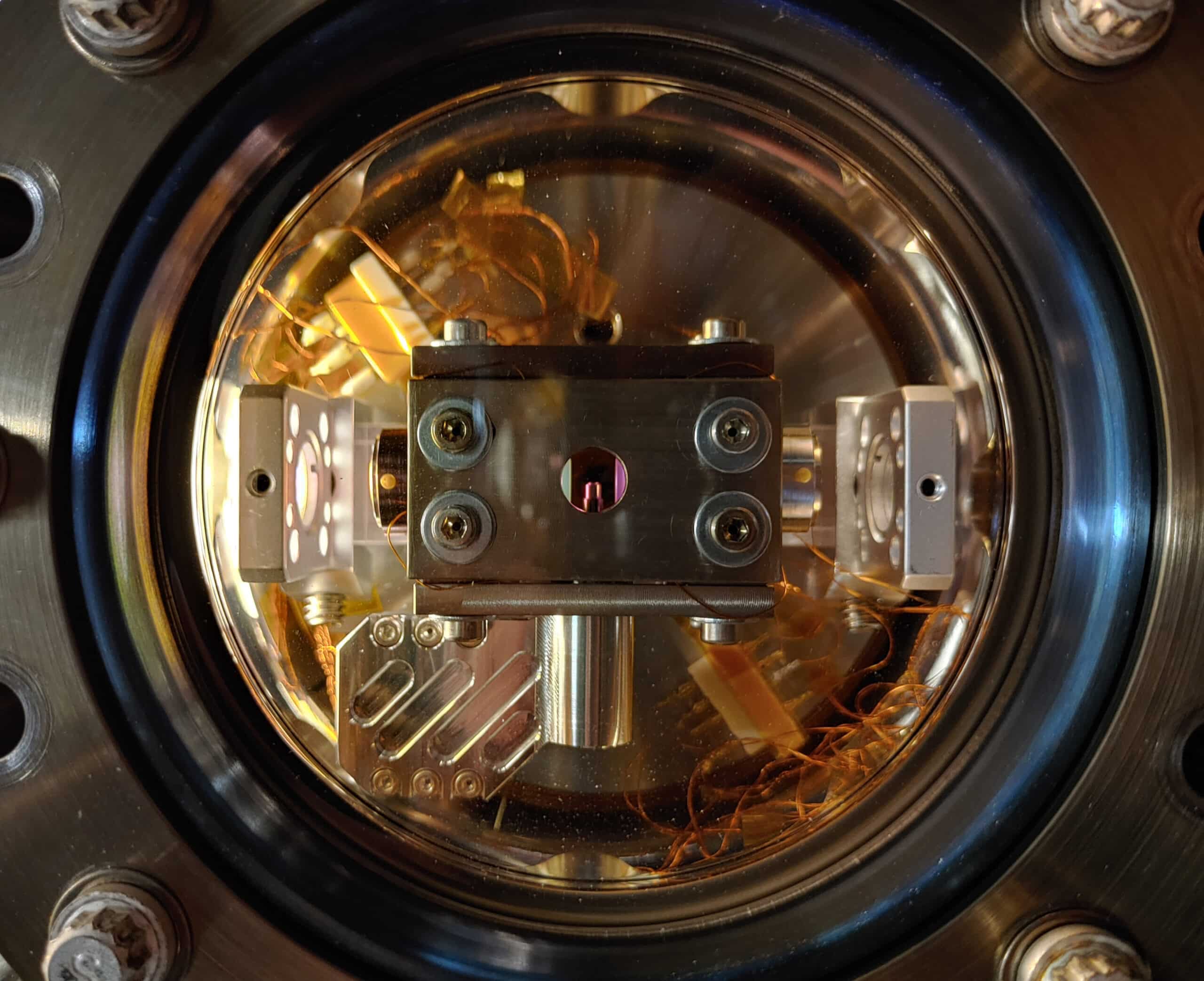
You can’t just put this nanorotor in a freezer. It floats in ultra‑high vacuum, far from any solid surface, and even a warm molecule of gas would ruin the quantum state. Instead, the researchers use light itself as a refrigerator. The method is known as coherent scattering cooling.
The nanorotor sits in a tightly focused laser beam — an optical tweezer — with a stunning light intensity of about 100 megawatts per square centimeter. That’s similar to the power density at the Sun’s surface, compressed into a microscopic spot. This tweezer beam is placed inside a high‑finesse optical cavity, made of two mirrors facing each other, with light bouncing back and forth many thousands of times.
When the nanorotor scatters a photon from the trapping beam into the cavity, that photon can carry away exactly one quantum of rotational energy. One photon leaves, one unit of librational motion disappears. Repeat this process again and again, and the rotational energy drains away step by step, until the rotor reaches its quantum ground state of rotation. Temperature then drops to about 20 microkelvin, just 0.00002°C above absolute zero.
That statement isn’t just poetic. At that level, the orientation uncertainty of the nanorotor is about 20 microradians. The team has genuinely run into the limit imposed by quantum mechanics itself. No cooling trick or engineering upgrade can push beyond that fundamental bound.
Why Does Cooling Two Rotational Axes Change the Game?
A free rigid body has three independent orientational degrees of freedom. Imagine three perpendicular lines — X, Y, Z — and a particle capable of rocking around each of them. Full quantum control of orientation means taming all three librational modes. That’s the long‑term dream of rotational optomechanics.
Previously, the record stood at cooling a single librational axis to its ground state. A team at ETH Zürich demonstrated that in 2025, which was a major accomplishment. But with just one axis controlled, the particle behaves like a boat with only partial steering. You can’t fully shape its motion or use it for more advanced quantum protocols. [web:2]
The Vienna–TU Wien–Ulm collaboration has now cooled two librational axes to their quantum ground states. When cooled one by one, the occupation numbers drop as low as nβ = 0.54 ± 0.32 and nα = 0.21 ± 0.03. When both axes are cooled together, they reach nβ = 0.73 ± 0.22 and nα = 1.02 ± 0.08. An occupation number below 1 means the rotor spends most of its time in the true ground state — with zero quanta of rotational energy.
• 2020 — Levitated nanoparticle translational ground state (Vienna group).
• 2025 — Rotational ground state along one axis (ETH Zürich).
• April 2026 — Rotational ground state in two axes simultaneously (Vienna / TU Wien / Ulm).
Which Numbers Show the Quantum Nature of the Nanorotor?
Physics isn’t just about pretty words. It’s about numbers that either stand up or fall apart. Here, they stand up impressively.
| Parameter | Value | What it means |
|---|---|---|
| Nanorotor material | Silica (SiO₂) | Glass — stable and well studied as a dielectric. |
| Particle size | ~150 nm per sphere | About 300× smaller than a human hair’s width. |
| Number of atoms | ~100 million | Among the most massive objects in a quantum‑limited state. |
| Laser trap intensity | 100 MW/cm² | Similar to the Sun’s surface power density, focused to a point. |
| Temperature reached | ~20 µK | Only 0.00002°C above absolute zero. |
| Orientation precision | 20 µrad | Set by quantum zero‑point fluctuations, not by technical noise. |
| Occupation (β‑axis, single) | nβ = 0.54 ± 0.32 | Already mostly in the ground state. |
| Occupation (α‑axis, single) | nα = 0.21 ± 0.03 | Almost always in the ground state. |
| Occupation (both axes) | nβ = 0.73, nα = 1.02 | Two axes simultaneously near the quantum limit. |
The Heisenberg uncertainty principle for rotation links angular position (Δθ) and angular momentum (ΔL):
The team also estimated the average angular momentum quantum number at room temperature. For their nanorotor, it’s around:
Moving from j̄ ≈ 60,000 to the quantum ground state is not just a change in temperature. It’s a change in the very way the system stores and exchanges energy.
What Future Technologies Could Quantum‑Cooled Nanorotors Enable?
This experiment is more than a scientific stunt. A quantum‑cooled nanorotor is a powerful tool for future technology and basic research.
1. Quantum torque sensing. A nanorotor in its ground state is exquisitely sensitive to tiny torques — the rotational analog of small forces. Even minute twists from magnetic fields, surface interactions, or gravitational gradients change its quantum state in measurable ways. The team points to applications in inertial navigation, materials science, and sensing of minute mechanical signals. If we scale down to particles with the mass of a tobacco mosaic virus — roughly 100 times lighter — the sensitivity would grow even further. [web:3][web:28]
2. Rotational matter‑wave interferometry. This is where things get almost science‑fiction like. If you prepare the nanorotor in its ground state and then release it, its orientation is described by a quantum wave function. The rotor can occupy a superposition of orientations, effectively “pointing” in many directions at once. With the right timing and pulses of light, those orientation states can interfere with each other, similar to how waves overlap. This rotational matter‑wave interferometer could measure torques, test gravitational effects, and probe new physics in ways that linear motion can’t match. Theoretical proposals for this kind of interferometry already exist. Now, the experimental groundwork is finally in place. [web:7][web:13][web:18]
3. Probing quantum superpositions of massive objects. In January 2026, the Vienna group also demonstrated spatial superpositions of sodium clusters containing roughly 7,000 atoms, separated by about 133 nanometers. That experiment, discussed in Nature and university press releases, reached a macroscopicity score of μ = 15.5 — about an order of magnitude larger than previous records. Combining such translational superpositions with rotational ground‑state control hints at future experiments where truly massive objects exist in superpositions of both position and orientation. [web:6][web:14]
Are We Touching the Quantum–Classical Boundary?
At some point you might ask yourself a simple question: if a 100‑million‑atom glass dumbbell can behave quantum mechanically, why doesn’t your coffee mug do the same?
The most accepted answer invokes decoherence. As objects get bigger, they interact more strongly with their environments. Scattered photons, vibrations, and collisions with air molecules rapidly entangle the object with its surroundings. That destroys the fragile phase relationships needed for a clean quantum superposition. Decoherence doesn’t deny quantum mechanics; it just explains why quantum behavior fades so quickly for large systems.
There’s also a more speculative idea: the Diósi–Penrose hypothesis. It suggests that gravity itself might cause quantum states to collapse, setting a fundamental limit on how massive a superposed object can be. Experiments like this nanorotor ground‑state cooling, and future rotational interferometers built upon it, may one day be able to test parts of these ideas directly. The data isn’t there yet, and honest scientists will say so. But the tools needed for those tests are starting to exist.
Final Thoughts: A Spinning Dumbbell, a Quiet Mind, and the Fight Against Misinformation
On April 6, 2026, researchers in Vienna, Vienna University of Technology, and Ulm achieved something no one had before. They took a glass nanorotor of about 100 million atoms, trapped it with laser light at 100 megawatts per square centimeter, and cooled its rotational motion down to around 20 microkelvin. They restricted its orientation to just 20 microradians, smashing into the zero‑point limits set by quantum physics itself. Not just for one librational axis, but for two at the same time. [web:3][web:17][web:16]
Their work opens the door to quantum torque sensors, rotational matter‑wave interferometers, and new tests of how far quantum mechanics really reaches. It shows that the strange behavior usually reserved for electrons and photons can also appear in objects millions of times bigger. This isn’t the final word on the quantum–classical boundary, but it’s an important chapter in that story.
At FreeAstroScience.com, we wrote this article specifically for you. Our mission is to explain complex scientific principles in clear, honest language, without watering down the truth. We want you to keep your mind awake and active, because the sleep of reason breeds monsters — confusion, conspiracy theories, and deliberate lies. Here, we stand on the side of careful evidence and verifiable data. We exist to protect you from misinformation.
So stay curious. Keep asking questions. And come back to FreeAstroScience.com whenever you want to sharpen your understanding of the universe — one photon, one atom, and one spinning glass dumbbell at a time.
References & Sources
- Troyer S., Delić U., Stickler B., Arndt M. et al., Quantum ground‑state cooling of two librational modes of a nanorotor, Nature Physics, April 5–6, 2026. DOI: 10.1038/s41567-026-03219-1. [nature.com] [web:17]
- University of Vienna / EurekAlert, Quantum ground state of rotation: For the first time in two dimensions, April 5, 2026. [eurekalert.org] [web:3]
- arXiv preprint, arXiv:2509.13398, Quantum ground‑state cooling of two librational modes of a nanorotor, September 2025. [arxiv.org] [web:16][web:18]
- Quantum Zeitgeist, Quantum Cooling Achieves Ground‑State Librational Control Of Nanorotors, September 21, 2025. [quantumzeitgeist.com] [web:2]
- Interesting Engineering, Quantum ground state of rotation reached in a world‑first in Europe, April 6, 2026. [interestingengineering.com] [web:9]
- Delić U. et al., Cooling of a levitated nanoparticle to the motional quantum ground state, Science, 2020. [science.org] [web:24]
- University of Vienna, Metal clumps in quantum state: Vienna research team breaks records, January 21, 2026. [univie.ac.at] [web:14]
- Nature News, Schrödinger’s cat just got bigger: quantum physicists create record superposition, January 20, 2026. [nature.com] [web:6]
- Schrinski B., Stickler B., Hornberger K., Interferometric control of nanorotor alignment, arXiv:2110.01301, 2021. [arxiv.org] [web:29]
- Hornberger K., Quantum rotations of nanoparticles, review article. [klaus-hornberger.de] [web:5]