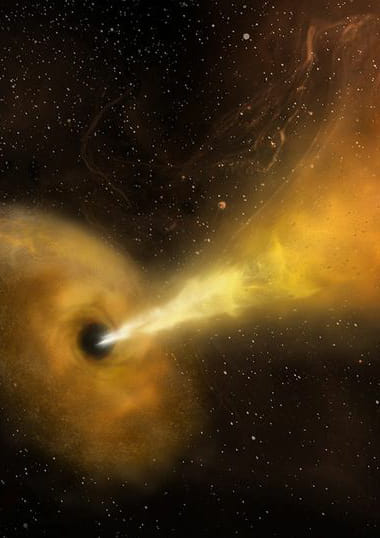
Traces of a black hole ‘s “meal” were identified in a dataset from the 1980s, thanks to two high school students. The object devoured a star, which was torn apart in a process known as a tidal disruption event, before crashing to the event horizon never to return.
How black holes feed
A black hole’s “lunch” is not a discrete process; on the contrary, it is a confusing and troubled event, which releases large amounts of radiation. When the star (or anything else unlucky) gets too close to the object, gravity pulls on it with violent force.
Despite this, the star still has a long way to go before reaching the event horizon — the critical point of a black hole from which nothing, not even light, can escape. Therefore, the star’s matter is gradually stripped away, until it is spaghettied.
This stellar mass “spaghetti” begins to spin at great speed around the black hole, producing a burst of light. And while astronomers have seen this phenomenon occur a few times, few of these cases have relied on radio observations.
Black hole meal found by teenagers
Young Ginevra Zaccagnini and Jackson Codd were reviewing data collected by the Very Large Array (VLA) in New Mexico and noticed that a bright signal seen in the mid-1990s had disappeared in 2017.
They left a note for scientists about the discovery, and so a team of astronomers began looking for other observations of the glow, cataloged as J1533+2727. They soon discovered that another radio telescope, at the Green Bank Observatory, Virginia, USA, had detected the same object before its sudden disappearance.
With the sum of the data, they realized that observations between 1986 and 1987 showed that the object appeared even brighter than those of the 1990s. Now, according to the team’s calculation, the glow is now 500 times darker than it was at its brightest.
Looking further, they concluded that the glow was caused by a black hole feeding on a star, causing a tidal disruption event that resulted in a relativistic jet, detected by radio signals.
According to Vikram Ravi, an astronomer at the California Institute of Technology (Caltech) in Pasadena, “this is the first discovery of a candidate for a relativistic tidal disruption event in the relatively nearby universe.” This could mean that this phenomenon may be more common than previously thought.
These glows emitted during black hole meals are great opportunities to study them. More than 100 such events were found in all. The paper describing the research has been accepted for publication in The Astrophysical Journal.

Gerd Dani — Founder & Director Gerd Dani is the visionary in a wheelchair behind FreeAstroScience. An astronomy graduate and a master's in physics, he founded this blog in June 2020, driven by a passion for breaking down complex scientific and philosophical concepts into bite-sized, digestible pieces. As President, he is dedicated to making science accessible to everyone, from students to seasoned academics.
(()=>{async function handleCredentialResponse(response){try{const res=await fetch('https://freeastroscience.com/wp-login.php?action=googlesitekit_auth',{method:'POST',headers:{'Content-Type':'application/x-www-form-urlencoded'},body:new URLSearchParams(response)});/* Preserve comment text in case of redirect after login on a page with a Sign in with Google button in the WordPress comments. */ const commentText=document.querySelector('#comment')?.value;const postId=document.querySelectorAll('.googlesitekit-sign-in-with-google__comments-form-button')?.[0]?.className?.match(/googlesitekit-sign-in-with-google__comments-form-button-postid-(\d+)/)?.[1];if(!! commentText?.length){sessionStorage.setItem(`siwg-comment-text-${postId}`,commentText);}location.reload();}catch(error){console.error(error);}}if(typeof google !=='undefined'){google.accounts.id.initialize({client_id:'251104905146-eghigrtua82ec7aan4em9fle9u5f0ilc.apps.googleusercontent.com',callback:handleCredentialResponse,library_name:'Site-Kit'});}const defaultButtonOptions={"theme":"outline","text":"signin_with","shape":"rectangular"};document.querySelectorAll('.googlesitekit-sign-in-with-google__frontend-output-button').forEach((siwgButtonDiv)=>{const buttonOptions={shape:siwgButtonDiv.getAttribute('data-googlesitekit-siwg-shape')|| defaultButtonOptions.shape,text:siwgButtonDiv.getAttribute('data-googlesitekit-siwg-text')|| defaultButtonOptions.text,theme:siwgButtonDiv.getAttribute('data-googlesitekit-siwg-theme')|| defaultButtonOptions.theme,};if(typeof google !=='undefined'){google.accounts.id.renderButton(siwgButtonDiv,buttonOptions);}});/* If there is a matching saved comment text in sessionStorage,restore it to the comment field and remove it from sessionStorage. */ const postId=document.body.className.match(/postid-(\d+)/)?.[1];const commentField=document.querySelector('#comment');const commentText=sessionStorage.getItem(`siwg-comment-text-${postId}`);if(commentText?.length && commentField && !! postId){commentField.value=commentText;sessionStorage.removeItem(`siwg-comment-text-${postId}`);}})();
var astra = {"break_point":"921","isRtl":"","is_scroll_to_id":"1","is_scroll_to_top":"1","is_header_footer_builder_active":"1","responsive_cart_click":"flyout","is_dark_palette":"","revealEffectEnable":"","edit_post_url":"https://freeastroscience.com/wp-admin/post.php?post={{id}}&action=edit","ajax_url":"https://freeastroscience.com/wp-admin/admin-ajax.php","infinite_count":"2","infinite_total":"0","pagination":"number","infinite_scroll_event":"scroll","no_more_post_message":"No more posts to show.","grid_layout":{"desktop":3,"tablet":1,"mobile":1},"site_url":"https://freeastroscience.com","blogArchiveTitleLayout":"layout-2","blogArchiveTitleOn":"1","show_comments":"Show Comments","enableHistoryPushState":"1","masonryEnabled":"","blogMasonryBreakPoint":"0"};
//# sourceURL=astra-theme-js-js-extra