
Will You Watch Humanity Return to the Moon — Live With Us?
Have you ever imagined what it feels like to witness history unfold in real time — right from your screen, surrounded by people who share your sense of wonder? What if we told you that moment is just days away?
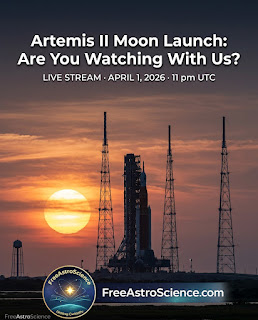
Welcome, friends. We're Gerd Dani and Flavia Ceccato from FreeAstroScience, and we have a very special invitation for you. On April 1, 2026, NASA will launch four astronauts toward the Moon aboard the Artemis II mission — the first crewed lunar voyage in more than half a century . We don't want to watch it alone. And we don't think you should either.
So we're hosting a live stream watch party at 11:00 PM UTC on April 1, and every single one of you is welcome. Stay with us through this post — we'll tell you everything you need to know about the mission, what to expect during our stream, and why this night could become a memory you carry for the rest of your life.
📑 Table of Contents
🔭 What Is Artemis II — And Why Should You Care?
Let's rewind for a moment. The last time a human being traveled beyond low Earth orbit, Richard Nixon was president. Apollo 17 splashed down in December 1972. Since then — through every shuttle launch, every space station module, every Mars rover — no human has left our planet's immediate neighborhood.
Artemis II changes that story.
This is NASA's first crewed mission under the Artemis program. The agency will test the Orion spacecraft's life support systems for the first time with humans aboard, helping lay the groundwork for future crewed missions to the Moon — and eventually Mars. Think of it as the dress rehearsal before astronauts actually set foot on lunar soil again.
The mission will send its crew on an approximately 10-day journey around the Moon . They won't land this time, but they'll loop behind it, test every critical system, and — if the launch happens on April 1 — they're expected to surpass the record for humanity's farthest distance from Earth, previously set by Apollo 13 at 248,655 miles.
That's not a typo. These four people will be farther from home than any human being has ever been.
👩🚀 Who Are the Four Astronauts Flying to the Moon?
Every great mission needs a great crew. Here's who'll be strapped into Orion when that SLS rocket roars to life:
Four people from two nations. Wiseman, Glover, Koch, and Hansen. Jeremy Hansen represents the Canadian Space Agency (CSA), making him the first non-American to fly on a Moon-bound mission. Ever.
Each one of them brings years of training, thousands of hours in simulators, and — we'd bet — a heart that's beating just a little faster with each passing day.
🚀 When and Where Does the Rocket Launch?
Here are the key numbers:
- Launch date: Wednesday, April 1, 2026
- Launch time: 6:24 PM EDT (that's 10:24 PM UTC)
- Launch window: Two hours, so liftoff can happen anytime between 10:24 PM and 12:24 AM UTC
- Launch site: Kennedy Space Center, Launch Complex 39B, Florida
- Backup dates: April 2 through April 6
The rocket? NASA's Space Launch System (SLS) — the most powerful rocket the agency has ever built. On top sits the Orion spacecraft, which will carry our crew around the Moon and safely back to Earth.
NASA will begin live coverage of tanking operations at 7:45 AM EDT on launch day, with full NASA+ launch coverage starting at 12:50 PM EDT You can track Orion in real time throughout the mission using NASA's AROW (Artemis Real-time Orbit Website).
But if you want something warmer — something with heart, conversation, and community — that's where we come in.
📅 What Happens During the 10-Day Mission?
The mission doesn't end at launch. Not even close. Here's a simplified timeline of what the Artemis II crew will experience:
Day 1 — Launch and Earth Orbit (April 1)
The SLS rocket launches. About two and a half hours later, the upper stage performs a burn to send Orion into high Earth orbit .
Day 2 — Heading Moonward (April 2)
A translunar injection burn sends the crew and Orion toward the Moon. The first live crew downlink is expected around 10:24 PM EDT .
Days 3–5 — Coast Toward the Moon (April 3–5)
Daily status briefings and live downlink events keep the public connected to the crew. The Canadian Space Agency holds its own downlink sessions too .
Day 6 — Lunar Flyby (April 6)
This is the big one. NASA+ begins coverage of the lunar flyby at 12:45 PM EDT . The crew is expected to pass behind the Moon's far side, temporarily losing all communication with Earth . During this flyby, video may be limited as the spacecraft passes through a lunar eclipse 1:45 PM EDT, if the April 1 launch holds, these four astronauts will officially become the farthest humans from Earth — surpassing the Apollo 13 record of 248,655 miles .
Let that sink in for a moment.
Days 7–9 — Return Journey (April 7–9)
The crew heads back toward Earth. Highlights include a conversation with astronauts aboard the International Space Station on April 7 and a crew news conference on April 9 .
Day 10 — Splashdown (April 10)
NASA+ coverage of the crew's return begins at 6:30 PM EDT, with splashdown in the Pacific Ocean expected at 8:06 PM EDT. Recovery teams will assist the astronauts out of Orion and transport them to a recovery ship.
Home. Safe. History made.
🎙️ Our Live Stream: How to Join Us on April 1
Now, here's the part we're most excited about.
🌕 FreeAstroScience Live Stream
Watch the Artemis II Launch — Together
April 1, 2026
11:00 PM UTC
Gerd Dani & Flavia Ceccato
📍 On FreeAstroScience channels
No ticket. No sign-up. Just your curiosity.
We've set our stream start at 11:00 PM UTC — about 35 minutes after the launch window opens at 10:24 PM UTC. That gives us time to settle in, say hello, and get our hearts racing together before the engines ignite.
What We'll Do During the Stream
- Real-time commentary as we follow NASA's live broadcast
- Plain-language explanations of every stage — from ignition to orbital insertion
- Open conversation — ask us anything, share your excitement, connect with fellow space lovers
- Post-launch reactions — what just happened, what comes next, and why it matters
You can also track Orion's position in real time through NASA's tracking page at nasa.gov/trackartemis. And if you want the official NASA coverage running alongside ours, it'll be streaming on NASA+, YouTube, and Amazon Prime.
NASA is even inviting the public to register as virtual guests for the launch, complete with a stamp for their virtual guest passport. It's free and takes just a minute.
But our stream? That's where the conversation lives. Where the science meets the feeling.
🌕 Why Watch It Together?
We could give you a dozen practical reasons. We will. But let's start with the honest one.
Space can feel lonely. Not just for astronauts — for those of us who love it from down here, too. We stare at the Moon from our windows. We read about distant galaxies at 2 AM. We carry a quiet fascination that not everyone around us shares.
That's exactly why moments like this matter.
When the SLS rocket lights up the Florida sky on April 1, four human beings will ride a column of fire toward the Moon. And somewhere on this planet — in kitchens, bedrooms, offices, and hospital rooms — thousands of people will be watching. Holding their breath. Feeling small and enormous at the same time.
We want to feel that together. With you.
At FreeAstroScience, we believe complex scientific ideas deserve simple, clear language. We believe knowledge shouldn't be locked behind jargon or paywalls. And we believe — deeply — that the sleep of reason breeds monsters. So we ask you: never turn off your mind. Keep it active. Keep it curious. Keep it hungry.
This live stream is one small way we practice what we preach.
✨ See You Under the Same Sky
Let's bring this home.
On April 1, 2026, at 11:00 PM UTC, Gerd Dani and Flavia Ceccato will be live — waiting for you. We'll watch together as four brave astronauts ride the most powerful rocket NASA has ever built toward our Moon. We'll explain what's happening. We'll share the silence between engine burns. We'll cheer at liftoff like kids watching fireworks.
This is more than a rocket launch. It's a reminder of what we're capable of — as individuals, as a species, as dreamers who refuse to stop looking up. The Artemis program is carrying us toward a future where humans walk on the Moon again, where a woman and a person of color set foot on lunar soil for the first time, and where Mars isn't science fiction anymore .
Mark the date. Tell a friend. Set your alarm.
📅 April 1, 2026 — 11:00 PM UTC
🎙️ Gerd Dani & Flavia Ceccato
📍 FreeAstroScience Live
And when the countdown reaches zero, know that you're not watching alone.
Come back to FreeAstroScience.com — where we explain the universe in words that feel like home. Because science belongs to all of us. Every single one.
See you under the same sky. 🌕
— Gerd Dani & Flavia Ceccato, FreeAstroScience