Earth from 244,000 Kilometers Away: The View That Took 54 Years to Return
What happens when four human beings look back at Earth from a distance no one has reached in over half a century — and share what they see with the rest of us?
Welcome to FreeAstroScience — where we break down complex scientific principles into words that feel like a conversation between friends. We’re a science and cultural group built on one simple belief: the sleep of reason breeds monsters, so we never stop asking questions. Today, we have a story that might just make your heart skip a beat. Right now, as you read this, four astronauts aboard NASA’s Orion capsule are racing toward the Moon. The images they’re beaming back to Earth are the first of their kind in 54 years — and they’re absolutely stunning. Stay with us to the end. You’ll walk away seeing our little blue planet with fresh eyes.

Side-by-side comparison of Earth from space: Apollo 17 Blue Marble photo (1972) and Artemis II full Earth image (2026), both showing Africa and oceans. Credit: NASA
📖 Table of Contents
- 1.Who Are the Four Astronauts Aboard Artemis II?
- 2.What Do the First Earth Images from Artemis II Reveal?
- 3.Has Earth Changed in 54 Years? A Side-by-Side Look
- 4.What Comes Next for the Artemis Program?
- 5.Why Do These Photos Hit Us So Hard?
Who Are the Four Astronauts Aboard Artemis II?
Inside the Orion capsule sit four people who just made history: Commander Reid Wiseman, Pilot Victor Glover, Mission Specialist Christina Koch, and Mission Specialist Jeremy Hansen . They’re the first humans to leave low Earth orbit since the Apollo era ended in December 1972 .
Let that sink in. Fifty-four years. Every person born after 1972 has never lived in a world where anyone was this far from home — until right now.
By two and a half days after launch, the Orion capsule had already crossed the halfway mark between Earth and the Moon: 244,000 km from us and roughly 200,000 km from our natural satellite . In about two more days, these four crew members will become the first people since Apollo to fly by the Moon .
| Detail | Data |
|---|---|
| Mission | Artemis II (first crewed Artemis flight) |
| Spacecraft | NASA Orion Capsule |
| Crew | Reid Wiseman, Victor Glover, Christina Koch, Jeremy Hansen |
| Distance from Earth (at halfway point) | ~244,000 km |
| Distance from Moon (at halfway point) | ~200,000 km |
| Lunar landing? | No — flyby mission only |
| Last time humans were this far out | Apollo 17, December 1972 (54 years ago) |
What Do the First Earth Images from Artemis II Reveal?
Over the past two days, both the astronauts and the onboard cameras have captured extraordinary views of our planet — images from a distance no human had experienced in more than 50 years .
We did see similar deep-space shots of Earth during the uncrewed Artemis I mission at the end of 2022 . Those were beautiful, no question. But these new photographs carry a completely different weight. This time, human eyes saw the view first. Human hands pressed the shutter. And that changes everything .
The Night Side of Earth, Bathed in Moonlight
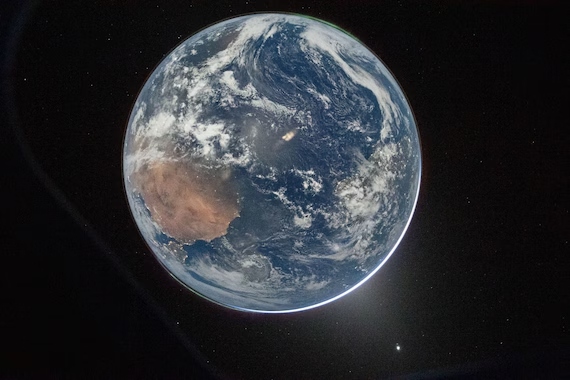
One photograph stands out among the rest. It shows our entire planet — but from the night side . The details look soft, slightly hazy. Why? The only light illuminating the scene is something astronomers call earthshine: faint sunlight bouncing weakly off the Moon’s surface back toward our planet .
Even in that ghostly glow, we can make out recognizable features. The eastern Sahara Desert stretches across the frame. The Iberian Peninsula curves along the edge. The dark Atlantic Ocean wraps around everything .
Now look at the lower right. A thin, bright crescent of Earth catches direct sunlight . And just below it, further right — a tiny, luminous dot. That’s Venus. Another planet entirely, casually photobombing one of the most historic images of our generation .
Earth Through Orion’s Window
Then there’s the photo that grabs you by the heart. Earth — small, fragile, impossibly blue — peeking through one of Orion’s windows.
A blue marble framed by the cold metal and glass of a spacecraft. This specific view — a human eye gazing out a deep-space window at our shrinking homeworld — had been completely unavailable to everyone alive for more than half a century. Not a single person on this planet had that experience between December 1972 and this week.
Now it’s back. And honestly? We’re all a little emotional about it.
Has Earth Changed in 54 Years? A Side-by-Side Look
Here’s the detail that stopped us cold. Place the legendary Apollo 17 “Blue Marble” photo from 1972 next to the new Artemis II image, and Earth looks… exactly the same.
Blue as far as the eye can see. White clouds spinning in mesmerizing, almost hypnotic patterns. Brown and green land masses where billions of tiny humans build their lives .
The planet didn’t budge. We’re the ones who changed — dramatically.
| Metric | Apollo 17 (1972) | Artemis II (2026) |
|---|---|---|
| World Population | ~3.5 billion | ~8+ billion |
| Internet | Did not exist | 5+ billion users |
| Artificial Intelligence | Early concepts | Everywhere |
| Smartphones | Unimaginable | In nearly every pocket |
| Human Awe at Earth from Space | 💙 Profound | 💙 Exactly the same |
| How Earth Looks from Space | Blue, cloudy, beautiful | Blue, cloudy, beautiful |
In 1972, 3.5 billion people shared this planet. Today, over 8 billion call it home . Technology has taken giant leaps: we’ve invented the Internet, built artificial intelligence, and put smartphones in nearly every hand .
But our fascination — that deep, almost primal wonder — when we see our planet from afar? Unchanged .
There’s something profoundly comforting about that. No matter how much we evolve, how many gadgets we invent, how crowded our cities become — the sight of Earth floating alone in the blackness still takes our breath away. It always will.
What Comes Next for the Artemis Program?
Artemis II is a flyby mission — it won’t land astronauts on the lunar surface. For that, we’ll need to wait for Artemis IV, scheduled for 2028.
So what’s the point of Artemis II, then? Simple: it tests — with real people aboard — the maneuvers and systems that’ll make those future Moon landings possible . Think of it as a dress rehearsal with the highest possible stakes.
And what a rehearsal it is. Within days, Wiseman, Glover, Koch, and Hansen will pass just a few thousand kilometers above the Moon’s surface . They’ll observe something no ordinary person can ever witness from Earth: the far side of the Moon — that hidden face that’s always turned away from us .
The long-term ambition goes even further. NASA wants to build a permanent lunar base and maintain continuous human presence on the Moon . Not a visit. Not a flag-planting photo opportunity. A home.
| Mission | Year | What It Achieves |
|---|---|---|
| Artemis I | 2022 | Uncrewed test flight around the Moon |
| Artemis II | 2026 | First crewed lunar flyby in 54 years |
| Artemis IV | 2028 (planned) | First crewed lunar landing since Apollo 17 |
Why Do These Photos Hit Us So Hard?
A camera on a robotic spacecraft can capture the same pixels. But when a person lifts their own camera to a window 244,000 kilometers from home, the image carries weight that no algorithm can replicate.
Commander Reid Wiseman took one of these photos himself . He pointed a camera through a small, round window on the Orion capsule and captured our entire planet — blue, glowing, impossibly alive. Behind that photo is a heartbeat. A pair of lungs breathing recycled air. A human being experiencing the kind of awe that only a handful of people in all of history have ever known.
That’s why these images hit differently.
When astronauts photograph Earth from deep space, they hold up a mirror for the rest of us. They’re saying: This is it. This is home. No borders. No fences. No divisions visible. Just a blue sphere hanging in darkness, carrying everyone you’ve ever loved.
If you’re reading this and the world feels heavy — and it often does — take a breath. Right now, four people are looking back at all 8 billion of us from a quarter-million kilometers away. From that distance, every problem looks a little more solvable. Every divide, a little more absurd.
You’re not alone out here. None of us are.
Conclusion
We started this article with a question: what happens when someone looks back at Earth from a distance no one has reached in half a century? Now we know. It reminds us that our planet is the same blue, breathtaking sphere it was in 1972 — while we, its passengers, have transformed beyond recognition. From 3.5 billion souls to 8 billion. From rotary phones to artificial intelligence. And yet, the wonder we feel? Identical.
Artemis II isn’t just a test flight. It’s a statement. We’re going back. Not for a visit — for good. In 2028, Artemis IV aims to place human boots on the lunar surface once more. And after that, a permanent lunar base . The Moon is about to become more than a light in our sky. It’ll become a neighborhood.
These photographs — Earth glowing against the void, seen through a tiny spacecraft window by actual human eyes — remind us that science doesn’t just answer questions. It gives us perspective. It shrinks our problems and expands our sense of possibility.
Come back to FreeAstroScience.com whenever you want to sharpen that perspective. We’re here to help you understand the cosmos in plain language — because when we stop thinking, when we stop wondering, that’s when the real darkness sets in. As Goya once warned us: the sleep of reason breeds monsters. So keep your mind awake. Keep looking up. And we’ll keep writing for you.
📚 References & Sources
- Bonaventura, F. (April 4, 2026). “Le prime immagini di Artemis II della Terra: esseri umani non la vedevano da così lontano da oltre 50 anni.” Geopop. geopop.it
- NASA. “Artemis II Mission Overview.” nasa.gov/artemis-ii
- NASA Image Gallery. “Artemis II Earth & Moon Photography.” images.nasa.gov
Article written for FreeAstroScience.com — Science & Cultural Group · Written by Gerd Dani