The international conference on asteroids, comets, and meteorites, known as ACM, is currently underway in Flagstaff, Arizona. Interestingly, a mere 60 km away lies the Meteor Crater, a much sought-after destination for enthusiasts of small Solar System bodies.
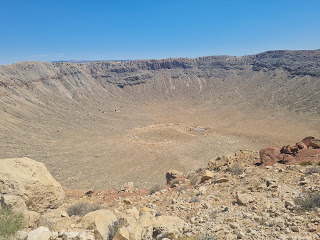
Yesterday, a few of my colleagues who are attending the conference took a trip to the crater and shared some truly awe-inspiring pictures with me.
Originating from an asteroid composed of nickel and iron that impacted the surface approximately 50,000 years ago, the Meteor Crater is a sight to behold. The collision was so intense that it almost entirely vaporized the asteroid, leaving only a few fragments behind. The largest of them, measuring 80 cm in diameter, can now be seen at the crater’s visitor center.
The Meteor Crater boasts a diameter of 1.2 km and a depth of roughly 170 meters. It is encircled by a 45-meter high ring. While the outer walls were originally 20 meters higher, erosion over time has reshaped them. Similarly, sedimentation phenomena have filled the crater’s bottom with a 30-meter thick layer. Yet, due to its relative youth and Arizona’s dry climate, the Meteor Crater remains one of the best-preserved craters on Earth.
The crater was initially thought to be of volcanic origin until 1903 when mining engineer and businessman Daniel Barringer suggested it could be a meteorite impact site. Barringer, who was hoping to find large iron deposits, even obtained a mining concession for the crater from Theodore Roosevelt. For two decades, Barringer dug in the crater for the valuable meteorite but found nothing, eventually depleting his fortune. Barringer passed away in 1929, a year after an astronomer confirmed that the meteorite had likely vaporized upon impact.
Surprisingly, the Meteor Crater is privately owned by the Barringer family and therefore cannot be declared a national natural monument by the government. However, over the past century, the Barringers have maintained and preserved the site excellently. They have even established a museum featuring several interactive exhibits on asteroids and meteorites. The site draws approximately 270,000 tourists each year.
Gerd Dani — Founder & Director Gerd Dani is the visionary in a wheelchair behind FreeAstroScience. An astronomy graduate and a master's in physics, he founded this blog in June 2020, driven by a passion for breaking down complex scientific and philosophical concepts into bite-sized, digestible pieces. As President, he is dedicated to making science accessible to everyone, from students to seasoned academics.
(()=>{async function handleCredentialResponse(response){try{const res=await fetch('https://freeastroscience.com/wp-login.php?action=googlesitekit_auth',{method:'POST',headers:{'Content-Type':'application/x-www-form-urlencoded'},body:new URLSearchParams(response)});/* Preserve comment text in case of redirect after login on a page with a Sign in with Google button in the WordPress comments. */ const commentText=document.querySelector('#comment')?.value;const postId=document.querySelectorAll('.googlesitekit-sign-in-with-google__comments-form-button')?.[0]?.className?.match(/googlesitekit-sign-in-with-google__comments-form-button-postid-(\d+)/)?.[1];if(!! commentText?.length){sessionStorage.setItem(`siwg-comment-text-${postId}`,commentText);}location.reload();}catch(error){console.error(error);}}if(typeof google !=='undefined'){google.accounts.id.initialize({client_id:'251104905146-eghigrtua82ec7aan4em9fle9u5f0ilc.apps.googleusercontent.com',callback:handleCredentialResponse,library_name:'Site-Kit'});}const defaultButtonOptions={"theme":"outline","text":"signin_with","shape":"rectangular"};document.querySelectorAll('.googlesitekit-sign-in-with-google__frontend-output-button').forEach((siwgButtonDiv)=>{const buttonOptions={shape:siwgButtonDiv.getAttribute('data-googlesitekit-siwg-shape')|| defaultButtonOptions.shape,text:siwgButtonDiv.getAttribute('data-googlesitekit-siwg-text')|| defaultButtonOptions.text,theme:siwgButtonDiv.getAttribute('data-googlesitekit-siwg-theme')|| defaultButtonOptions.theme,};if(typeof google !=='undefined'){google.accounts.id.renderButton(siwgButtonDiv,buttonOptions);}});/* If there is a matching saved comment text in sessionStorage,restore it to the comment field and remove it from sessionStorage. */ const postId=document.body.className.match(/postid-(\d+)/)?.[1];const commentField=document.querySelector('#comment');const commentText=sessionStorage.getItem(`siwg-comment-text-${postId}`);if(commentText?.length && commentField && !! postId){commentField.value=commentText;sessionStorage.removeItem(`siwg-comment-text-${postId}`);}})();
var astra = {"break_point":"921","isRtl":"","is_scroll_to_id":"1","is_scroll_to_top":"1","is_header_footer_builder_active":"1","responsive_cart_click":"flyout","is_dark_palette":"","revealEffectEnable":"","edit_post_url":"https://freeastroscience.com/wp-admin/post.php?post={{id}}&action=edit","ajax_url":"https://freeastroscience.com/wp-admin/admin-ajax.php","infinite_count":"2","infinite_total":"0","pagination":"number","infinite_scroll_event":"scroll","no_more_post_message":"No more posts to show.","grid_layout":{"desktop":3,"tablet":1,"mobile":1},"site_url":"https://freeastroscience.com","blogArchiveTitleLayout":"layout-2","blogArchiveTitleOn":"1","show_comments":"Show Comments","enableHistoryPushState":"1","masonryEnabled":"","blogMasonryBreakPoint":"0"};
//# sourceURL=astra-theme-js-js-extra