The Sun is now 4.6 billion years old and there are still some doubts as to exactly what we would see if we were here to see its end. But, luckily, it’s possible to get an idea of what to expect with the help of other stars similar to ours.
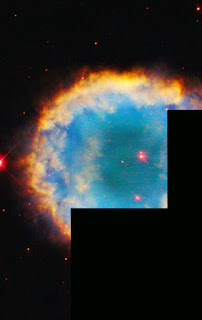
A new Hubble Space Telescope image shows NGC 2438, a spherical planetary nebula formed by large clouds of gas, ejected by a “dying” star that looks similar to the Sun. In other words, what is happening there reveals the what will happen around here. The stage that NGC 2438 is at should take no more than 10,000 years and is the result of a long process similar to what awaits our star.
When the Sun runs out of hydrogen to perform nuclear fusion, the core will begin to cool and contract, affecting the delicate balance of pressure and gravity responsible for maintaining our star’s structure.
With that, more hydrogen will be formed in the region that surrounds the nucleus, creating a kind of shield surrounding the structure. In the image, blue represents oxygen; hydrogen appears in green; nitrogen, in orange; and red indicates sulfur (NASA, ESA, K. Knoll/NASA Goddard, S. Öttl/University of Innsbruck, et. al.; Gladys Kober/NASA/CUA) This process will generate a large amount of energy capable of expanding the Sun’s outer layers.
Then, there will come a time when instability will be such that it will eventually cause a series of eruptions capable of ejecting much of the star’s mass into the space, and in the end, what’s left is just a white dwarf, which glows faintly with the remaining heat. In the case of NGC 2438, it is still at a stage where the ejected material continues to expand into space, at a speed of 37 km/s.
In another few thousand years, this material will be too thin to be seen. While we can observe it, we also find a glowing “halo” that surrounds the innermost ring of the nebula. It does not appear in this image, but it can often be seen in round planetary nebulae. A recent study of NGC 2438 showed that the halo in question is receiving ionizing radiation from the white dwarf at its center, which causes it to glow.
Gerd Dani — Founder & Director Gerd Dani is the visionary in a wheelchair behind FreeAstroScience. An astronomy graduate and a master's in physics, he founded this blog in June 2020, driven by a passion for breaking down complex scientific and philosophical concepts into bite-sized, digestible pieces. As President, he is dedicated to making science accessible to everyone, from students to seasoned academics.
(()=>{async function handleCredentialResponse(response){try{const res=await fetch('https://freeastroscience.com/wp-login.php?action=googlesitekit_auth',{method:'POST',headers:{'Content-Type':'application/x-www-form-urlencoded'},body:new URLSearchParams(response)});/* Preserve comment text in case of redirect after login on a page with a Sign in with Google button in the WordPress comments. */ const commentText=document.querySelector('#comment')?.value;const postId=document.querySelectorAll('.googlesitekit-sign-in-with-google__comments-form-button')?.[0]?.className?.match(/googlesitekit-sign-in-with-google__comments-form-button-postid-(\d+)/)?.[1];if(!! commentText?.length){sessionStorage.setItem(`siwg-comment-text-${postId}`,commentText);}location.reload();}catch(error){console.error(error);}}if(typeof google !=='undefined'){google.accounts.id.initialize({client_id:'251104905146-eghigrtua82ec7aan4em9fle9u5f0ilc.apps.googleusercontent.com',callback:handleCredentialResponse,library_name:'Site-Kit'});}const defaultButtonOptions={"theme":"outline","text":"signin_with","shape":"rectangular"};document.querySelectorAll('.googlesitekit-sign-in-with-google__frontend-output-button').forEach((siwgButtonDiv)=>{const buttonOptions={shape:siwgButtonDiv.getAttribute('data-googlesitekit-siwg-shape')|| defaultButtonOptions.shape,text:siwgButtonDiv.getAttribute('data-googlesitekit-siwg-text')|| defaultButtonOptions.text,theme:siwgButtonDiv.getAttribute('data-googlesitekit-siwg-theme')|| defaultButtonOptions.theme,};if(typeof google !=='undefined'){google.accounts.id.renderButton(siwgButtonDiv,buttonOptions);}});/* If there is a matching saved comment text in sessionStorage,restore it to the comment field and remove it from sessionStorage. */ const postId=document.body.className.match(/postid-(\d+)/)?.[1];const commentField=document.querySelector('#comment');const commentText=sessionStorage.getItem(`siwg-comment-text-${postId}`);if(commentText?.length && commentField && !! postId){commentField.value=commentText;sessionStorage.removeItem(`siwg-comment-text-${postId}`);}})();
var astra = {"break_point":"921","isRtl":"","is_scroll_to_id":"1","is_scroll_to_top":"1","is_header_footer_builder_active":"1","responsive_cart_click":"flyout","is_dark_palette":"","revealEffectEnable":"","edit_post_url":"https://freeastroscience.com/wp-admin/post.php?post={{id}}&action=edit","ajax_url":"https://freeastroscience.com/wp-admin/admin-ajax.php","infinite_count":"2","infinite_total":"0","pagination":"number","infinite_scroll_event":"scroll","no_more_post_message":"No more posts to show.","grid_layout":{"desktop":3,"tablet":1,"mobile":1},"site_url":"https://freeastroscience.com","blogArchiveTitleLayout":"layout-2","blogArchiveTitleOn":"1","show_comments":"Show Comments","enableHistoryPushState":"1","masonryEnabled":"","blogMasonryBreakPoint":"0"};
//# sourceURL=astra-theme-js-js-extra