Astronomers utilizing the exceptional sensitivity of the James Webb space telescope (JWST) have detected distinct atmospheric variations between the morning and evening transition zones, known as terminators, of the ultra-hot gas giant WASP-121 b. This pioneering research, led by Cyril Gapp of the Max Planck institute for astronomy (MPIA), confirms previous theoretical predictions regarding temperature and chemical non-uniformity. By measuring the asymmetric absorption of infrared starlight during the exoplanet’s transit, scientists are now able to analyze the atmospheric characteristics of distant worlds longitude by longitude.
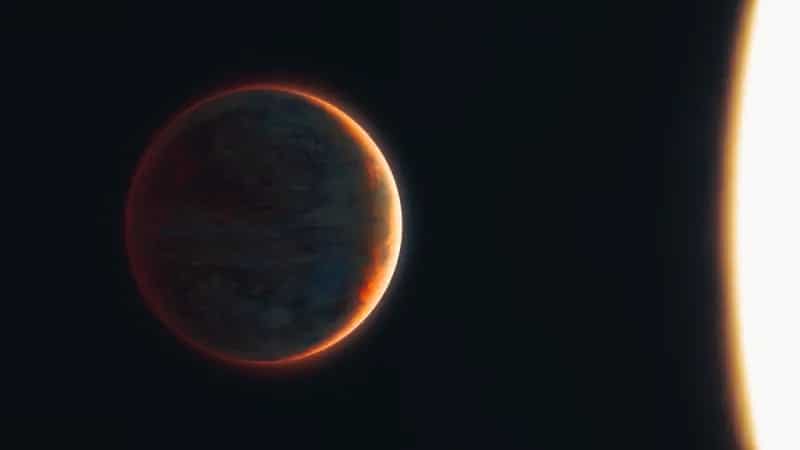
James Webb space telescope reveals atmospheric asymmetries on ultra-hot exoplanet WASP-121 b
The evening terminator of WASP-121 b exhibits a higher absorption of starlight compared to the morning side, reinforcing the hypothesis of powerful winds transporting intense heat from the dayside to the nightside. Following the eastward rotation of the planet, these thermal currents significantly warm the evening region. As temperatures escalate, this specific atmospheric zone expands, thereby increasing the cross-section of the planet and enabling a more efficient absorption of stellar radiatioqn.
Data collected by the near-infrared spectrograph (NIRSpec) instrument onboard the JWST revealed a general decline in luminosity toward the end of the transit, accompanied by an elevated signal for carbon monoxide. However, researchers determined that this variance is an effect of temperature fluctuation rather than an actual increase in molecular abundance. Conversely, a measurable decrease in water vapor was observed, suggesting that upper-atmosphere temperatures are sufficiently high to split water molecules into their fundamental components.
This extreme atmospheric behavior is driven by tidal forces, which have synchronized the orbital and rotational periods of the planet, resulting in permanent dayside and nightside hemispheres. Co-author Tom Evans-Soma of Newcastle university noted that average temperatures reach approximately 2,770 Kelvin on the dayside, whereas the nightside drops to around 1,000 Kelvin. These stark differences correspond to nearly 2,500 degrees Celsius during the day and 725 degrees Celsius at night.
Observational methodology and statistical verification
As WASP-121 b transits its host star, the planet rotates by approximately 30 degrees, allowing astronomers to glimpse different portions of the dawn and dusk regions beyond the dark hemisphere. Spectrographs decompose the incoming starlight into a spectrum, much like a prism separating colors based on wavelengths. Because atmospheric gases absorb light at specific wavelengths, a detailed analysis of this filtered signal over time reveals the precise chemical composition across different longitudes.
Traditionally, astronomers average data across the entire transit to achieve a clearer signal, which obscures localized atmospheric variations. In this study, Gapp and his colleagues accounted for the time-dependent variations caused by planetary rotation to monitor how the signal evolved throughout the trajectory. By applying advanced statistical methods, the team demonstrated that their time-dependent model provided a significantly better fit to the data, confirming the validity of the detected variations.
To verify whether the measured temperatures could cause the observed local expansion, the researchers simulated heat distribution within the upper atmospheric layers based on the characteristics of the planet and its host star. While these models successfully replicated an asymmetric effect due to spatial temperature differences, the actual signal amplitude observed in the data was larger than predicted. This discrepancy suggested the presence of unmodeled cooling mechanisms acting upon the morning terminator.
Cloud modeling and future comparative studies
Astronomers suspected that the lower temperatures recorded at the morning terminator could be caused by the presence of mineral clouds, such as silicates, which shield the infrared light emitted from deeper, hotter layers. Simulating the physics of condensation, evaporation, and cloud dynamics in a highly volatile environment represents a major computational challenge. Consequently, standard exoplanetary atmosphere models often omit these factors, which can lead to unrealistic interpretations of the observed data.
After modifying the simulation to approximate how clouds impact infrared radiation from deeper atmospheric strata, the theoretical results aligned more closely with the JWST observations. Nevertheless, the definitive confirmation of these mineral clouds will require the deployment of more sophisticated, multi-dimensional models. These refined computational tools will be essential for interpreting future observations and correcting the biases present in current simplified simulations.
The optimization of these analytical methods will enhance future investigations of similar celestial bodies, as astronomers have already identified multiple target exoplanets with compatible temperature ranges and rotation speeds. Establishing a broader sample of ultra-hot gas giants will enable researchers to map longitudinal structures systematically. Ultimately, this comparative approach will uncover the shared mechanisms and unique differences that define these extreme cosmic environments.
The study is published in Nature Astronomy.