What if a galaxy 217 million light-years away were hiding not one, but two giant black holes locked in a death spiral, ready to merge and shake the fabric of spacetime?
Welcome, dear reader. We’re glad you’re here. We’re Gerd Dani, writing for /FreeAstroScience.com, where we break down complicated science into words you can actually use at dinner. Today we want to share one of the most striking discoveries of 2026: a second jet shooting out from the heart of Markarian 501, a famous blazar that has puzzled astronomers for forty years. Stick with us until the end. The story gets wilder than you’d expect, and the consequences reach all the way to gravitational waves and the future of radio astronomy.
A Quiet Galaxy With a Loud Secret
Who is Markarian 501, anyway?
Markarian 501 (also called Mrk 501, 1652+398, or J1653+3945) sits at redshift z = 0.034, roughly 456 million light-years from Earth. Astronomers classify it as a BL Lac object, a kind of blazar where one of the relativistic jets points almost straight at us .
For decades, Mrk 501 has been a headache. Its radio jets look drastically misaligned: the structure on parsec scales (close to the core) doesn’t match the structure on kiloparsec scales (far from it). Back in 1986, W. Breugel and R. Schilizzi already noticed this strange bend, suggesting the jet must twist within 40 parsecs of the nucleus . Many astronomers suspected something exotic was hiding inside. A pair of black holes, perhaps?
Why is this blazar so odd?
A few features make Mrk 501 stand out from the blazar crowd:
- Its inner jet shows no superluminal motion, unlike most blazars. Jet features simply sit there for 23 years.
- It suffers from the famous “Doppler factor crisis”: numbers don’t quite add up between high-energy and radio observations.
- Past studies hinted at periodic flares in gamma rays, TeV photons, and X-rays, suggesting some clock ticking deep inside .
Something needed explaining. And in 2026, an international team led by S. Britzen at the Max Planck Institute for Radio Astronomy may have found the answer.
What did the team actually discover?
The team reanalysed 83 datasets taken with the Very Long Baseline Array (VLBA) at 43 GHz, spanning from 24 September 2011 to 24 July 2023. They also pulled in earlier data at 15 GHz and 8 GHz for comparison .
Buried in those 83 epochs, they spotted something that had escaped earlier eyes: a second jet, which they call Jet 2.
How does Jet 2 behave?
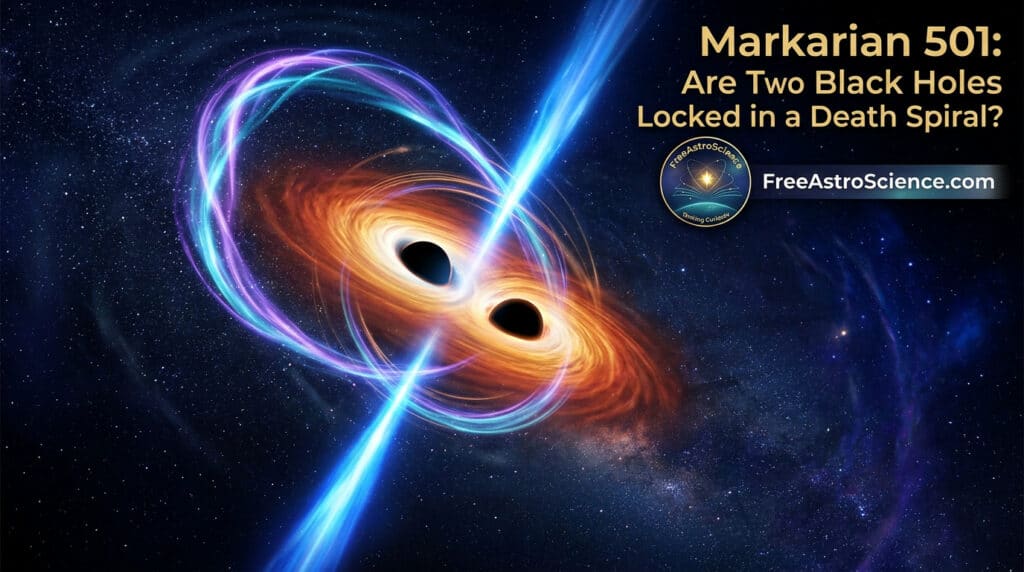
Jet 2 doesn’t shoot out where you’d expect. It starts on the counterjet side of the radio core (the “wrong” side, opposite the known Jet 1) and then loops anticlockwise around the primary core, eventually merging with Jet 1 to the north.
Picture a child running around a parent’s legs and then grabbing their hand. That’s what Jet 2 looks like over a few months.
Even stranger, the team measured how often Jet 2 reappears in the same configuration. The repeating pattern points to a period of 0.40 ± 0.06 years in the observer’s frame, or roughly 146 ± 22 days . Correct that for cosmological redshift and you get about 141 days at the source.
What about the longer rhythm?
The 43 GHz light curve also pulses on a much slower beat. A discrete autocorrelation analysis pulled out a second peak at 7.4 ± 0.1 years . The Lomb–Scargle periodogram of the core’s flux density shows a related ~9.5-year period, with the 121-day signal riding on top .
Two clocks ticking at once. One fast (months), one slow (years). That’s exactly what you’d expect from a binary system whose orbital plane is also precessing.
Why did a partial Einstein ring show up?
On 24 June 2022, the VLBA caught Jet 2 forming an almost perfect circle around the radio core. The team reads this as a partial Einstein ring caused by gravitational lensing: light from Jet 2 (launched by the secondary black hole) gets bent by the gravity of the primary black hole sitting in front .
You only see this geometry when source, lens, and observer line up almost perfectly. That alignment isn’t permanent. The orbital plane is drifting, so the ring shows up only at special epochs. Albert Einstein predicted this effect over a century ago, and we may now be watching it play out inside an active galactic nucleus on scales of fractions of a milliarcsecond.
What numbers describe this binary monster?
Let’s pin down the physics with some real values from the paper.
| Parameter | Value | Notes |
|---|---|---|
| Redshift | z = 0.034 | About 456 million light-years away |
| Short orbital period | ≈ 121 days (≈ 141 d corrected) | From Jet 2 reappearance and core flux |
| Long precession period | 7.4 ± 0.1 years | Total flux density autocorrelation |
| Estimated total mass | ≈ 7 × 10⁸ M☉ | Following Ghisellini et al. 2010 |
| Mass of each component | 10⁸ – 10⁹ M☉ | Assuming roughly equal masses |
| Orbital separation | 27 – 128 Schwarzschild radii (≈ 252–543 au) | Depends on assumed mass |
| Maximum angular size | ≈ 3.6 μas | Below current EHT resolution (~20 μas) |
| Predicted GW frequency | ≈ 8 × 10⁻⁸ Hz | Within SKA pulsar timing range |
Kepler’s law in action
The team applied Kepler’s third law to fix the size of the orbit. Here it is in plain notation:
Plug in M ≈ 7 × 10⁸ solar masses and T ≈ 141 days, and you land on a semimajor axis of about 469 astronomical units. That’s roughly 12 times the distance from the Sun to Pluto, but packed with two beasts each weighing hundreds of millions of suns.
How long until they merge?
Using the standard general-relativity formula for inspiral driven by gravitational-wave emission :
The binary should survive for at least 250 orbital cycles, even with equal-mass components . So no, they won’t crash tomorrow. But on cosmic timescales, this pair is already on its final approach.
Could something other than a binary explain this?
Good scientists question their own conclusions. The team did exactly that, weighing four competing scenarios:
- Kelvin–Helmholtz instabilities: helical waves rippling through the jet. They can produce filaments, but they don’t explain the asymmetric stratification between 15 and 43 GHz seen here .
- Core position shifts with frequency: real, but only ≈ 0.05 mas in Mrk 501, and along the wrong direction .
- Internal shocks: probably play a role for individual bright knots, yet they can’t drive Jet 2’s looping motion .
- Non-uniform mass loading: would create a spine-sheath structure, which Mrk 501 doesn’t show at 43 GHz .
None of these alone covers everything: the second jet, the Einstein ring, the 121-day cycle, the 7-year drift, and the clockwise offset between the 43 GHz and 15 GHz jets. The supermassive binary black hole (SMBBH) model fits all of it .
Will we ever catch its gravitational waves?
Here’s the part that gives us goosebumps. The estimated gravitational-wave frequency of this binary, about 8 × 10⁻⁸ Hz, falls right in the window targeted by the Square Kilometre Array (SKA) through pulsar timing arrays (10⁻⁹ to 10⁻⁷ Hz) .
If we monitor more than 20 millisecond pulsars for over a decade with high precision, the tiny ripples in spacetime caused by this orbiting pair could leave their fingerprint in pulsar arrival times . We’d be reading a gravitational wave from a single, identified source, not just the cosmic background hum reported by NANOGrav and EPTA in 2023.
The Event Horizon Telescope can’t separate the two black holes yet (they’re under 4 microarcseconds apart, while EHT resolves about 20). The proposed Black Hole Explorer mission, with ~6 μas resolution, would still struggle. So pulsar timing might give us the first direct confirmation that two giant black holes really live inside Mrk 501.
A Quiet Reflection Before You Leave
We’ve just looked into a galaxy where two supermassive black holes seem to be circling each other, dragging their jets through curved spacetime, lensing their own light, and slowly broadcasting gravitational waves toward us. The discovery rests on 83 nights of patient observation, a careful comparison of three radio frequencies, and a willingness to question old assumptions about what blazars do.
This article was written for you by FreeAstroScience.com, where we explain complicated scientific principles in simple words. Our promise is straightforward: we want you to keep your mind awake. As Goya warned us, the sleep of reason breeds monsters. Science is one of the best tools we have to keep that sleep at bay.
Come back soon. The universe keeps writing strange stories, and we’ll keep translating them for you.
Frequently Asked Questions
Q1. What exactly is a blazar?
A blazar is an active galactic nucleus where a relativistic jet points almost straight toward Earth. Mrk 501 is a high-synchrotron-peaked BL Lac object, a specific subtype with strong gamma-ray and TeV emission .
Q2. Why did it take 40 years to spot the second jet?
Earlier observations had lower resolution or fewer epochs. The Britzen et al. 2026 study modelled 83 VLBA datasets at 43 GHz between 2011 and 2023, which gave the time coverage and angular detail needed to track Jet 2’s looping motion around the core.
Q3. How big is the binary, in human terms?
The two black holes are separated by about 252 to 543 astronomical units, which is roughly 6 to 12 times the average Sun-Pluto distance. Each one weighs between 100 million and 1 billion solar masses.
Q4. When will the two black holes merge?
Not soon. The inspiral time covers at least 250 orbital cycles, so we’re talking about timescales much longer than human history. The merger itself will eventually radiate enormous gravitational waves.
Q5. Have we directly detected the gravitational waves yet?
Not yet. The predicted frequency (≈ 8 × 10⁻⁸ Hz) sits inside the range that pulsar timing arrays, particularly with the future Square Kilometre Array, should be able to probe over the next decade or two.