Which Mountains Tower Above Everything Else in Our Solar System?
Have you ever stood at the foot of a mountain and felt impossibly small? Now picture a peak so tall that Mount Everest would look like a speed bump beside it. Welcome, dear reader, to a cosmic climb you’ll never forget. We at FreeAstroScience.com put this article together just for you, and we promise that by the time you reach the summit of this read, you’ll see our solar system through completely different eyes. Stick with us till the very end. The view from the top is worth it.
📜 Table of Contents
- Why Do Other Worlds Grow Bigger Mountains Than Earth?
- Is Olympus Mons Really the King of All Peaks?
- How Did a Tiny Asteroid Build a Mountain Bigger Than Earth’s?
- What’s That Strange Wall Wrapping Around Iapetus?
- Why Is Mars on This List Twice?
- How Does Volcanic Io Push Up Such Massive Peaks?
- How Do These Cosmic Giants Stack Up Side by Side?
- Frequently Asked Questions
The Cosmic Climbers That Dwarf Earth’s Highest Peaks
Earth’s Mount Everest stands at roughly 8.85 km. Impressive, right? Yet across our solar neighborhood, there are mountains that make Everest look modest. We’re talking peaks two, even three times taller. The data we share here comes from spacecraft flybys, telescope observations, and radar mapping. Heights are approximate. Space, after all, doesn’t always hand us perfect rulers.
Why Do Other Worlds Grow Bigger Mountains Than Earth? {#why-mountains}
Earth limits its own mountains. Plate tectonics shuffles crust around, and gravity pulls heavy peaks down before they can grow much higher than 9 km. On worlds without moving plates, lava can pile up in the same spot for millions of years. Lower gravity helps too. Less weight means stone can stack higher before it crumbles under itself.
That’s the recipe behind every giant on this list.
Is Olympus Mons Really the King of All Peaks? {#olympus}
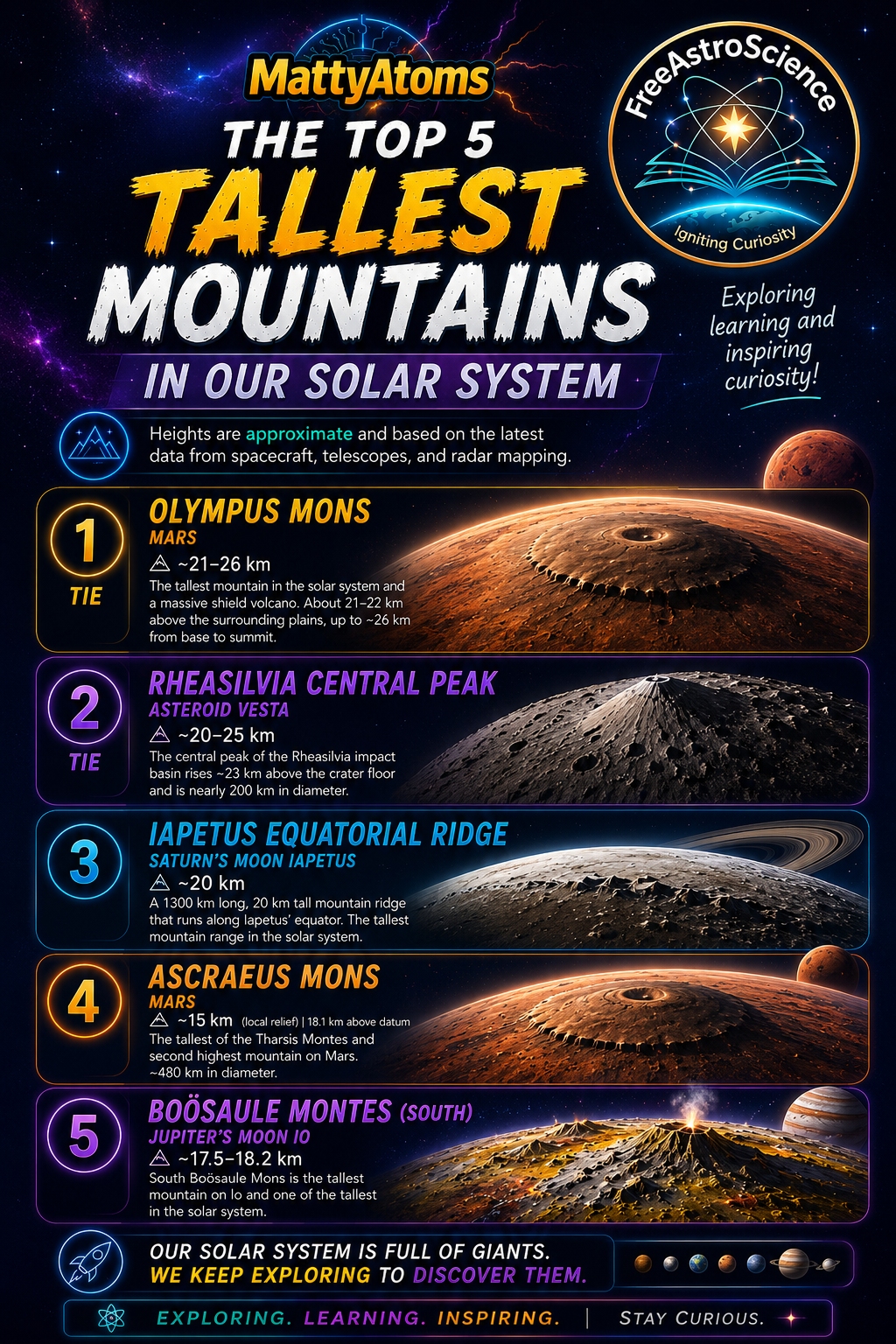
Olympus Mons sits on Mars and ties for first place on our list. We’re looking at a shield volcano that rises about 21 to 22 km above the surrounding plains, with measurements stretching up to ~26 km from base to summit.
Imagine driving from Rome to Naples. That’s roughly the diameter of this beast at its base. Olympus Mons covers an area about the size of Italy itself. Its slopes are so gentle that if you stood on them, you wouldn’t even realize you were climbing a mountain. You’d just see a horizon that never quite makes sense.
Mars built this giant because it has no plate tectonics. A single hotspot kept feeding lava upward for hundreds of millions of years. The result? A volcanic record-breaker.
How Did a Tiny Asteroid Build a Mountain Bigger Than Earth’s? {#rheasilvia}
Here’s the twist. Our second peak doesn’t sit on a planet at all.
The Rheasilvia central peak rises from the floor of a massive impact basin on asteroid Vesta. It climbs roughly 20 to 25 km (about 23 km on average) above the crater floor and stretches nearly 200 km in diameter.
Think about that. A mountain almost as tall as Olympus Mons, sitting on a rock only 525 km wide. NASA’s Dawn spacecraft revealed this giant in 2011. The peak formed when something big slammed into Vesta, blasting out a crater so deep that the surface rebounded violently in the middle. That bounce-back? It’s the mountain.
What’s That Strange Wall Wrapping Around Iapetus? {#iapetus}
If Olympus Mons is a dome and Rheasilvia is a spike, the Iapetus equatorial ridge is something stranger entirely. It’s a wall.
This ridge runs along the equator of Saturn’s moon Iapetus, stretching for an astonishing 1,300 km while reaching heights of about 20 km. We’re calling it the tallest mountain range in the solar system, and it’s also one of the weirdest.
Scientists still argue about how it formed. Some think Iapetus once had a tiny ring that collapsed onto its surface. Others suspect the moon spun fast in its early days, squeezing material toward its waist. Either way, the ridge gives Iapetus the look of a walnut, and the Cassini spacecraft’s 2004 images turned it into one of astronomy’s biggest puzzles.
Why Is Mars on This List Twice? {#ascraeus}
Mars doesn’t quit. Ascraeus Mons, the tallest of the Tharsis Montes, claims fourth place with ~15 km of local relief and a reading of 18.1 km above the Martian datum (the planet’s reference “sea level”). It spreads about 480 km wide.
Ascraeus is the second-highest mountain on Mars, sitting in a row of three volcanic giants on the Tharsis bulge. Together with Olympus Mons, these volcanoes tell us Mars was once geologically wild. Lava flows, eruptions, and pressure built features so big that they actually changed the planet’s tilt.
We find that thrilling. A planet whose mountains are heavy enough to wobble its spin? That’s poetry written in basalt.
How Does Volcanic Io Push Up Such Massive Peaks? {#boosaule}
Round out the top five with Boösaule Montes (South) on Jupiter’s moon Io. Its peak reaches ~17.5 to 18.2 km, making it the tallest mountain on Io and one of the tallest known anywhere.
Io is the most volcanic body in our solar system. Jupiter’s gravity squeezes the moon constantly, heating its insides until magma pushes through the crust in explosive bursts. Yet Io’s mountains aren’t volcanoes. They’re tilted blocks of crust shoved upward by tectonic-like stress. South Boösaule rises in dramatic cliffs, with one face dropping more than 15 km, possibly the tallest cliff in the solar system.
Standing at its base would feel like staring at a frozen tsunami of stone.
How Do These Cosmic Giants Stack Up Side by Side? {#comparison}
We built a quick comparison so you can scan the giants at a glance.
| Rank | Mountain | Location | Height | Type |
|---|---|---|---|---|
| 1 (tie) | Olympus Mons | Mars | ~21–26 km | Shield volcano |
| 2 (tie) | Rheasilvia Peak | Asteroid Vesta | ~20–25 km | Central impact peak |
| 3 | Iapetus Equatorial Ridge | Saturn’s moon Iapetus | ~20 km | Mountain ridge |
| 4 | Ascraeus Mons | Mars | ~15 km (18.1 km above datum) | Shield volcano |
| 5 | Boösaule Montes (South) | Jupiter’s moon Io | ~17.5–18.2 km | Tilted crustal block |
A Quick Math Note: Why Low Gravity Lets Mountains Grow Taller
Want a simple equation? The maximum theoretical height of a mountain scales roughly with the inverse of surface gravity:
hmax ∝ σcrust / (ρ × g)
Where hmax is the tallest possible mountain, σcrust is the strength of the rock, ρ is its density, and g is gravity. Mars has only 38% of Earth’s gravity. Vesta has less than 3%. That’s why these worlds grow giants while Earth keeps things modest.
Final Thoughts From Your Friends at FreeAstroScience
Our solar system is full of giants, and we keep exploring to find them. From Olympus Mons crowning Mars to a single peak on a distant asteroid that rivals it, the universe loves surprises. Each of these mountains tells a story: about gravity, about violent collisions, about lava and ice and time itself.
We at FreeAstroScience.com explain hard science in plain words because we believe in one thing above all: never let your mind go to sleep. The sleep of reason breeds monsters, as Goya warned us long ago. So keep your curiosity sharp. Keep asking questions. And come back to FreeAstroScience.com whenever you want to climb another peak of knowledge with us.
Stay curious. The cosmos has plenty more to show you.
Frequently Asked Questions {#faq}
**1. What is the tallest mountain in the solar system?** Olympus Mons on Mars holds the crown, rising about 21–26 km from base to summit. It’s a shield volcano so wide it would cover most of Italy. **2. Why isn’t Mount Everest on this list?** Everest stands at 8.85 km, roughly one-third the height of Olympus Mons. Earth’s plate tectonics and stronger gravity prevent mountains from growing much taller here. **3. How can a small asteroid like Vesta have a mountain almost as tall as Olympus Mons?** Vesta’s Rheasilvia peak formed from a giant impact. The collision blasted out a deep crater, and the floor rebounded upward, leaving a 20–25 km tall central peak. Low gravity helps it stay standing. **4. Are there mountains taller than these we just haven’t discovered?** Possibly. Many moons and dwarf planets remain poorly mapped. Future missions to places like Ceres, Pluto, and the moons of Uranus and Neptune may reveal new giants. **5. Could humans ever climb Olympus Mons?** In theory, yes. The slopes average just 5 degrees, gentler than most ski runs. The bigger challenges would be the thin atmosphere, radiation, and the sheer size, with a base-to-summit trek of hundreds of kilometers.