Astronomers may have detected a hidden supermassive black hole within the famous Antennae galaxies, a pair of colliding spiral systems designated as NGC 4038/4039 and renowned for spectacular bursts of star formation. Located approximately 70 million light-years from Earth, this system represents the closest and one of the youngest examples of a merger between two gas-rich galaxies. The gravitational interaction has pulled away elongated tidal tails of gas, dust, and stars that resemble insect antennae. This violent encounter has triggered one of the most intense starburst episodes observed in the local universe, making the system a premier laboratory for studying galactic growth.
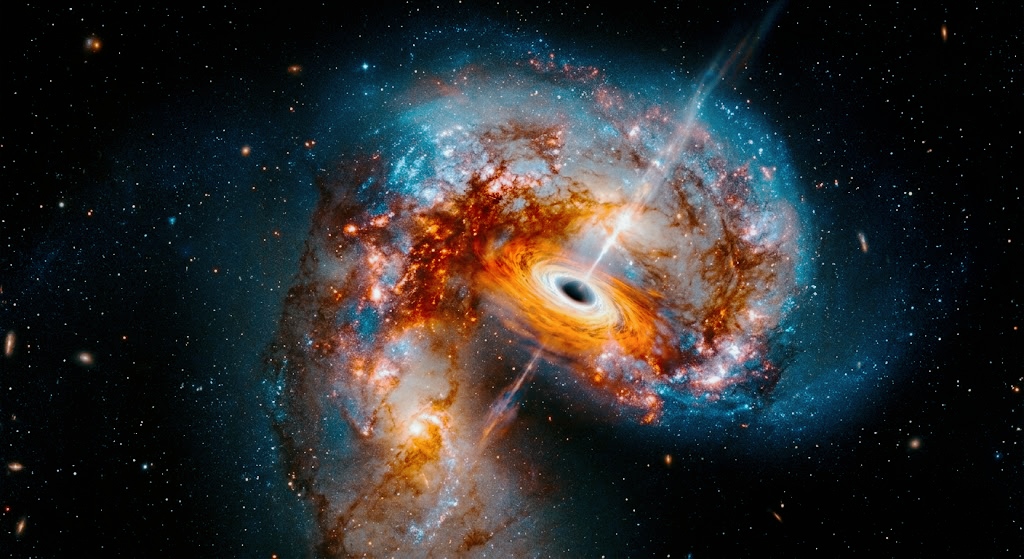
Hidden supermassive black hole suspected in the colliding Antennae galaxies
While galactic mergers are well known for stimulating rapid star formation, the resulting gravitational disruption can also channel vast quantities of gas toward the galactic centers. This process often fuels resident supermassive black holes, transforming them into luminous active galactic nuclei. Until recently, optical and spectroscopic data from the Antennae system indicated a spectrum dominated exclusively by starburst activity, with no clear evidence of active black hole consumption. However, past variations in luminosity detected near the core of one galaxy prompted researchers to investigate whether an active galactic nucleus might be obscured within the region.
Time variability observations using the Atacama large millimeter array
To investigate this phenomenon, a team of astronomers led by Shinya Komugi from Kogakuin University in Japan utilized the Atacama large millimeter array to observe the Antennae galaxies at a frequency of 100 gigahertz. The researchers monitored the system 52 times over a period of approximately two and a half months to specifically track flux variations over time. Rapid variability in millimeter emissions provides crucial constraints regarding the physical dimensions of an emitting source. Because physical information cannot propagate faster than the speed of light, any observed change in brightness implies that the source must be smaller than the distance light travels during that specific timeframe.
The observational data focused on two compact sources located near the nucleus of NGC 4039, labeled by the team as S3 and S4. The S3 source appears slightly extended and exhibits a luminosity that exceeds the typical output of standard supernova remnants or X-ray binaries. Despite its brightness, S3 displays no detectable time variability during the observation period. Consequently, the research team suggests the emission likely originates from free-free radiation within a young, massive star cluster, although the possibility of an active galactic nucleus origin cannot be entirely ruled out.
In contrast, the S4 source exhibits highly volatile behavior, demonstrating significant flux variations over a timescale of merely 13 days. This rapid rate of variability restricts the maximum physical diameter of the emitting region to less than 13 light-days, which equates to approximately 0.01 parsecs. Such an exceptionally compact area rules out the possibility of a standard star-forming region, a supernova remnant, or a typical interstellar dust cloud. The researchers note that this strict spatial boundary corresponds closely to a Schwarzschild radius appropriate for a supermassive black hole containing the mass of 10 million suns.
Non-thermal emission properties and extreme brightness temperatures
The physical characteristics of S4 are further highlighted by its brightness temperature, which exceeds one million Kelvin at the observed frequency. If the millimeter emission were generated by standard thermal processes, such as those driven by intense stellar replication, the temperature would not reach such extreme levels. Instead, this elevated brightness temperature indicates a non-thermal emission mechanism. This signature is characteristically associated with high-energy relativistic processes occurring in the immediate vicinity of an active supermassive black hole accretion disk.
A standard active galactic nucleus of this magnitude would typically emit high-energy, hard X-rays that are easily detectable by space telescopes. However, neither S3 nor S4 was detected in hard X-ray bands during previous observations of the system. The researchers propose that this absence of high-energy radiation is only possible if the object is a Compton-thick active galactic nucleus. In such a scenario, the central engine is deeply embedded within a dense shroud of surrounding gas and dust that effectively absorbs even the most penetrating X-ray wavelengths.
The authors state in their published paper that these observations likely indicate the presence of an obscured active galactic nucleus during the relatively early phases of a galactic interaction. This finding challenges the traditional view of the Antennae galaxies as a pure starburst system. It suggests that black hole growth and galactic feedback mechanisms can initiate much earlier in the merging process than previously predicted by traditional evolutionary models.
Diagnostic requirements for definitive active galactic nucleus confirmation
The research team emphasizes that definitive confirmation of an obscured black hole will require additional observations across a broader frequency spectrum to fully understand the emission mechanisms of both sources. Future infrared spectroscopic investigations utilizing the James Webb space telescope could peer through the dense dust lanes to isolate the signatures of ionized gas surrounding the core. Simultaneously, high-energy X-ray observations using instruments like the nuclear spectroscopic telescope array could help detect any faint, hard X-ray leakage that bypasses the dense obscuration.
For the present time, this study provides an updated and more nuanced framework for interpreting the evolution of the Antennae system. Rather than representing an environment driven solely by stellar birth, the merging galaxies appear to host a deeply shrouded, actively feeding supermassive black hole. This active nucleus operates efficiently despite the early, unevolved stage of the overarching galactic collision.
The detection underscores the utility of high-frequency millimeter variability monitoring as a tool for discovering hidden active galactic nuclei in the local universe. As computational models and observational arrays continue to advance, astronomers expect to locate similar obscured objects in other interacting systems. This ongoing research will ultimately refine scientific understanding regarding the synchronized growth of galaxies and their central black holes.
The study is published on arXiv.