When Satan Crashed Into Earth: The Wild New Theory That Reads Dante’s Inferno as a Cosmic Impact
What if the most haunting poem ever written in Italian wasn’t only describing a journey through the afterlife, but the wound left on Earth by a falling asteroid? Welcome aboard, dear reader. We’re glad you’ve stopped by FreeAstroScience.com today, because this story is the kind that makes you stop scrolling and look up at the sky. A literature professor just walked into one of Europe’s biggest geosciences conferences and proposed something audacious: Dante Alighieri, seven centuries ago, may have intuited the physics of a planet-shattering impact. Stay with us until the last line. We promise this trip through poetry, planetary science, and medieval imagination will change how you read Canto XXXIV forever.
A Medieval Poet Walks Into a Geophysics Conference
Picture the scene. Vienna, May 2026. The European Geosciences Union General Assembly buzzes with researchers swapping data on earthquakes, volcanoes, and planetary impacts. Among hundreds of posters, one stops people in their tracks. It isn’t about a fault line or a moon rock. It’s about Dante.
The proposal, presented (but not yet published in a peer-reviewed journal), argues something bold. Dante’s *Inferno* might describe not just a soul’s descent through the afterlife, but a physical reshaping of our planet. In this reading, the poet may have been one of the very first humans on record to think through what happens when a massive object slams into Earth at high speed.
Who Is Timothy Burbery, and What Is Geomythology?
The mind behind this hypothesis is Timothy Burbery, a literature professor at Marshall University in the United States and a specialist in geomythology. We love that word. Geomythology hunts for traces of real geological events hidden inside ancient myths and legends. Think tsunamis tucked into flood stories, or volcanic eruptions disguised as battles between angry gods.
Burbery’s poster, titled *Meteoritics and Dante’s Inferno: Examining Satan’s Fall as an Impact Event*, builds on earlier geological readings of the *Divine Comedy*. Scholars already knew Dante peppered his Hell with real-world phenomena: earthquakes, landslides, sulfur, rivers of fire. The fresh step is asking whether the very *shape* of Hell records a cosmic catastrophe.
Is Satan Really an Asteroid in This Reading?
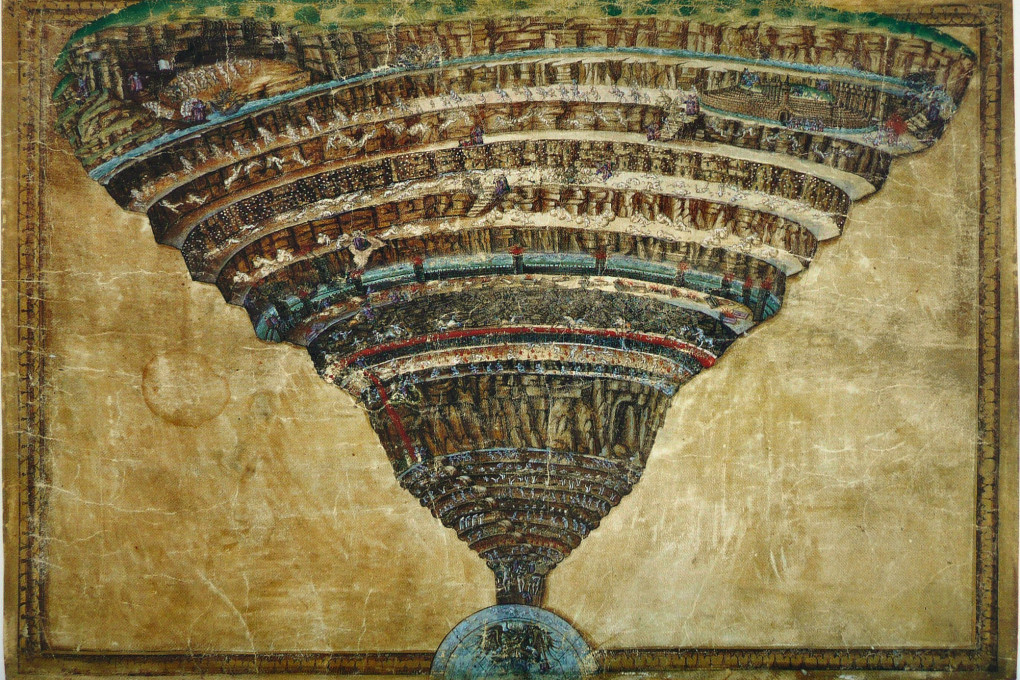
Here’s where it gets thrilling. In Burbery’s interpretation, Dante’s Satan isn’t only the fallen spirit cast out by God. He’s also a giant meteorite that smashed into the Earth’s southern hemisphere and sank all the way down to the planet’s core. The brutal collision dug out a colossal terraced, circular crater, and that crater *is* Hell.
To convey the scale, Burbery compares the event to Chicxulub, the asteroid that wiped out the non-avian dinosaurs about 66 million years ago. He also points to the Hoba meteorite in Namibia, the largest space rock ever found on Earth, weighing roughly 64 tonnes. An object on that scale, moving fast enough, could in principle carve the kind of wound Dante describes.
Why Do the Nine Circles Look Like Impact Craters?
Now think about how Dante draws Hell. Nine concentric, descending circles. Each tighter and deeper than the last. We’ve all seen Botticelli’s famous funnel-shaped map painted between 1480 and 1495.
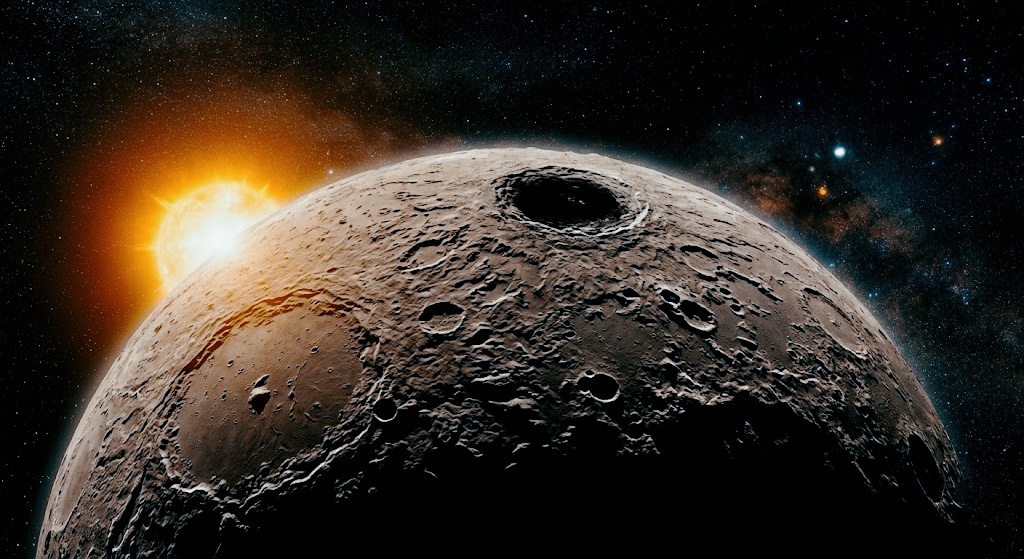
Burbery argues those nine circles aren’t merely symbols for sin. They look strikingly like the ring structures of impact craters scattered across the Solar System: on the Moon, on Venus, and beyond. Big impacts often leave behind multi-ring basins, those bullseye scars planetary scientists spot on cratered worlds. Coincidence? Maybe. Or maybe Dante, working purely from imagination and old myth, sketched something a planetary geologist would recognise instantly.
How Does Mount Purgatory Complete the Picture?
This is the part we find most poetic. In Dante’s cosmology, Mount Purgatory rises in the middle of the southern ocean, directly opposite Jerusalem. In Burbery’s geophysical reading, that mountain is the material thrown up by the impact, piled high on the far side of the planet.
A massive impact really can deform Earth’s crust on a global scale. Planetary scientists have long debated whether shock waves, focused at the antipode of huge impacts, can lift terrain or fracture the surface. Burbery is essentially saying that Dante, intuitively, drew exactly that geometry seven centuries before anyone had a name for it.
Does the Science Actually Hold Up?
We have to be honest with you. This is where we slow down. The hypothesis was presented as a conference poster at EGU 2026 (abstract EGU26-14300), not yet published in a peer-reviewed journal. That distinction matters. Conference posters are where ideas go to be debated, challenged, and refined. They’re not the final word.
The modern study of meteors only got going firmly in the 19th century. Before scientific analysis of the 1833 Leonid meteor shower (which returns roughly every 33 years from the constellation Leo), meteors were thought of as atmospheric phenomena, not rocks falling from space. Dante, writing in the early 1300s, had no telescopes, no impact craters mapped on the Moon, no concept of asteroids. So whether he had some intuitive grasp of impact physics, or simply described real geological phenomena without realising it, remains wide open.
The *Divine Comedy* is a bit like the Pyramids. Every so often, someone shows up with a brand-new reading, some more credible than others. We treat this one as a fascinating thought experiment rather than settled fact.
What Does This Mean for How We Read Dante?
Even if the asteroid hypothesis never makes it into a peer-reviewed journal, Burbery has done something valuable. He’s reminded us that great literature can hold scientific echoes its author never planned. Whether Dante was channelling memories of real earthquakes, drawing on classical myths like the Greek Titanomachy, or sketching something deeply intuitive about planetary violence, his Hell stays a “mythogenic landscape”, a place where storytelling and earth science overlap.
For us at FreeAstroScience, that’s the real treasure here. The *Inferno* becomes a doorway for geo-education, a way to teach planetary impacts through a poem most students already know. Imagine a literature class that ends with a discussion about Chicxulub, or a geology lecture that opens with Canto XXXIV. That’s beautiful.
Final Thoughts: Poetry, Physics, and Keeping Our Minds Awake
We started with a question, so let’s end with one. Did Dante know, somewhere in his poetic mind, that the Earth could be reshaped by a falling sky? Probably not the way a modern astrophysicist knows it. But his Hell, with its terraced rings, its central pit reaching the core, and its mountain rising on the antipode, sketches a geometry any planetary scientist would recognise. That coincidence, real or imagined, is worth a poster at a major geosciences meeting.
This article was written for you by FreeAstroScience.com, where we break down complex scientific principles into simple language because we believe knowledge belongs to everyone. We want you never to switch off your mind. Keep it alert, curious, sceptical, and playful, because the sleep of reason breeds monsters. Come back to FreeAstroScience.com to keep sharpening that mind of yours. We’ll be here, asteroid or not.
Frequently Asked Questions
1. Is this theory officially published or peer-reviewed?
No. The hypothesis was presented as a poster at the European Geosciences Union General Assembly held in Vienna, 3–8 May 2026 (abstract EGU26-14300). It has not yet been published in a peer-reviewed scientific journal.
2. Who is Timothy Burbery?
He’s a literature professor at Marshall University (USA) and a specialist in geomythology, the field that hunts for traces of real geological events inside ancient myths and legends.
3. Why compare Satan to the Chicxulub asteroid?
Because Burbery wants to convey the catastrophic scale of the imagined impact. Chicxulub, which struck Earth around 66 million years ago and wiped out the non-avian dinosaurs, gives us a real benchmark for the kind of energy a planet-scarring impact requires.
4. What do the nine circles of Hell have to do with craters?
Burbery argues that Dante’s nine concentric, terraced circles resemble the ring structures of large impact craters seen on planets and moons across the Solar System, such as on the Moon and Venus.
5. And Mount Purgatory? Where does it fit?
In Burbery’s reading, Mount Purgatory is the ejected material from the impact, piled up on the opposite side of the planet from where Satan crashed in the southern hemisphere.