The Ghost Spiral That Throws Gas Like a Boomerang
Have you ever wondered what happens to a galaxy when it starts losing its very breath—the gas that fuels its stars? What if, against all odds, some of that lost gas comes circling back, like a cosmic boomerang? Welcome to the story of NGC 4921, a galaxy that’s rewriting the rules of how galaxies live, change, and sometimes surprise us.
We’re thrilled to have you here at FreeAstroScience.com, where we break down the universe’s most complex mysteries into stories you can actually enjoy. Whether you’re a seasoned stargazer or just someone who likes to look up and wonder, you’re in the right place.
Stick with us to the end. You’ll discover not just the facts about NGC 4921, but also why its strange behavior matters for all galaxies—including our own. Let’s keep our minds awake, because as we say here, the sleep of reason breeds monsters.
Table of Contents
- What Kind of Galaxy Is NGC 4921?
- Key Facts Table
- Who First Spotted This Galaxy?
- What Makes NGC 4921 Look So Different?
- Why Is NGC 4921 Called an Anaemic Galaxy?
- How Does the Coma Cluster Shape This Galaxy?
- Ram Pressure Stripping: The Formula
- What Do Radio Observations Tell Us?
- Composite Image of NGC 4921
- What Is the Boomerang Effect — and Why Does It Matter?
- What Does This Discovery Change About Galaxy Science?
- Final Thoughts
- References
What Kind of Galaxy Is NGC 4921?
NGC 4921 isn’t your everyday spiral. It’s a barred spiral galaxy—catalogued as SBab—sitting about 320 million light-years away in the constellation Coma Berenices. You might also find it listed as UGC 08134 or PGC 044899. Its coordinates are RA 13h 01m 26.12s, Dec +27° 53′ 09.6″ (J2000.0), and it’s moving away from us with a redshift of z = 0.018249. That’s a cosmic speed limit of 7,560 km/s!
What makes NGC 4921 stand out isn’t just its stats. It’s the way it looks—almost ghostly, with a strong central bar, a ring of dust packed with hot blue stars, and spiral arms so faint they’re barely there. It’s nearly face-on, giving us a perfect view of its structure. But as we’ll see, this galaxy is more than just a pretty face.
Key Facts Table
| Property | Value |
|---|---|
| Galaxy Name | NGC 4921 (UGC 08134, PGC 044899) |
| Type | Barred Spiral (SBab) |
| Constellation | Coma Berenices |
| Distance | ~320 million light-years (98 Mpc) |
| Coordinates | RA 13h 01m 26.12s, Dec +27° 53′ 09.6″ (J2000.0) |
| Redshift (z) | 0.018249 |
| Recessional Velocity | 7,560 km/s |
| Discovery | William Herschel, April 11, 1785 |
| Cluster | Coma Cluster (Abell 1656) |
| Cluster Mass | ~1.88×10¹⁵ solar masses |
| HI Deficiency | ~1.0 (lost ~90% of expected neutral hydrogen) |
| Central Features | Strong bar, dust ring with hot blue stars |
| Outer Disk | Smooth, faint spiral arms |
| Ram Pressure Stripping | Active; HI disk 13 kpc NW vs 24 kpc SE |
| Boomerang Effect | Molecular gas stripped, then falls back (first observed here) |
Who First Spotted This Galaxy?
Let’s rewind to April 11, 1785. William Herschel, the legendary astronomer who’d already discovered Uranus, was scanning the sky with his homemade telescopes. That night, he spotted a faint patch of light—NGC 4921. Herschel, with help from his sister Caroline, catalogued over 2,400 nebulae and clusters. Many of these, including NGC 4921, would later be organized into the New General Catalogue (NGC) by John Dreyer in 1888.
Herschel’s work didn’t just fill up star charts. It changed how we see the universe. He was among the first to suggest that these “nebulae” were actually other galaxies—“island universes” far beyond our own. NGC 4921 is a living piece of that history.
What Makes NGC 4921 Look So Different?
When you look at NGC 4921, you notice something odd. The center glows with a strong bar, wrapped in a ring of dust that’s home to clusters of hot, blue stars. But the spiral arms? They’re so faint and smooth, they almost fade into the background. It’s like a ghost of a spiral galaxy.
Why does it look this way? Part of the answer is its orientation. We see it almost face-on, so we get a clear view of its structure. But there’s more. In 1976, astronomer Sidney van den Bergh coined the term “anaemic galaxy” for spirals like this—galaxies that have lost much of their gas and, with it, their ability to make new stars. NGC 4921 is the poster child for this rare class.
Why Is NGC 4921 Called an Anaemic Galaxy?
NGC 4921 isn’t just a little low on gas—it’s missing about 90% of the neutral hydrogen (HI) we’d expect for a galaxy its size. Astronomers call this an HI deficiency of 1.0. That’s a big deal. Without gas, star formation slows to a crawl. The galaxy’s surface brightness drops, and the spiral arms lose their punch.
This is what makes NGC 4921 “anaemic.” It’s stuck between being a normal spiral and a fully quenched lenticular (S0) galaxy. It’s not dead, but it’s not thriving either. It’s a galaxy in transition, caught in the act of changing from one type to another.
How Does the Coma Cluster Shape This Galaxy?
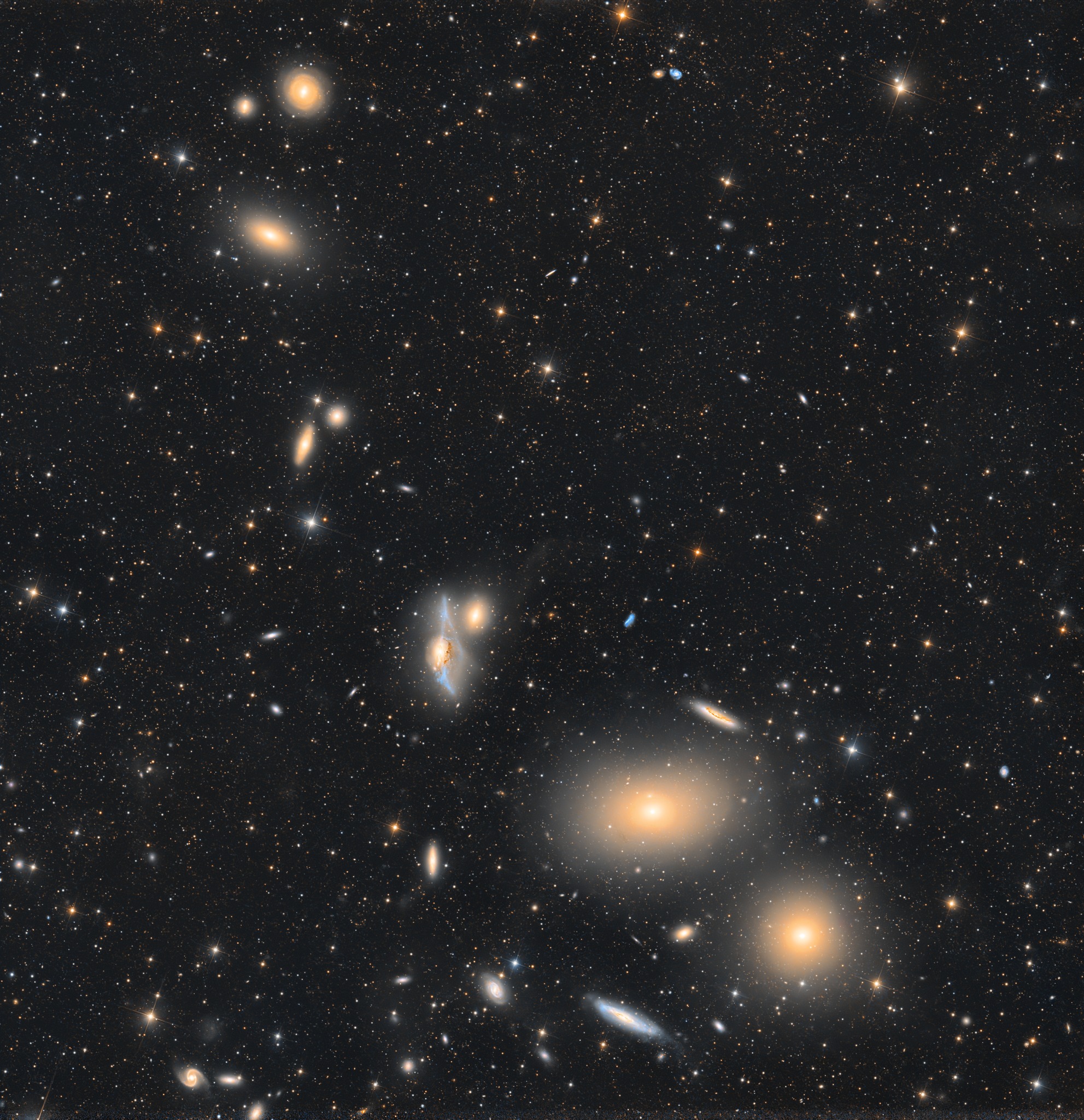
NGC 4921 lives in a tough neighborhood—the Coma Cluster, also known as Abell 1656. This cluster is a heavyweight, with over 1,000 galaxies and a mass of about 1.88×10^15 times that of our Sun. NGC 4921 sits about 700,000 light-years from the cluster’s center, right where the action is.
The cluster isn’t just crowded. It’s filled with hot, X-ray-emitting gas called the intracluster medium (ICM), with temperatures soaring to 10^7–10^8 Kelvin. As NGC 4921 speeds through this soup at 7,560 km/s, it faces a headwind that can strip away its gas. This process is called ram pressure stripping, and it’s the main reason NGC 4921 is so anaemic.
Ram Pressure Stripping: The Formula
Ram Pressure Formula:
Pram = ρICM × v2
Pram: Ram pressure
ρICM: Density of the intracluster medium
v: Galaxy’s velocity through the cluster
This formula, first written down by Gunn & Gott in 1972, tells us how the ICM can push gas out of a galaxy. The faster the galaxy moves, or the denser the ICM, the stronger the stripping.
What Do Radio Observations Tell Us?
Radio telescopes like the VLA have mapped NGC 4921’s hydrogen. The results are striking. The HI disk is lopsided—just 13 kpc wide on the northwest (the leading edge), but 24 kpc on the southeast (the trailing edge). That’s a classic sign of ram pressure stripping at work.
The velocity field is also disturbed. The southeast spiral arm, in particular, is less extended than the optical disk. It’s as if the galaxy’s gas is being peeled away, leaving behind only the densest, most stubborn clouds.
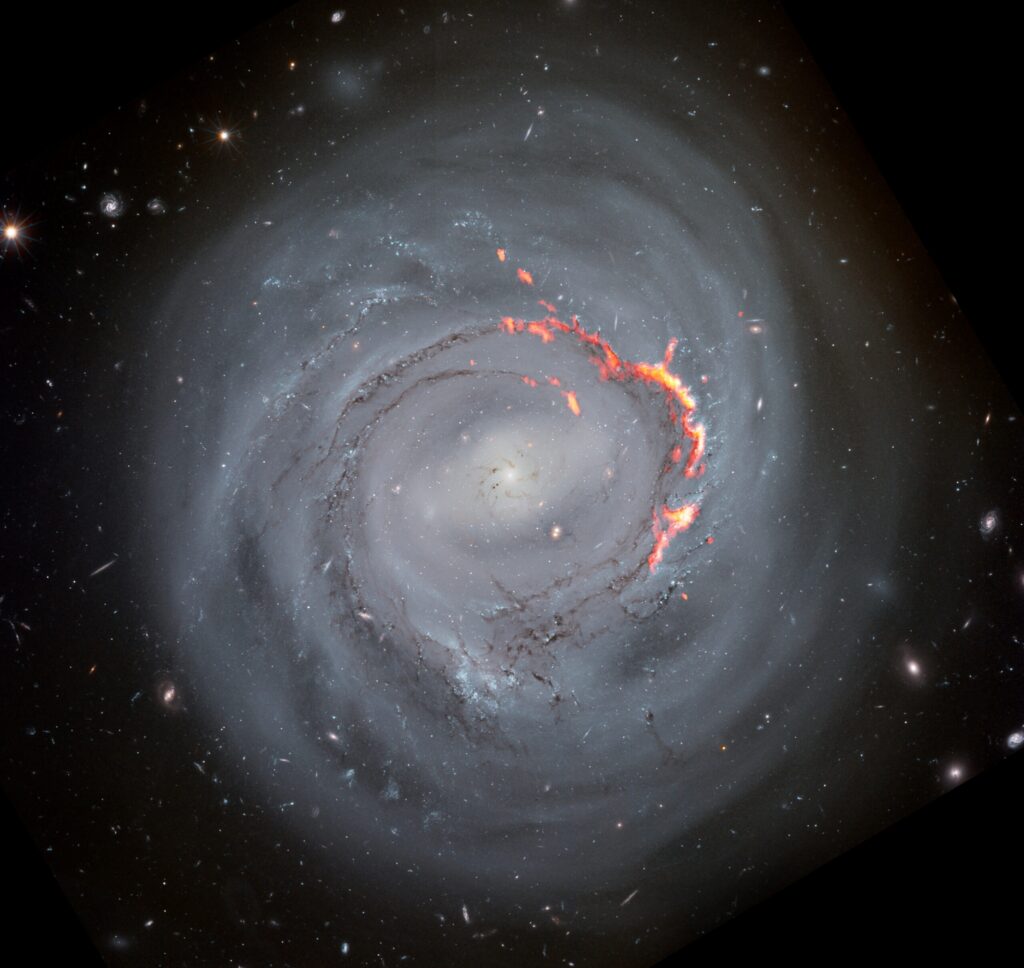
Composite Image of NGC 4921

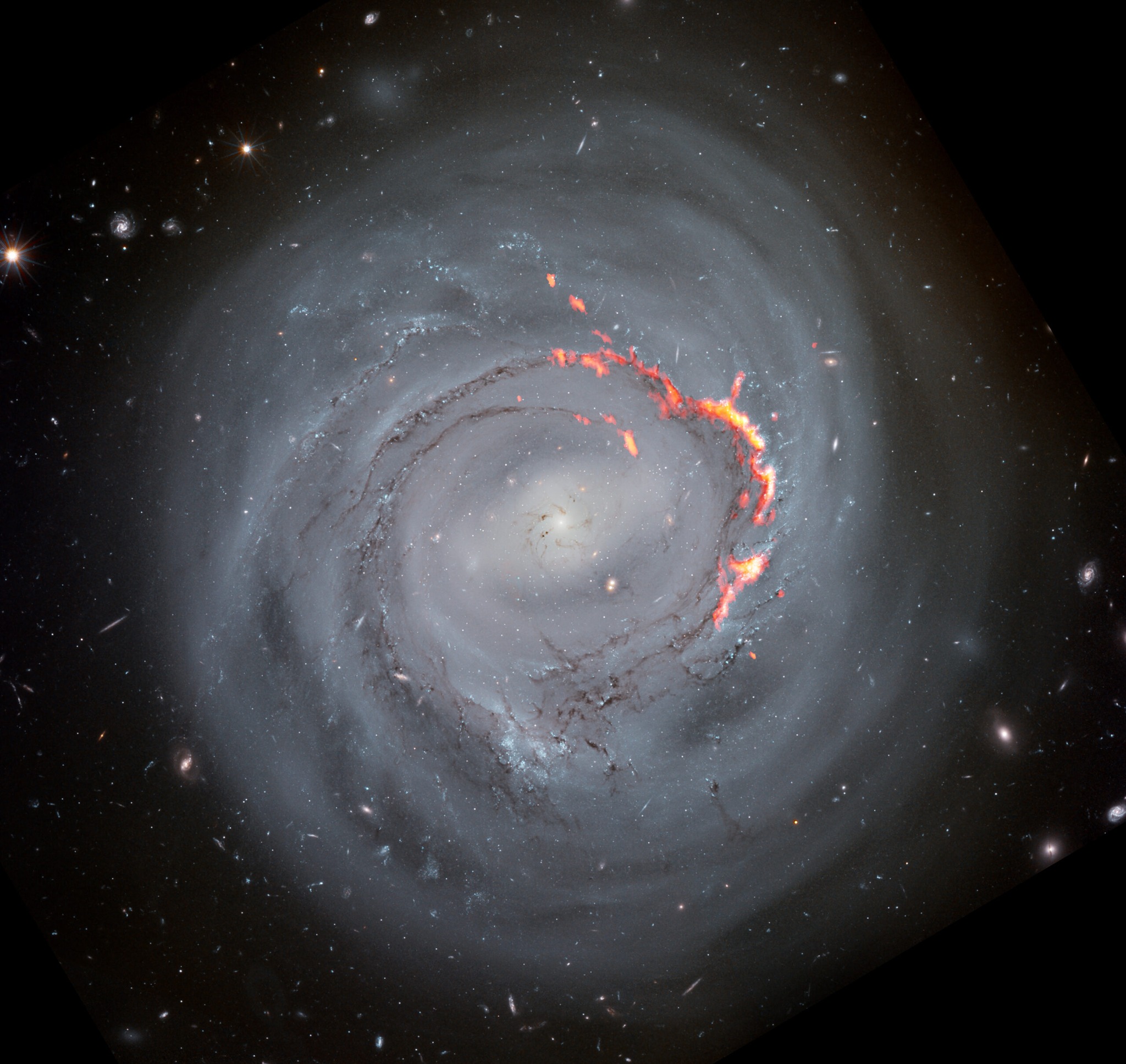
Figure: Composite image of NGC 4921. Optical data from the Hubble Space Telescope (blue: B-band, green: B+I-band, red: I-band) combined with millimetre/submillimeter data from ALMA (red and orange overlays).
Credit: ALMA (ESO/NAOJ/NRAO)/S. Dagnello (NRAO), NASA/ESA/Hubble/K. Cook (LLNL), L. Shatz
What Is the Boomerang Effect — and Why Does It Matter?
Here’s where NGC 4921 really breaks the mold. Using ALMA’s sharp eyes, astronomers found something never seen before: streams of molecular gas that were stripped from the galaxy, but then circled back and fell in again. They call this the “boomerang effect.”
ALMA’s CO(2-1) observations, at a crisp 0.4 arcseconds, revealed three filaments of molecular gas stretching up to 2.1 kpc. Some clouds, found beyond the main gas ring, are blueshifted by up to 50 km/s—meaning they’re falling back toward the galaxy, not escaping forever.
This isn’t just a curiosity. It’s the first time anyone has caught molecular gas re-accreting after being stripped by ram pressure. The discovery was made by William Cramer, Jeffrey Kenney, and their team, published in 2021.
Let’s hear from the researchers themselves:
“Much of the previous work on ram pressure stripped galaxies is focused on the material that gets stripped out of galaxies. In this new work we see some gas that rather than being thrown out of the galaxy never to return is instead moving like a boomerang, being ejected out but then circling around and falling back to its source.”
— William Cramer (Arizona State University, lead author)“By combining Hubble and ALMA data at very high resolution, we are able to prove that this process is happening.”
— William Cramer“The boomerang effect is significant for several reasons. It provides hard evidence about the evolution of galaxies; it confirms a long-held theory about galaxy development; and it aids astronomers trying to predict the birthrate of new stars.”
— William Cramer“We’ve seen in simulations that not all of the gas being pushed by ram pressure stripping escapes the galaxy because it has to reach escape velocity in order to actually escape and not fall back. The re-accretion that we’re seeing, we believe is from clouds of gas that were pushed out of the galaxy by ram pressure stripping, and didn’t achieve escape velocity, so they’re falling back.”
— Jeffrey Kenney (Yale University, co-author)“If you don’t know that gas can fall back onto the galaxy and continue to recycle and form new stars, you’re going to overpredict the quenching of the stars. Having proof of this process means more accurate timelines for the lifecycle of galaxies.”
— Jeffrey Kenney
This is more than just a neat trick. It means that galaxies like NGC 4921 might not lose all their star-making fuel as quickly as we thought. Some of that gas comes back, giving the galaxy a second wind.
What Does This Discovery Change About Galaxy Science?
For decades, simulations hinted that not all stripped gas escapes. Some falls back, but until now, we’d never seen it happen. The boomerang effect in NGC 4921 confirms these predictions and forces us to rethink how quickly galaxies stop making stars.
If up to 50% of stripped gas can return, as some models suggest, then the process of “quenching” star formation is more complicated than a simple one-way trip. Magnetic fields seem to help hold dense gas together, letting it resist the stripping and even return home.
NGC 4921 is now a cosmic laboratory—a place where we can watch galaxy evolution in action. It shows us that even in the harshest environments, galaxies can surprise us, holding onto life a little longer than we’d expect.
Final Thoughts
NGC 4921 isn’t just another faint spiral lost in the crowd. It’s a galaxy that’s teaching us how the universe works, one surprise at a time. From its discovery by William Herschel in 1785 to the first-ever sighting of the boomerang effect, this galaxy has been at the center of some of astronomy’s biggest questions.
We’ve seen how the Coma Cluster shapes its fate, how ram pressure stripping peels away its gas, and how, against the odds, some of that gas comes back. It’s a reminder that the universe is full of second chances—and that science is always ready to rewrite the rules.
Here at FreeAstroScience.com, we believe in keeping our minds active and our curiosity alive. As Goya warned, “the sleep of reason breeds monsters.” So let’s keep asking questions, keep learning, and never stop wondering what’s out there.
Come back soon for more stories that make the universe feel a little closer.
References
- Cramer et al. 2021, ApJ, 921(1), 22 (arXiv)
- ALMA Press Release (ALMA Observatory)
- Yale News: Catching a Cosmic Boomerang in Action
- NRAO: Gas Re-accretion Seen in Dying Galaxies
- NASA/Hubble: Hubble Sees Anemic Spiral NGC 4921
- ESA: Exceptionally Deep View of Strange Galaxy
- Kenney et al. 2015, arXiv:1506.04041
Written for you by FreeAstroScience.co mind never sleeps.