NASA’s Lithium MPD Thruster: The Quiet Breakthrough That Could Send Humans to Mars
What if the biggest space news of 2026 happened inside a vacuum chamber in Pasadena, and almost nobody noticed?
Welcome, dear reader. We’re glad you’re here. On February 24, 2026, a tungsten electrode glowed white-hot at more than 2,800 °C while a red plume of lithium plasma shot across an 8-meter chamber at NASA’s Jet Propulsion Laboratory . It lasted only moments. Yet what happened inside that chamber might matter more for humanity’s future on Mars than any rocket launch you’ve seen on TV this year. Stay with us to the end—we promise the physics is simpler than it sounds, and the implications are bigger than you think.
📋 Table of Contents
- Why Are Chemical Rockets Holding Us Back?
- What Exactly Happened at JPL on February 24, 2026?
- How Does a Magnetoplasmadynamic Thruster Work?
- Why Lithium Instead of Xenon?
- What Do the Numbers Tell Us?
- What Still Stands Between This Test and Mars?
- Why Should You Care About This Right Now?
Why Are Chemical Rockets Holding Us Back?
Going to Mars isn’t just about picking a destination. It’s about how you get there.
With today’s chemical rockets, a Mars trip takes roughly seven months under the best conditions . The propellant bill is staggering, and the payload shrinks dramatically. When you add people—food, water, life support, return fuel, radiation shielding—the math starts breaking down fast.
We’ve been stuck inside this problem for decades. Chemistry hits a wall. You can burn fuel faster, or you can burn it more efficiently, but you can’t do both without cheating physics. So engineers cheat physics a different way: they stop burning fuel altogether.
What Exactly Happened at JPL on February 24, 2026?
Inside JPL’s Electric Propulsion Lab sits a 26-foot water-cooled vacuum chamber built specifically to test metal-vapor thrusters. That chamber is a one-of-a-kind national asset.
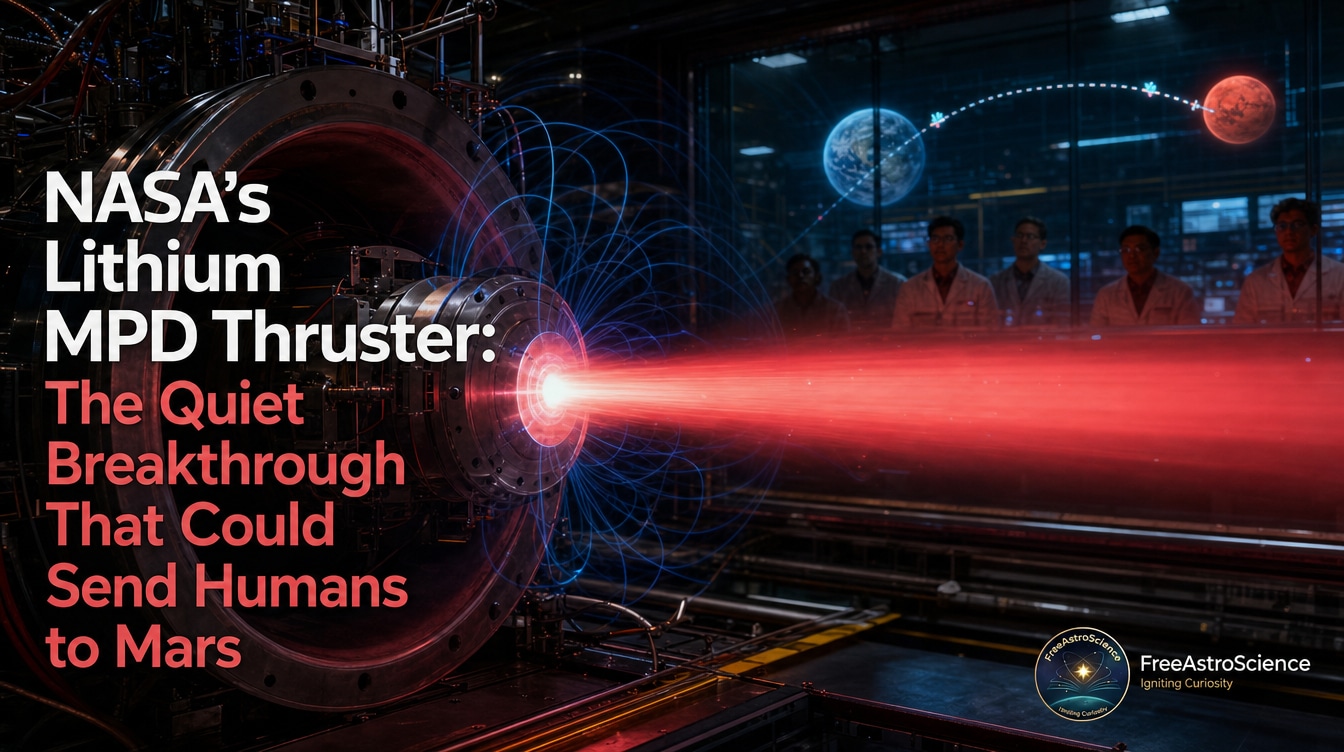
On that Tuesday in February, the team fired up an electromagnetic thruster running on lithium metal vapor. Five ignitions. Peak power: 120 kilowatts. The central tungsten electrode hit temperatures above 5,000 °F (2,800 °C), glowing incandescent white, while the outer nozzle-shaped electrode pushed out a vibrant red plume of accelerated plasma .
“At NASA, we work on many things at once, and we haven’t lost sight of Mars,” said NASA Administrator Jared Isaacman. “This marks the first time in the United States that an electric propulsion system has operated at power levels this high”.
James Polk, the senior research scientist who’s been chasing lithium MPD physics for decades—he worked on Dawn and Deep Space 1—watched through a small portal. After years of design and construction, the thing worked on the first real try.
How Does a Magnetoplasmadynamic Thruster Work?
Let’s keep this honest and simple.
A chemical rocket burns fuel. The hot gas squeezes through a nozzle, and Newton’s third law pushes the rocket forward. It’s loud, fast, and wasteful.
A traditional ion thruster (like the ones on NASA’s Psyche spacecraft) uses solar electricity to accelerate xenon ions. Gentle push, but continuous—so over months, the spacecraft builds up enormous speed. Psyche’s thrusters, for reference, can push it to 124,000 mph .
A magnetoplasmadynamic (MPD) thruster is a different beast. It runs high electric currents through a plasma. That current interacts with a magnetic field, and the resulting Lorentz force launches the plasma out the back at extreme velocity . No combustion. No solar panels squeezing out watts. Just electromagnetic muscle.
The catch? MPD thrusters are power-hungry. They’ve existed on paper since the 1960s, but we’ve never had enough spaceborne electricity to make them useful. Until now.
Why Lithium Instead of Xenon?
Here’s where the engineering gets clever. Lithium is light, easy to ionize, and stores compactly as a solid metal. Heat it, and it becomes vapor. Feed that vapor into the thruster, and you get a dense, efficient plasma.
Electric propulsion systems like this one can use up to 90% less propellant than chemical rockets . Less propellant means less launch mass, lower cost, and more room for the stuff that actually matters—crew, science instruments, return fuel, habitats.
What Do the Numbers Tell Us?
Numbers tell this story better than words. Take a look:
| System | Power | Propellant | Status |
|---|---|---|---|
| Psyche mission thrusters | ~4.5 kW | Xenon | Flying now |
| JPL lithium MPD prototype | 120 kW | Lithium vapor | Tested Feb 24, 2026 |
| Near-term MPD goal | 500 kW – 1 MW | Lithium vapor | In development |
| Crewed Mars mission need | 2 – 4 MW total | Lithium vapor | Requires nuclear power source |
Look at that second row. The new thruster is over 25 times more powerful than the strongest electric thrusters NASA currently flies
The physics behind MPD thrust can be summarized with a clean equation. The force produced scales with the square of the discharge current:
FMPD ∝ μ0 · I2 4π · ln(ra / rc)
Where I is the discharge current, μ₀ is the permeability of free space, and ra/rc is the ratio of anode to cathode radii. Double the current, quadruple the thrust.
That quadratic dependence is why power matters so much. It’s also why scaling from 120 kW to a megawatt isn’t a minor tweak—it’s a game-changer.
What Still Stands Between This Test and Mars?
We’re not there yet. We’d be lying if we said otherwise.
The JPL team wants to push each thruster to between 500 kilowatts and 1 megawatt. A crewed Mars mission would need a combined 2 to 4 megawatts, meaning several of these engines running in parallel—each one operating continuously for more than 23,000 hours That’s roughly 2.6 years of nonstop firing at temperatures hot enough to melt steel many times over.
The hardware challenge is brutal. Can the tungsten electrode survive? Can the magnetic coils keep their geometry? Can the lithium feed system run flawlessly for years?
And there’s the elephant in the room: power. Solar panels won’t cut it at Mars distance. You need a compact nuclear reactor flying alongside the thruster. That’s why this work sits inside NASA’s Space Nuclear Propulsion project, launched in 2020 out of Marshall Space Flight Center and focused on five critical technology pieces—electric propulsion being one of them. The collaboration stretches from JPL to Princeton University to NASA’s Glenn Research Center.
Three Honest Uncertainties Worth Naming
- Endurance: Short tests prove the physics. Long tests prove the engineering. We don’t yet have the second.
- Power source maturity: Space-rated nuclear reactors at this scale still need years of qualification work.
- Schedule: “A crewed Mars mission” has been a NASA horizon for 50+ years. This test moves the needle, but it doesn’t set a date.
Why Should You Care About This Right Now?
A human landing on Mars is no longer pure science fiction. It’s an open construction site with increasingly concrete deadlines . Every realistic Mars plan eventually collides with the propulsion problem—and this test is the first real crack in that wall in a long time.
Pair an MPD thruster with a nuclear power source, and you might genuinely shorten travel time, shrink launch mass, and carry enough cargo to keep humans alive on Mars for real durations. It isn’t warp drive. It’s something better: a measurable, testable, fixable step forward .
The fact that a tungsten electrode glowed at 2,800 °C inside a Pasadena vacuum chamber in February 2026 might be the most important space story of the year—and almost nobody’s talking about it .
Our Closing Thought
We wrote this piece for you, specifically, at FreeAstroScience.com, where we work hard to turn hard science into plain language you can actually use. Our mission is simple: never let you switch your mind off. Because, as Goya warned us, the sleep of reason breeds monsters—and curiosity is the only reliable vaccine.
The lithium MPD thruster isn’t a finished product. It’s a promise in metal and plasma. Five ignitions, 120 kilowatts, a red plume, and a team that’s been waiting decades for this exact moment. Mars is still a long way off, but today it’s measurably closer than it was before February 24, 2026.
Come back and visit us soon. We’ll keep watching the quiet breakthroughs the rest of the world misses. Your mind deserves the workout.
📚 Sources & Further Reading
- NASA Jet Propulsion Laboratory — NASA Fires Up Powerful Lithium-Fed Thruster for Trips to Mars. Available at: https://www.jpl.nasa.gov/
- Retemedia — Marte è ancora lontano ma la NASA testa il nuovo thruster elettromagnetico al litio, 7 May 2026.
- NASA Space Technology Mission Directorate — Space Nuclear Propulsion Project, Marshall Space Flight Center, Huntsville, Alabama.