A groundbreaking study by researchers at the Massachusetts Institute of Technology has introduced a sophisticated numerical tool designed to simulate wave behavior across the cosmos. This model, titled PlanetWaves, represents the first comprehensive framework capable of capturing the full spectrum of wave dynamics by accounting for diverse planetary conditions. By integrating variables such as gravity, atmospheric pressure, and the specific physical properties of surface liquids, the team has provided a transformative method for predicting how environments beyond Earth are shaped by their unique physical laws.
The fluid dynamics of alien worlds: introducing the PlanetWaves model on Titan
The primary objective of the PlanetWaves project was to challenge the standard human understanding of fluid dynamics, which is naturally biased toward Earth’s specific environment. Andrew Ashton, a research associate at the Woods Hole Oceanographic Institution and MIT faculty member, emphasizes that while we are accustomed to how wind interacts with water under terrestrial gravity, the model allows scientists to test their intuition against vastly different criteria.
For instance, the research explores how waves form on bodies with atmospheres and liquid compositions that bear little resemblance to our own. This shift in perspective is crucial for understanding the evolutionary history of planetary landscapes and the mechanical forces at play on distant shores. By removing the terrestrial lens, scientists can finally quantify how the interplay of atmospheric density and liquid viscosity alters the very fabric of a planet’s surface.
The team specifically developed this comprehensive wave model to account for more than just gravity. They integrated factors such as surface tension, which is the resistance of a liquid to forming ripples, and the atmospheric pressure that pushes back against the rising crests of a wave. This holistic approach allows for a much more accurate simulation of how a completely still lake begins to stir under the influence of the first gust of wind.
To ensure the reliability of their new tool, the researchers first tested PlanetWaves against two decades of terrestrial data collected from buoys on Lake Superior. The model successfully predicted the exact wind speeds required to generate waves of specific heights on Earth. This successful calibration gave the team the confidence to apply their findings to much more exotic environments, where direct measurements are currently impossible to obtain.
The surprising turbulence of the seas on Titan
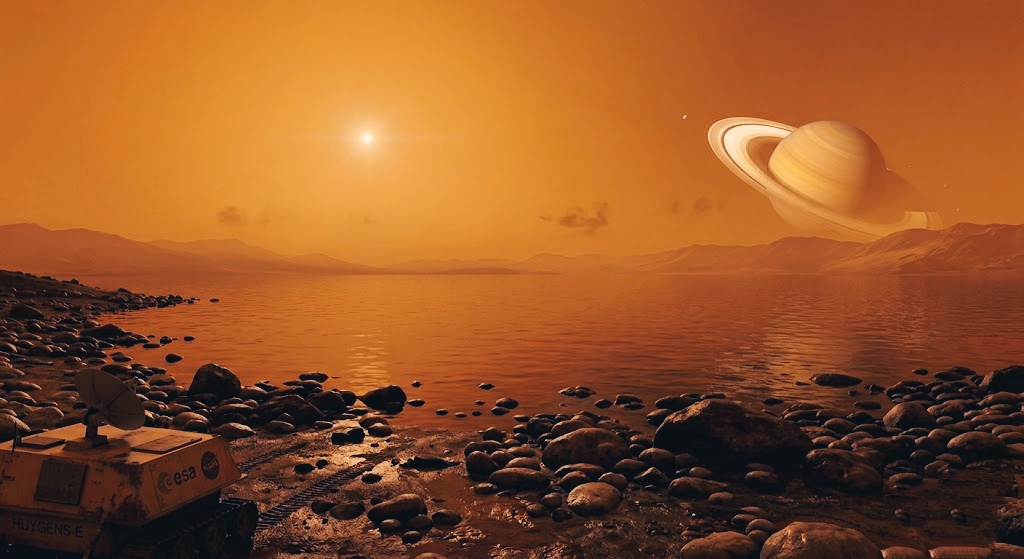
One of the most striking applications of the model involves Titan, Saturn’s largest moon and the only other body in our solar system known to host stable surface liquids. On Earth, a gentle breeze might only cause a slight shimmer on a lake’s surface, but the PlanetWaves model predicts that the same wind speed on Titan would generate massive waves reaching heights of three meters.
This phenomenon occurs because the lakes on Titan are filled with liquid hydrocarbons, which are significantly lighter than water. When combined with the moon’s low gravity and unique atmospheric pressure, these factors make the liquid surface exceptionally easy to disturb. The result is a surreal environment where towering waves appear to move in what humans would perceive as slow motion.
The research team is particularly fascinated by how these waves might be responsible for the lack of river deltas on the moon’s surface. Despite having numerous rivers and coastlines, the geological formations on Titan do not mirror those found on Earth. This suggests that wave energy might be powerful enough to redistribute sediment and prevent the formation of traditional deltas, effectively rewriting the moon’s coastal geography.
Furthermore, the model provides a window into a world that has only been seen through radar imagery. Since we lack direct optical observations of how these lakes behave in real-time, PlanetWaves serves as a theoretical laboratory. It allows scientists to visualize the violent potential of a landscape that, at first glance through a telescope, appears to be a frozen and quiet wasteland.
Engineering challenges for future exploration on Titan
Understanding these aquatic dynamics is not merely a matter of theoretical interest but a practical necessity for future space missions. If space agencies were to deploy a probe or a floating lander to the lakes on Titan, the vessel would need to be engineered to withstand the specific energy profiles of these alien waves.
Lead author Una Schneck, a doctoral student at MIT, points out that knowing the intensity and frequency of wave impacts is vital for designing resilient scientific instruments. A vessel designed for the relatively predictable waters of Earth might be torn apart or capsized by the surprisingly high-energy waves produced by Titan’s light hydrocarbons.
The model provides the necessary quantitative data to ensure that future explorers do not succumb to the very environments they are sent to investigate. By predicting the maximum height and force of waves under various wind conditions, engineers can create specialized hulls and stabilization systems. This foresight is critical for the success of multi-billion dollar missions that aim to search for signs of prebiotic chemistry in these alien seas.
Ultimately, this research bridges the gap between planetary science and aerospace engineering. It ensures that when humanity eventually touches down on the liquid shores of another world, we will do so with a profound understanding of the forces that govern it. The PlanetWaves model thus acts as an essential safety manual for the next generation of deep-space exploration.
Comparative analysis of waves from Mars to Titan
The versatility of the PlanetWaves model extends far beyond our immediate celestial neighborhood, offering insights into the history of Mars and the surfaces of distant exoplanets. By simulating the conditions of ancient Mars, the team demonstrated how the thinning of the Martian atmosphere would have changed the planet’s hydrology. As pressure decreased over time, it would have required increasingly powerful winds to generate any surface waves at all.
This historical perspective allows researchers to better interpret the geological features found by rovers like Perseverance in the Jezero Crater. If waves were once present, they would have left distinct marks on the crater’s edge, helping scientists determine how long liquid water actually persisted on the surface. The model effectively acts as a time machine, recreating the vanished seas of the Red Planet.
Furthermore, the researchers applied the model to extreme environments such as 55-Cancri e, a lava world where the liquid rock is incredibly dense. In such an environment, the model predicts that even hurricane-force winds would barely produce a ripple of a few centimeters. This stark contrast to the volatile seas of Titan illustrates the incredible diversity of planetary surfaces across the galaxy.
These comparisons highlight how the interplay of viscosity, density, and gravity creates a diverse tapestry of planetary surfaces. From the easily agitated hydrocarbon seas on Titan to the nearly immovable oceans of molten rock on distant super-Earths, the PlanetWaves model provides a unified theory for the movement of liquids throughout the universe. It reminds us that our experience on Earth is just one small part of a much larger physical reality.
The study was published in the Journal of Geophysical Research: Planets.