
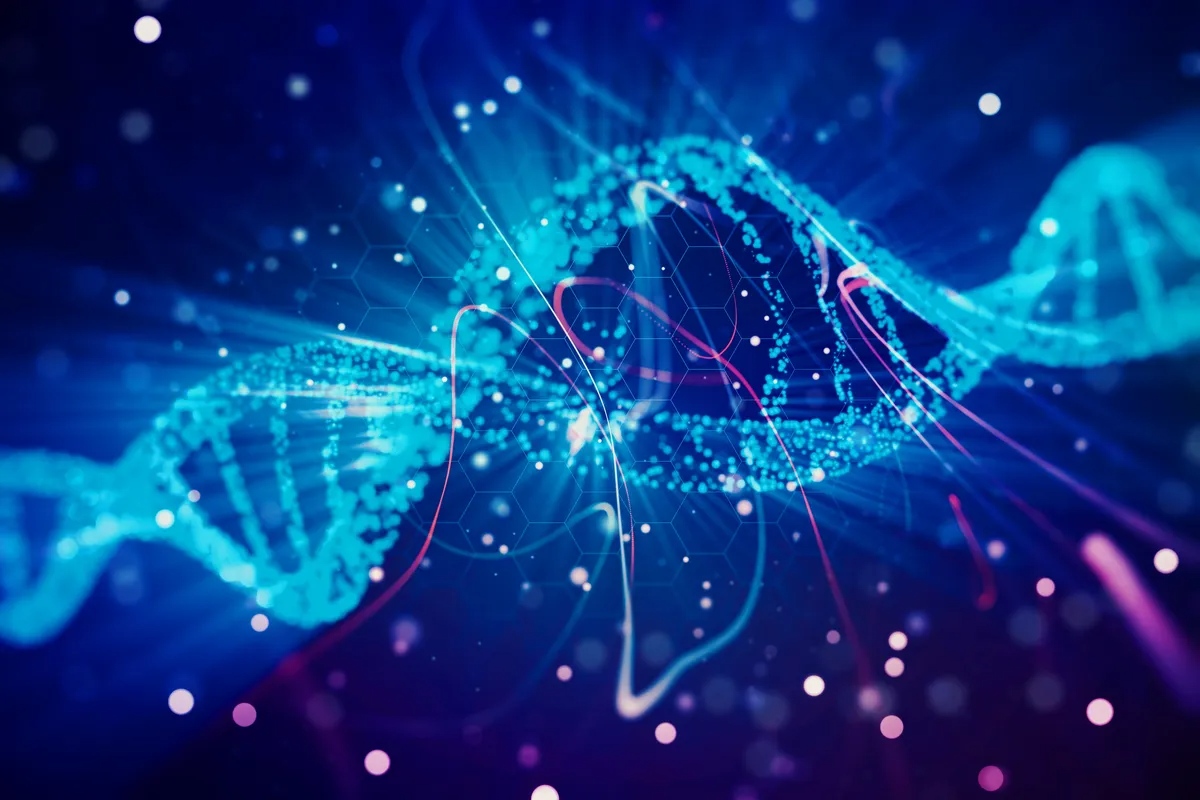
What Happens When You Put a Genome Inside a Quantum Computer?
Have you ever wondered what it would look like if we could hand the most powerful type of computer ever conceived the blueprint of life itself — and ask it to read?
Welcome to FreeAstroScience, where we explain complex scientific ideas in plain language — because we believe your mind deserves to stay sharp, curious, and always switched on. As Francisco Goya once warned us, the sleep of reason breeds monsters. So let’s keep our reason wide awake today.
Because something extraordinary just happened. For the very first time in history, scientists loaded an entire genome onto a quantum computer. Not a simulation. Not a toy model. A real viral genome — encoded into quantum states on real hardware. And the implications stretch from cancer treatment to drug design to how we understand what makes each of us genetically unique.
Stick with us through this article. We wrote it for you — whether you’re a physics student, a biology enthusiast, or just someone who wants to understand where science is heading next. By the end, you’ll know exactly why this moment matters and what it could mean for the future of medicine.
📑 Table of Contents
- 1. What Exactly Did the Scientists Do?
- 2. Why Do We Need Pangenomes in the First Place?
- 3. How Does a Quantum Computer Handle DNA Better?
- 4. Qubits vs. Classical Bits — The Numbers Are Staggering
- 5. A “Hunger Games” for Science — The Quantum for Bio Program
- 6. What Comes Next? Cancer, Superbugs, and Personalised Medicine
- 7. Conclusion — Why This Matters to All of Us
1. What Exactly Did the Scientists Do?
Let’s start with the headline-grabbing fact.
A team led by the University of Oxford and the Wellcome Sanger Institute took the complete 1,700 base-pair genome of the hepatitis D virus and encoded it into a quantum state. They then stored and processed it on an IBM quantum computer equipped with a 156-qubit Heron processor .
That might sound like a mouthful. So let’s break it down.
A genome is essentially the complete instruction manual for a living thing — written in a chemical alphabet of just four letters: A, C, T, and G. The hepatitis D virus has a tiny genome by biological standards (just 1,700 of those letters), but loading even this small dataset onto quantum hardware had never been done before .
The hardest part wasn’t the biology. It was the translation. You can’t just plug a USB stick with DNA data into a quantum machine and say “go.” The genome sequence first had to be converted into a mathematical structure compatible with quantum hardware. Then the researchers had to design the exact sequence of operations — called circuits — to prepare this state on real physical qubits .
As lead researcher Sergii Strelchuk from Oxford put it: “Writing the programme, generating the circuits – this is where the biggest difficulty is. Without generating the right instructions for a quantum computer, you really cannot achieve this goal, no matter how conceptually feasible it is” .
In other words, the science was only as good as the engineering that made it real.
2. Why Do We Need Pangenomes in the First Place?
To understand why this achievement matters, we need to talk about pangenomes.
You probably remember the Human Genome Project. Completed in 2003, it gave us the first complete map of human DNA. That was a massive deal. But here’s the thing — it was based on genetic material from just a handful of people .
Strelchuk was blunt about the limitation: “Having a single sequenced genome is a far cry off where we want to be, precisely because we humans are very different. We need to build a data structure that captures this variation across the human population” .
That’s where pangenomes come in. Rather than showing one person’s DNA, a pangenome captures the genetic diversity of many individuals at once. Think of it less like a book and more like a map — showing all the possible routes a genome can take.
The Tube Map Analogy
Strelchuk described a pangenome as something like a London Underground map . The straight lines represent DNA sequences shared by everyone. Where there are loops, detours, and branching paths — those show the places where individuals differ genetically.
“It allows you to see where things are different, where things are the same,” he explained .
In 2023, the first draft human pangenome was published, covering 47 individuals. The Human Pangenome Reference Consortium is expected to release an even broader version — covering more than 300 individuals — possibly as soon as this summer .
But here’s the catch. The richer these datasets become, the harder they are to analyze with traditional computers.
3. How Does a Quantum Computer Handle DNA Better?
This is where things get truly exciting — and a little mind-bending.
One of the core tasks in genomics is sequence alignment: taking someone’s DNA and mapping it against a reference structure to find where it fits. When that reference structure is a simple, linear genome, classical computers handle it well. But when the reference is a pangenome graph — a sprawling, branching network — the problem grows exponentially harder .
Strelchuk put it vividly: “You can imagine the kind of complexity of a Japanese subway-style map” .
And some regions of the genome are worse than others. The HLA region, which governs much of our immune system’s ability to fight disease, produces a pangenome graph so tangled that Strelchuk called it a “hairball” and a “hot mess” .
“Classically, you don’t even begin to hope for anything really, because it’s just way too complex,” the researcher said .
This is exactly the kind of problem where quantum computing might shine. Not because quantum machines are simply “faster,” but because they process information in a fundamentally different way.
4. Qubits vs. Classical Bits — The Numbers Are Staggering
Let’s get into the physics for a moment — don’t worry, we’ll keep it clear.
A classical computer stores information in bits: tiny switches that are either 0 or 1. A quantum computer uses qubits, which can exist in superpositions of 0 and 1 simultaneously. But the real power isn’t superposition alone — it’s entanglement .
When qubits are entangled, they’re no longer independent of one another. Information gets stored not just in each qubit’s individual state, but in the relationships between them — their correlations .
And here’s where the numbers get wild.
| Property | Classical Bits | Qubits |
|---|---|---|
| Human genome size | 3.2 billion base pairs | 3.2 billion base pairs |
| Bits/qubits required | 6.4 × 10⁹ | ~33 |
| Encoding method | 2 bits per base pair | Entangled correlations (2n) |
| Scaling behaviour | Linear | Exponential |
Let’s put the math front and centre.
Number of correlations for n qubits:
Correlations = 2n
For the human haploid genome (3.2 × 10⁹ base pairs):
• Classical encoding: 6.4 × 109 bits (2 bits per base pair)
• Quantum encoding (theoretical): ~33 qubits (since 233 ≈ 8.6 × 10⁹ correlations)
Read that again. The entire human genome — 6.4 billion classical bits of information — could theoretically be encoded with just 33 qubits . That’s the exponential power of quantum entanglement at work.
Of course, theory and practice are very different beasts. Getting those 33 qubits to behave perfectly is an engineering challenge of staggering proportions. But the direction of travel is clear.
5. A “Hunger Games” for Science — The Quantum for Bio Program
This work didn’t happen in a vacuum. (Well, parts of the quantum hardware probably did, but that’s a different story.)
The research emerged from a competitive program called Quantum for Bio, backed by $40 million in investment from the health research non-profit Wellcome Leap .
The program kicked off in September 2023 with 12 research projects selected from roughly 80 applicants. By August 2024, those 12 had been cut down to a final six — what Strelchuk candidly called a “Hunger Games-style” elimination .
The stakes? A $2 million prize for any team that could execute a biologically relevant task on a quantum machine of 50+ qubits and show a clear pathway to scaling . A bigger $5 million grand prize also exists, though Strelchuk was honest about the odds: “The depth of the program required is so big that no existing quantum computer can do it. I’ll be surprised if anyone gets the $5 million prize” .
What makes this team’s results so impressive is their breadth. They didn’t just demonstrate one thing. All four of their original objectives have now been executed on real quantum hardware :
- Data encoding — loading genomic data onto the quantum computer
- Sequence alignment — mapping DNA against pangenome graphs
- Pangenome assembly — constructing pangenome structures
- Phylogenetic tree construction — mapping evolutionary relationships
“We did all the pangenome-based sequence alignment – all four work streams have been executed on the quantum computer,” Strelchuk confirmed .
Several papers have already been released, and more are on the way.
6. What Comes Next? Cancer, Superbugs, and Personalised Medicine
So the proof of concept works. Where does it go from here?
Near-Term Targets
The team sees metagenomics and antimicrobial resistance as the next frontiers. Metagenomics involves analysing genetic material from entire environments — like the communities of bacteria living in your gut. These datasets are enormous, complex, and growing. Quantum tools could help us make sense of them faster .
Antimicrobial resistance — often called the “silent pandemic” — is another area where faster, more complete genomic analysis could save lives.
The Long Game: Chromothripsis
Further out lies one of the most devastating cancer mechanisms we know of: chromothripsis. In this process, a chromosome literally shatters and then reassembles itself — often incorrectly. The result can be a catastrophic reshuffling of genetic material that drives aggressive cancers .
Understanding chromothripsis computationally is almost impossibly hard with classical approaches. The sheer number of possible reassembly configurations is astronomical. Quantum computing could — someday — give us the tools to model and study this process.
“Classical tools are coming against this ever-increasing complexity,” Strelchuk explained. “We may have a possibility to get answers sooner, and better answers. Why not use that opportunity to do something cool?” .
That last sentence might be the most human thing a researcher can say. Why not do something cool?
📅 Key Timeline of Events
2003
Human Genome Project completed (a handful of individuals)
2023
First draft human pangenome published (47 individuals)
Sept 2023
Quantum for Bio program launches with 12 teams ($40M funding)
Aug 2024
Field narrowed to 6 finalists in “Hunger Games-style” elimination
March 2025
Program concludes; all teams submit findings
April 2025
Hepatitis D virus genome loaded onto IBM 156-qubit Heron processor — a world first
7. Conclusion — Why This Matters to All of Us
Let’s step back and look at the big picture.
We’re living through an age when two of the most powerful scientific revolutions in history — genomics and quantum computing — are beginning to meet. The loading of a viral genome onto a quantum computer is just the first step, a proof of concept, a beginning. But it’s a beginning that points toward a future where we can analyse the full genetic diversity of the human species in ways that classical machines simply can’t handle.
That matters for personalised medicine — treatments designed for your unique genetic makeup. It matters for fighting antibiotic-resistant bacteria. It matters for understanding cancers so complex that today’s best computers can barely scratch the surface.
Thirty-three qubits to encode the human genome. A subway map of our shared biology. A “hot mess” of immune system genetics that quantum machines might someday untangle.
We’re not there yet. The quantum computers we have now are noisy, limited, and fiendishly difficult to program. But as Sergii Strelchuk reminds us: “You have to iterate, you have to fail, you have to quickly pick yourself up” .
That’s good advice — not just for quantum researchers, but for all of us.
We hope this article gave you something to think about, something to wonder about, something to carry with you. Here at FreeAstroScience.com, we believe everyone deserves access to the ideas shaping our future. Complex science, explained simply. We want to educate you — never to turn off your mind, and to keep it active at all times. Because the sleep of reason breeds monsters.
Come back soon. There’s always more to explore.
📚 References & Sources
- Leslie, T. (2025). “You Have To Iterate, You Have To Fail, You Have To Quickly Pick Yourself Up”: Genome Loaded Onto Quantum Computer For First Time. IFLScience. iflscience.com
- Human Pangenome Reference Consortium. humanpangenome.org
- Wellcome Leap — Quantum for Bio Program. wellcomeleap.org
Article written for FreeAstroScience.com — where complex science meets clear language. © 2026

This is my first time pay a quick visit at here and i am really happy to read everthing at one place