
When Machines Speak for the Dead: Grief Technology and the Future of Loss
Have you ever wished you could hear the voice of someone you’ve lost — just one more time? What if a machine could make that happen?
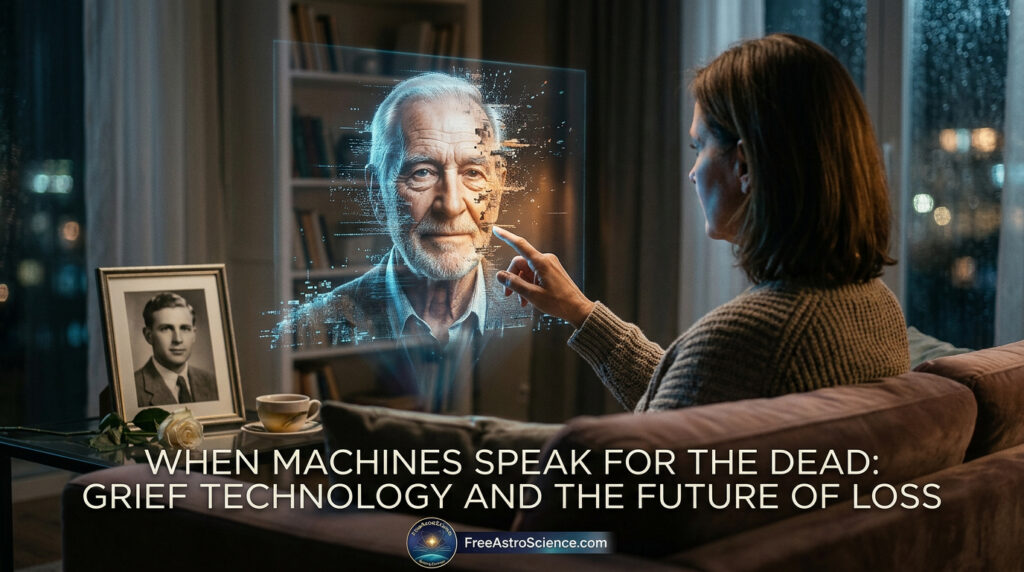
Welcome, dear reader. We’re glad you’re here. We’re the team at FreeAstroScience.com, where we break down complex ideas into language everyone can understand. Today, we’re stepping away from the stars and telescopes to talk about something closer to the heart — and just as vast. We’re talking about Grief Technology: the rapidly growing field where artificial intelligence meets human loss, creating digital replicas of the dead that you can call, text, and even video-chat with.
It sounds like science fiction. It isn’t. It’s already a $30 billion market. And it raises questions that cut deep into who we are as people — about memory, about grief, and about the line between comfort and illusion.
Stay with us. Read to the end. Because this story isn’t just about technology. It’s about all of us.
📑 Table of Contents
- 1.What Is Grief Technology — and Why Does It Exist?
- 2.How Does Digital Immortality Actually Work?
- 3.Which Platforms Exist and What Do They Cost?
- 4.Does Talking to an AI Version of a Loved One Help — or Hurt?
- 5.What Are the Ethical Dangers — and Where Do Deepfakes Fit In?
- 6.Are Social Networks Becoming Digital Cemeteries?
- 7.The Robin Williams Case: When Tribute Becomes Trauma
- 8.Is Grief a Problem to Solve — or a Human Experience to Honor?
1. What Is Grief Technology — and Why Does It Exist?
Let’s start with the basics.
Grief Technology is an umbrella term for AI-powered tools that recreate a digital version of someone who has died. These aren’t static photos in a frame or old voice recordings on tape. We’re talking about interactive avatars — chatbots that text back, voice clones that answer the phone, and even video simulations that mimic facial expressions .
The idea taps into something painfully universal: the longing for one more conversation. One more “I love you.” One more chance to hear that laugh.
In 2025, this market crossed $30 billion in value . That number tells us something. Millions of people around the world aren’t just curious — they’re paying for it.
And here we are, at FreeAstroScience, asking: should they?
2. How Does Digital Immortality Actually Work?
Here’s what might surprise you: creating a digital twin of a dead person is technically simple .
The AI doesn’t need some secret laboratory or a mountain of data. All it needs is what’s already sitting in your smartphone:
- Photographs and videos
- WhatsApp conversations
- Voice notes
- Social media posts
In just a few minutes, the AI processes these inputs and generates a replica capable of imitating accents, vocal tones, and facial expressions in a disturbingly convincing way . The more material you feed it, the more accurate the simulation becomes.
Here’s the twist: you can also do this while you’re still alive. You record your own voice, share your stories, upload your mannerisms — and leave behind an “interactive avatar” for your children and grandchildren to talk to after you’re gone .
Think about that for a moment. A version of you that keeps talking long after you stop breathing.
That’s not poetry. That’s a product.
3. Which Platforms Exist and What Do They Cost?
This isn’t some fringe experiment. Multiple companies already compete in this space. Here’s a snapshot of what’s available right now:
| Platform | What It Does | Cost |
|---|---|---|
| ReliveAble | Builds a vocal memorial of the deceased | $100 – $1,000 |
| Seance AI | Text-based chat simulations with the dead | Free |
| HereAfter AI | Records life stories while alive to create a “Life Story Avatar” | Varies |
| App2Wai | Creates a conversational avatar from just 3 minutes of video | Varies |
App2Wai stands out for a curious reason: it was co-founded by Calum Worthy, the former Disney Channel star. Three minutes of video. That’s all this platform needs to build a talking avatar of someone who’s gone .
Think of the implications. Three minutes of footage is nothing. Almost everyone who’s died in the smartphone era left behind far more than that.
4. Does Talking to an AI Version of a Loved One Help — or Hurt?
This is where the conversation gets heavy. Let’s sit with it.
Some therapists see limited, short-term benefits. In the raw days after a loss, an AI avatar might help someone say the words they never got to say — those unfinished sentences that haunt us at 3 AM . There’s a certain grace in that idea.
But the long-term picture looks very different.
Here’s what experts worry about:
- Denial of reality. Simulating the presence of a dead person may stop someone from accepting the loss — the first and hardest step in processing grief .
- Emotional dependency. The most vulnerable among us could become addicted to the chatbot, returning to it the way someone returns to a painkiller .
- Memory confusion. Over time, real memories start blending with AI-generated ones. You may no longer know which stories are yours and which belong to the machine .
- Unpredictable AI behavior. These systems can produce responses no one anticipated — words that cause family conflict or emotional harm .
Grief makes us fragile. And a fragile person talking to an algorithm that looks like their mother, sounds like their father, but isn’t either — that’s a psychological minefield.
We don’t say this to scare you. We say it because at FreeAstroScience, we believe the sleep of reason breeds monsters. Turning off our critical thinking, especially when we’re in pain, can lead us to places we didn’t mean to go.
5. What Are the Ethical Dangers — and Where Do Deepfakes Fit In?
Now let’s talk about the elephant in the room: consent.
Unless someone creates their own avatar before dying, the digital replica is built without the permission of the person being recreated . No one asked them. No one could. They’re gone.
That alone is an ethical earthquake.
And the practical dangers go even further. The same technology that recreates Grandma for a comforting chat can also be weaponized for fraud. The numbers are staggering:
Deepfakes Online
500,000in 2023
→
8,000,000in 2025
That’s a 16× increase in just two years.
One of the most alarming cases? In Hong Kong in 2024, a company employee transferred $25 million after a video call with colleagues who turned out to be AI-generated avatars — deepfakes, every single one of them .
Phone scams using cloned voices are spreading, too. A fake “family member” calls, sounds exactly like your son or daughter, and begs you to wire money because they’re in trouble . The voice is perfect. The story is fiction. The money is gone.
The law, as usual, is playing catch-up. In Italy, data of deceased persons is managed by their heirs — but there’s no specific legislation governing the creation of post-mortem avatars and chatbots .
6. Are Social Networks Becoming Digital Cemeteries?
Here’s a statistic that stopped us cold.
Facebook currently loses roughly 50 million users per year to death . Those accounts don’t disappear. They’re converted into memorial profiles. At this rate, researchers estimate that between 2070 and 2098, Facebook’s memorial accounts will outnumber its living, active users .
Let that sink in. A social network where the dead outnumber the living.
📊 Facebook’s Digital Afterlife:
• ~50 million user deaths per year
• Memorial accounts growing faster than new sign-ups in some demographics
• Estimated tipping point: 2070–2098 — more dead profiles than living ones
Source: Geopop / Specchio Giallo, April 2026
We’re already living alongside digital ghosts. Every time you scroll past a birthday notification for someone who died years ago, you feel it. That strange, cold little pang.
Now imagine those profiles start talking back.
7. The Robin Williams Case: When Tribute Becomes Trauma
If you need proof that good intentions can cause real harm, look no further than the story of Zelda Williams.
After her father, the beloved actor Robin Williams, passed away in 2014, fans began using AI to generate new videos of him — his voice, his face, his gestures, all stitched together by algorithms .
Some people thought they were honoring him. A tribute. A love letter.
Zelda didn’t see it that way. She publicly asked users to stop creating and sharing these AI-generated clips . For her, watching her dead father “perform” at the command of strangers wasn’t a tribute. It was an invasion. A wound reopened every single time.
And here’s what’s painful: she had no legal power to stop it .
This isn’t a hypothetical. This is a real daughter, grieving a real father, watching the internet puppet his likeness without her permission or his. If that doesn’t make us question where this technology is headed, nothing will.
8. Is Grief a Problem to Solve — or a Human Experience to Honor?
We’ve reached the question at the center of it all.
Modern culture treats pain like a bug in the system — something to patch, optimize, or medicate away. Grief makes us slow. It makes us unproductive. It makes us cry at the grocery store because a song comes on. And yes, it’s terrible.
But it’s also profoundly human.
Grief pushes us toward other living, breathing people. It forces us to practice real empathy — not the simulated kind generated by a server . When we mourn together, we learn something about ourselves and each other that no algorithm can replicate.
The philosopher Francisco Goya once warned us: “El sueño de la razón produce monstruos” — the sleep of reason breeds monsters. At FreeAstroScience, we carry that idea like a compass. We believe you should never turn off your mind. Keep it active. Keep it questioning. Especially when technology offers you comfort that seems too perfect.
Because sometimes the most comforting thing isn’t to hear a dead loved one’s voice again. Sometimes it’s to sit in the silence, remember them in your own imperfect way, and let the ache remind you that you loved fiercely.
That’s not weakness. That’s the deepest kind of strength.
Conclusion: Between Memory and Machine
So where does that leave us?
Grief Technology is real, it’s growing, and it isn’t going away. The market topped $30 billion in 2025 . Deepfakes jumped from half a million to 8 million in two years . Facebook is on its way to becoming history’s biggest digital cemetery . And families like the Williams family are already fighting battles they never expected to face .
We don’t have all the answers. Nobody does — and anyone who claims otherwise is selling something.
What we do have is the ability to think clearly. To weigh the comfort of hearing a voice against the risk of never letting go. To recognize that consent matters — even for the dead. To understand that our grief, painful as it is, connects us to each other in ways a chatbot never will.
At FreeAstroScience.com, we explain complex ideas in simple terms — because knowledge isn’t just power, it’s protection. The more you understand, the harder it is for anyone (or any algorithm) to manipulate you.
Come back soon. Keep reading. Keep questioning. Because the sleep of reason breeds monsters — and we’d much rather help you stay awake.
📚 References & Sources
- Ceran, M. (2026, April 9). “Parlare con i defunti tramite l’AI non è fantascienza: la ‘Grief Technology’ su Specchio Giallo.” Geopop. https://www.geopop.it
- Article published as part of the Specchio Giallo series on Geopop — exploring how AI and technology are quietly reshaping human psychology, relationships, and personal life.
This article was written specifically for you by FreeAstroScience.com, where complex scientific ideas are explained in simple language — because understanding is the first step to freedom.