
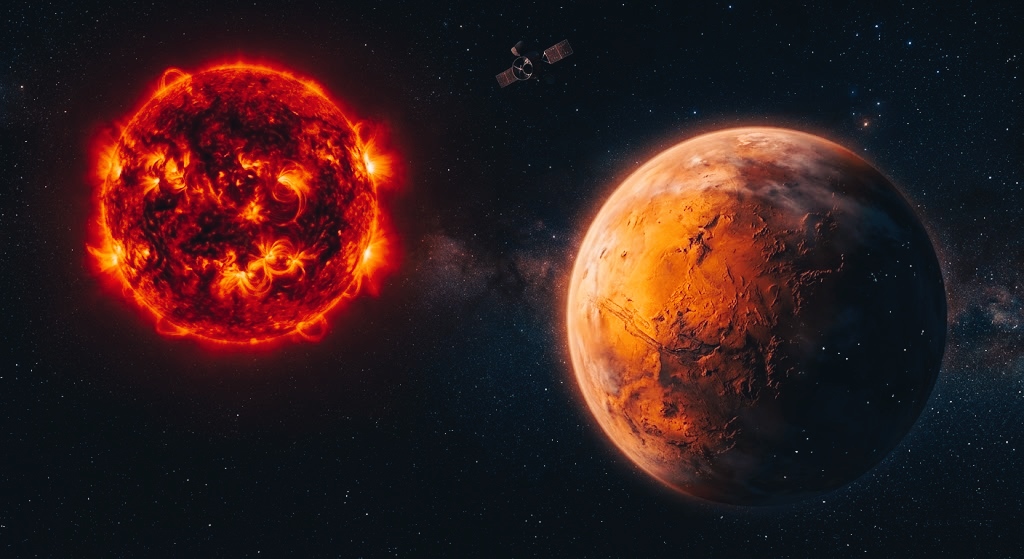
A major step forward in exoplanet research has been achieved by an international team of astronomers using data from NASA’s Transiting Exoplanet Survey Satellite (TESS). They have successfully detected and confirmed the presence of a new extrasolar world in orbit around TOI-4616, a neighboring red dwarf star. This alien planet, designated TOI-4616 b, is categorized as slightly larger than Earth, expanding our understanding of terrestrial planets around the most common type of stars.
The role of TESS and TOI-4616 b
Since its launch in 2018, TESS has been scrupulously scanning around 200,000 of the brightest stars in close proximity to our Sun. Its primary mission is to search for transiting exoplanets, which reveal their presence by causing subtle dips in a star’s brightness as they pass in front of it. This highly efficient survey has already yielded over 7,900 candidate exoplanets, with 760 confirmed cases, fundamentally changing our perception of the galaxy’s planetary population.
Among the multitudes of stars observed, TOI-4616, located approximately 91.8 light-years from Earth, was identified as having a potential planet. This red dwarf, with a spectral type of M4, showed a periodic transit signal in its light curve, suggesting an orbiting body with a period of about 1.5 days. Confirming this signal required dedicated follow-up observations and rigorous statistical analysis, which the team led by Francis Zong Lang from the University of Bern undertook with precision.
The validation process combined the initial TESS photometry with extensive ground-based multiband transit observations, high-resolution imaging, and detailed optical/near-infrared spectroscopy. This multi-faceted approach allowed the researchers to definitively eliminate alternate explanations and confirm the planetary nature of the detected signal. As stated by the authors, this comprehensive data fusion was essential for both the validation of TOI-4616 b and the precise determination of the system’s parameters.
Physical parameters of TOI-4616 b
The analysis revealed that TOI-4616 b is a “super-Earth” with a radius estimated to be 1.22 times that of Earth. Its mass is calculated to fall within the range of 1.5 to 3.0 Earth masses, confirming its terrestrial classification. The planet orbits its host star with remarkable speed, completing a full revolution every 37.2 hours, which places it in a very tight orbit compared to planets in our own solar system.
This extreme proximity to its star results in a high equilibrium temperature of approximately 525 K, far too hot to support liquid water on its surface. Based on these derived parameters, the astronomers conclude that TOI-4616 b is likely a rocky, terrestrial world. Its discovery orbiting a mid-M-type dwarf makes it an exceptionally valuable addition to the known exoplanet catalog.
The research team emphasizes that TOI-4616 and its newfound planet will serve as a critical reference system for future comparative studies. Understanding terrestrial planets orbiting mid-M dwarfs is crucial, as these stars are the most numerous in the Milky Way, yet our understanding of their planetary systems is still evolving. TOI-4616 b provides a tangible benchmark for this vital sub-field of exoplanet science.
Atmospheric considerations and the star
A key aspect of the study concerns the planet’s atmospheric evolution and its potential for future observation. The researchers hypothesize that any primordial hydrogen/helium envelope that TOI-4616 b might have once possessed has likely been effectively disrupted. However, they also suggest that a more compact, secondary atmosphere may have survived the planet’s intense environment. This possibility opens up fascinating avenues for future research.
The potential survival of a secondary atmosphere means TOI-4616 b is an excellent candidate for transmission spectroscopy studies. The James Webb Space Telescope (JWST) has the required sensitivity to potentially detect atmospheric features, provided a secondary atmosphere exists. Observations with JWST could revolutionize our understanding of super-Earth compositions and atmospheric escape processes.
Regarding the host star, TOI-4616, it is approximately 19% the size and mass of our Sun, typical for a red dwarf. It has an effective temperature of 3,150 K and a metallicity of roughly -0.3 dex. Estimating the star’s age between 300 and 800 million years provides a clear context for the planet’s formation and suggests a young and dynamic system worthy of continued exploration.
The study is published on arXiv.