
Compared with other Mesozoic animals, chigutisaurid fossils in Australia are rare. Only three species have been named so far. From Queensland, Keratobrachyops australis lived during the Triassic, and Siderops kehli during the Jurassic. The youngest of them, Koolasuchus cleelandi from Victoria, dates to the Cretaceous—and it holds a special place in history as the last known temnospondyl anywhere in the world.
A fossilized amphibian, hidden for millions of years and discovered in a retaining wall in the 1990s, has now been formally named and described by scientists at UNSW Sydney and the Australian Museum. Dating back 240 million years, the specimen marks a remarkable addition to Australia’s prehistoric record.
The fossil is now named Arenaerpeton supinatus (AM F125866), meaning ‘supine sand creeper’. The fossil, discovered originally by a retired chicken farmer in the rocks, was brought from a local quarry to build a garden wall. He later donated it to the Australian Museum in Sydney, where scientists uncovered its true prehistoric significance.
The specimen (AM F125866) is remarkably well‑preserved, showing an almost complete skeleton laid out belly‑side up, along with traces of soft tissue. Its features clearly link it to the chigutisaurid family, confirming earlier ideas that large amphibians of this group lived in Triassic Australia.
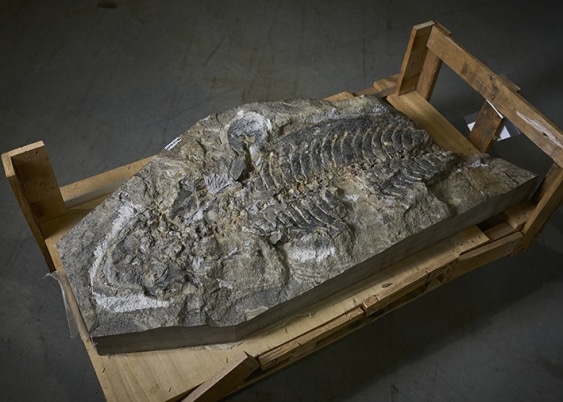
Mr Hart, a PhD candidate in the School of Biological, Earth and Environmental Sciences (BEES) at UNSW, stated, “This fossil is a unique example of a group of extinct animals known as temnospondyls, which lived before and during the time of the dinosaurs.”
“We don’t often find skeletons with the head and body still attached, and the soft tissue preservation is an even rarer occurrence.”
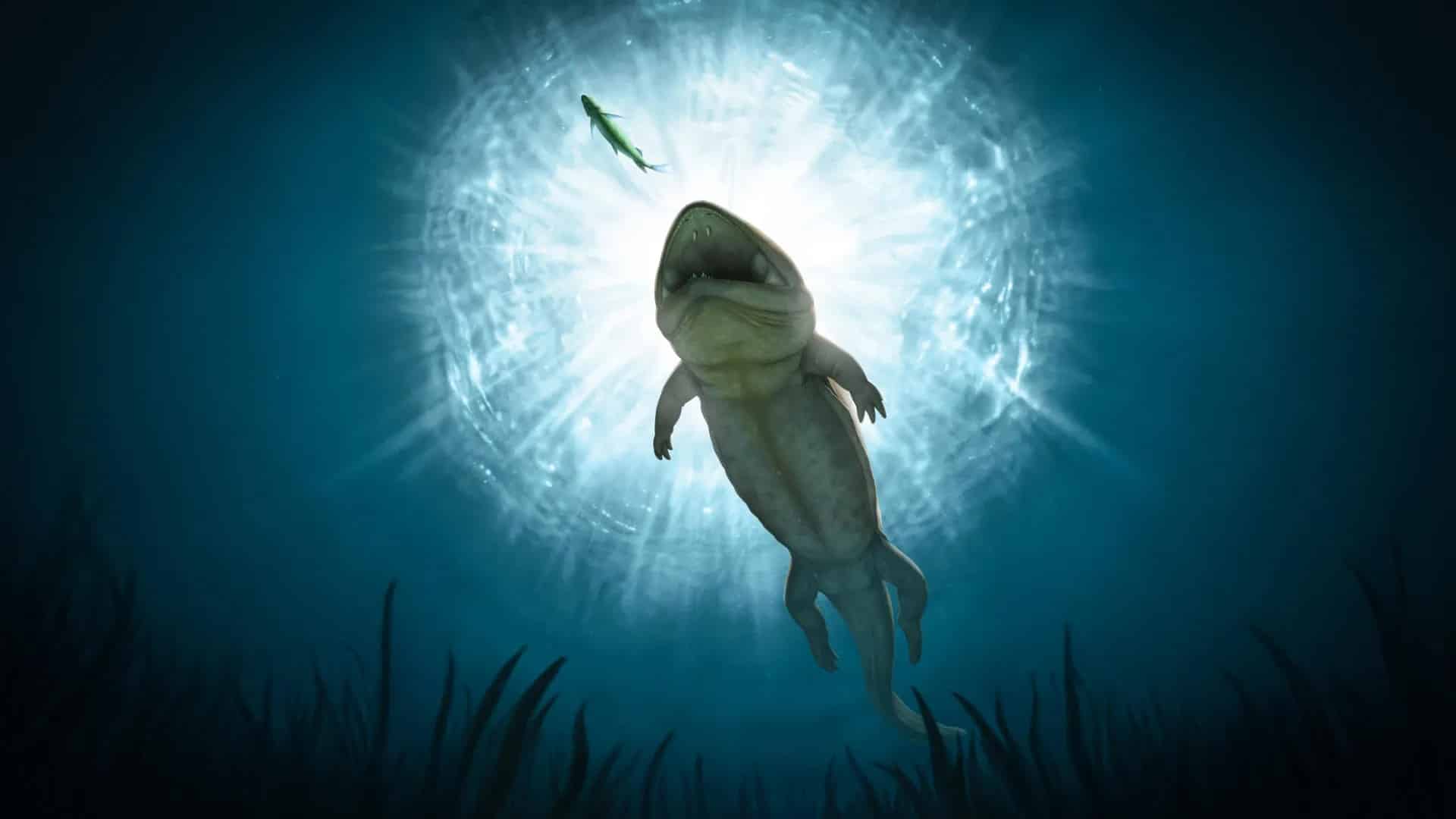
Around 240 million years ago, Arenaerpeton prowled the freshwater rivers of the Sydney Basin. It likely hunted ancient fish such as Cleithrolepis, though little else is known about the creatures it shared its world with. At first glance, Arenaerpeton resembles the modern Chinese Giant Salamander, especially in the shape of its head.
But the fossil tells a different story; its ribs and preserved soft tissue show it was far more heavyset, and its mouth bristled with fearsome teeth, including a pair of fang‑like tusks jutting from the roof of its mouth.
Mr Hart says “What is exciting about the discovery is that Arenaerpeton is large – estimated to be about 1.2m from head to tail – when most other closely related animals that lived at the same time were small.”
Temnospondyls, the ancient amphibians to which Arenaerpeton belonged, survived in Australia for another 120 million years after their time, some growing to enormous sizes. Their fossil record spans two mass extinctions, suggesting that evolving larger bodies may have helped them endure.
Dr Matthew McCurry of UNSW Sydney and the Australian Museum calls the Arenaerpeton fossil one of the most important discoveries in New South Wales in the past three decades.
“It represents a key part of Australia’s fossil heritage,” he says, underscoring its significance in the nation’s paleontological history.