
Why Investing in the Stars Might Be the Smartest Thing We Do for Earth
Introduction
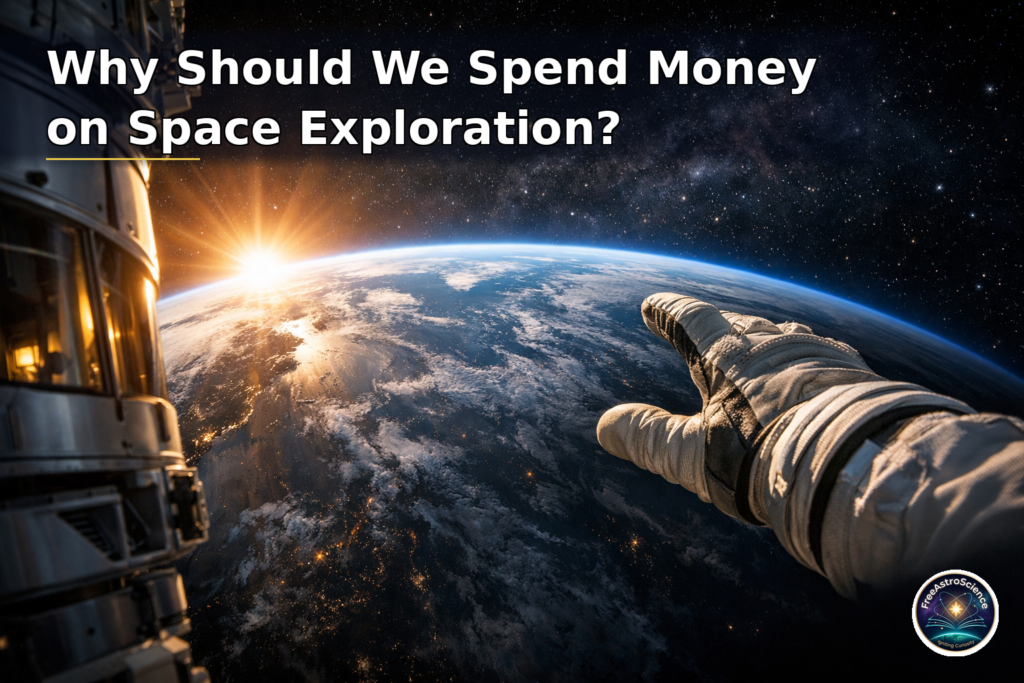
Have you ever looked up at the night sky and wondered‚ with millions of people still struggling to put food on the table, why do we keep throwing billions of dollars into the darkness of space?
It’s a fair question. An honest one. And you’re not alone in asking it.
Welcome to FreeAstroScience‚ where we explain complex scientific ideas in plain, human language, and where we believe the sleep of reason breeds monsters. We’re here to keep your mind awake, curious, and always questioning.
Today, we’re tackling one of the most debated questions in modern science and public policy: is space exploration worth the cost when Earth still has so many unsolved problems?
The short answer might surprise you. The long answer‚ the one filled with real stories, hard numbers, and technologies you probably used before breakfast ‚ is even better.
So stick with us. By the time you reach the end, we think you’ll see the night sky a little differently. And maybe you’ll see our own planet differently, too.
☶ Table of Contents
- 01 A Nun, a Scientist, and a Letter That Changed the Conversation
- 02 The Count, the Plague, and a “Useless” Hobby ‚Äî A Parable for Our Times
- 03 How Much Does Space Actually Cost? (Hint: Less Than You Think)
- 04 From Rockets to Your Kitchen: NASA Technologies You Use Every Day
- 05 Does Space Pay for Itself? The Economic Case for Looking Up
- 06 How Does Space Research Help Solve Real Problems on Earth?
- 07 Can Space Bring Humanity Together Instead of Pulling Us Apart?
- 08 What Happens If We Stop Watching the Sky?
- 09 One Photograph That Changed How We See Ourselves
- 10 Conclusion: Reaching for the Stars Is Reaching for a Better Earth
A Nun, a Scientist, and a Letter That Changed the Conversation
In 1970 ‚ right in the middle of the Apollo missions‚ a woman named Sister Mary Jucunda sat down in Kabwe, Zambia, and wrote a letter to NASA.
She wasn’t writing to congratulate them. She was angry. Confused. Heartbroken.
She worked among starving children every day. She watched families struggle to survive. And she wanted to know: how can you justify spending billions to go to the Moon while children die of hunger?
Her letter landed on the desk of Dr. Ernst Stuhlinger, NASA’s Associate Director for Science at the Marshall Space Flight Center. He could have ignored it. He could have sent a form reply.
Instead, he wrote one of the most thoughtful, compassionate, and clear-headed defenses of space exploration ever put to paper. Dated May 6, 1970, his letter didn’t dodge the question. It met it head-on.
“I know that you do not expect an answer such as ‘Oh, I did not know that there are children dying from hunger, but from now on I will desist from any kind of space research until mankind has solved that problem!'” Stuhlinger wrote. “In fact, I have known of famined children long before I knew that a voyage to the planet Mars is technically feasible.”
His response wasn’t cold. It was warm, careful, and deeply human. And at its heart sat a parable ‚ a story about a count, a plague, and what seemed like a very foolish investment.
The Count, the Plague, and a “Useless” Hobby ‚ A Parable for Our Times
Here’s the story Stuhlinger told Sister Mary Jucunda. We’re paraphrasing slightly, but the message is exact:
About 400 years ago, a nobleman lived in a small German town. He was generous‚ giving much of his income to his fellow citizens, who were poor and suffering from repeated outbreaks of plague.
One day, the count met a strange man. This man worked all day just to afford a few hours at night in his tiny laboratory, where he ground small lenses from glass, mounted them in tubes, and peered at the world of the very small.
The count was fascinated. He invited the man to move into his castle and work on his optical gadgets full-time.
The townspeople? They were furious. “We are suffering from the plague, and he’s paying that man for a useless hobby!”
But the count stood firm. “I give you as much as I can afford,” he said. “But I will also support this man, because I believe someday something good will come out of it.”
He was right.
That work‚ combined with similar efforts across Europe ‚ led to the invention of the microscope. And the microscope has done more to end plagues and contagious diseases than any amount of gold coins dropped into a beggar’s cup ever could.
The count, by holding back just a small part of his resources for research and discovery, ended up helping humanity far more than if he’d given everything to immediate relief.
This is the same argument, told across centuries, for space exploration.
How Much Does Space Actually Cost? (Hint: Less Than You Think)
Let’s talk numbers ‚Äî real, honest numbers. This is where the debate usually goes sideways, so let’s get it straight.
NASA’s budget for fiscal year 2025 was approximately $24.8 billion. That’s a big number. It sounds enormous until you put it in context.
The total U.S. federal budget in 2025 was roughly $6.75 trillion. NASA’s share? About 0.35% ‚ roughly one-third of one penny from every tax dollar.
Surveys regularly show that Americans believe NASA consumes around 25% of the federal budget. The reality is 50 to 70 times smaller than that perception.
Let’s compare:
| Category | Annual Spending (USD) |
|---|---|
| U.S. Defense Budget | ~$886 billion |
| Americans Spending on Pizza | ~$46 billion |
| Economic Cost of Tobacco (U.S.) | ~$250 billion |
| Americans Spending on Gambling | ~$110 billion |
| NASA’s Entire Budget (FY 2025) | ~$24.8 billion |
Americans spend nearly twice as much on pizza every year as they do on NASA. The annual economic toll of tobacco-related disease is ten times NASA’s entire budget.
When Stuhlinger wrote to Sister Mary Jucunda in 1970, NASA’s share of the federal budget was about 1.6%. Today it’s closer to 0.35%. We’re investing less ‚Äî proportionally ‚Äî than we did during the Apollo era.
So the question isn’t really “Why are we spending so much on space?” The better question is: what do we get back for that relatively small investment?
The answer is — a lot.
From Rockets to Your Kitchen: NASA Technologies You Use Every Day
Every morning, before you even leave your house, you’ve probably used at least three or four technologies that came from space research. And we’re not talking about Tang or Teflon (NASA didn’t actually invent those ‚Äî common misconception).
We’re talking about real, documented innovations. Since the 1970s, NASA’s Technology Transfer Program has recorded over 2,000 spinoff technologies ‚Äî inventions born from the demands of space travel that ended up transforming life on Earth.
Here are some you might recognize:
Health and Medicine
- Infrared ear thermometers — developed jointly by Diatek Corporation and NASA for rapid, non-contact temperature readings. Used in hospitals worldwide for newborns and incapacitated patients.
- Ventricular assist devices (heart pumps) — the MicroMed DeBakey VAD, a collaboration between NASA, Dr. Michael DeBakey, and Dr. George Noon, is one-tenth the size of previous devices. It keeps patients alive while they wait for a heart transplant and runs up to 8 hours on batteries.
- LASIK eye surgery tracking — the LADARVision 4000 uses NASA-developed Lidar technology to track your eye 4,000 times per second while reshaping the cornea. Approved in 1998.
- Cochlear implants ‚Äî engineered by NASA’s Adam Kissiah in the mid-1970s. Patented in 1977 with NASA’s help.
- Invisible dental braces — translucent polycrystalline alumina, originally developed for infrared antennae protection on missile-tracking satellites.
- Memory foam ‚Äî created at NASA’s Ames Research Center to improve airplane crash protection. Now in mattresses, pillows, prosthetics, and sports gear around the world.
Everyday Life
- The camera in your smartphone ‚Äî CMOS image sensors were invented at NASA’s Jet Propulsion Laboratory by Eric Fossum to miniaturize cameras for interplanetary missions. Today, they’re in every phone, laptop, and action camera.
- Portable cordless vacuums (the DustBuster) — Black & Decker developed the motor technology for an Apollo lunar drill. That same motor optimization program gave us cordless home tools.
- Freeze-dried food — perfected for Apollo astronauts. Retains 98% of its nutritional value at just 20% of its original weight.
- Scratch-resistant lenses — licensed from NASA technology originally designed to protect space helmet visors and equipment.
- Water purification systems — developed to recycle astronaut sweat and urine into clean drinking water on the ISS. Now used to provide safe water in developing regions with contaminated wells.
Safety and Environment
- Firefighting equipment — lightweight breathing masks, heat-resistant suits, and two-way radios all trace back to space program materials.
- Solar cells ‚Äî advanced single-crystal silicon solar cells, up to 50% more powerful than conventional ones, grew out of NASA’s efforts to power unmanned high-altitude aircraft.
- Earthquake shock absorbers — from the Space Shuttle fuel connector system. Now protecting buildings in Tokyo and San Francisco.
- Satellite-based GPS — RTG software from JPL provides inch-level accuracy, used in self-driving farm tractors across 70% of North American farmland.
That’s just a sample. Each year, NASA publishes its Spinoff book, documenting dozens more commercial products born from space research.
In Stuhlinger’s words from 1970: “Every year, about a thousand technical innovations generated in the space program find their ways into our Earthly technology where they lead to better kitchen appliances and farm equipment, better sewing machines and radios, better ships and airplanes, better weather forecasting and storm warning, better communications, better medical instruments, better utensils and tools for everyday life.”
Half a century later, that pipeline is still flowing. The 2024 Spinoff publication featured wireless arthroscopes approved by the FDA, 3D-printed rocket engine components, disc brakes that produce less dust, and computer software that helps communities recover from wildfires.
Does Space Pay for Itself? The Economic Case for Looking Up
Here’s a number that should stop every budget skeptic in their tracks:
For every $1 invested in space exploration, the estimated economic return is between $8 and $10.
That’s not a guess. That comes from decades of economic research. A 2008 estimate by G. Scott Hubbard, former Director of NASA Ames Research Center, put NASA’s return on investment at roughly 8:1. The National Space Society estimates the current ROI could be as high as 40:1 when you account for all indirect economic activity.
A peer-reviewed study published in the Proceedings of the National Academy of Sciences (PNAS) in 2023 found that space sector activity in the 1960s and 1970s increased real U.S. GDP by 2.2% on average over a 20-year period. Even in lower-investment decades since the 1980s, the spillover impact on GDP growth was still around 0.9%.
The researchers concluded: “Positive growth spillovers from space spending may be particularly attractive to policymakers in high-income economies to counterbalance stagnant growth.”
Let’s zoom out further:
| Indicator | Value | Source |
|---|---|---|
| U.S. Private Space Workforce (2023) | 373,000 employees | Bureau of Economic Analysis |
| U.S. Space Economy Gross Output (2023) | $240.9 billion | Bureau of Economic Analysis |
| Space Contribution to U.S. GDP (2023) | $142.5 billion (0.5%) | Bureau of Economic Analysis |
| Average U.S. Space Industry Salary (2023) | $135,000 | Space Foundation Report 2025 |
| Space Sector Employment Growth (2014–2024) | +27% (vs. 14.3% overall private sector) | Space Foundation Report 2025 |
| Projected Global Space Economy by 2035 | $1.8 trillion | McKinsey / Industry Reports |
| NASA Moon-to-Mars Jobs Supported | 90,000+ jobs, $20 billion output | ISECG 2024 Report |
Space isn’t a cost. It’s an investment engine. The industry generated $240.9 billion in gross output in 2023 alone, contributing $142.5 billion to U.S. GDP. The average space industry salary ‚Äî $135,000 ‚Äî is nearly double the U.S. private-sector average.
And space sector jobs have grown 27% over the past decade, outpacing the overall private sector’s 14.3% growth rate.
Think about that. We invest $24.8 billion and get back a $240.9 billion industry. That’s not charity. That’s smart economics.
How Does Space Research Help Solve Real Problems on Earth?
“But what about climate change? What about hunger? What about disease?”
These are the right questions. And the answer is: space research is already working on all of them.
Climate Monitoring
Right now, hundreds of satellites orbit our planet, measuring everything from Arctic ice thickness to Amazon deforestation rates, from sea-level rise to atmospheric CO‚ÇÇ concentrations. Without space-based Earth observation, we’d be flying blind on climate change ‚Äî literally. Most of what we know about global temperature trends, ocean currents, and weather patterns comes from instruments circling the planet at 28,000 km/h.
Food Security
Remember what Stuhlinger wrote in 1970? He argued that satellites could monitor crops, soil conditions, rainfall, droughts, and harvests from orbit — boosting food production worldwide. He was right. Today, satellite data helps farmers across the developing world know when to plant, what to plant, and where. GPS-guided precision agriculture reduces waste and increases yields. NASA even developed the WATEX system, which used satellite data to locate underground water in Darfur refugee camps in 2004.
Medical Breakthroughs
Zero-gravity research on the International Space Station has opened doors to understanding diseases in ways that earthbound labs simply can’t. Studying how bones deteriorate in microgravity has improved our understanding of osteoporosis. Protein crystal growth experiments in space produce larger, purer structures ‚Äî giving pharmaceutical researchers better targets for drug design. Heart pump technology from NASA keeps transplant patients alive. Diagnostic technologies for coronavirus, hepatitis, and cancer all trace lineage back to the space program.
Clean Water and Clean Energy
NASA’s water purification systems ‚Äî designed to turn astronaut sweat and urine into drinking water ‚Äî now serve communities in regions where clean groundwater isn’t an option. And the solar cell technology pushed forward by space mission requirements has made renewable energy more efficient and affordable for everyone.
Space exploration doesn’t compete with solving Earth’s problems. It works alongside them. The tools we build for the cosmos come home, transformed, and serve us in ways nobody predicted.
Can Space Bring Humanity Together Instead of Pulling Us Apart?
Here’s one of the most overlooked benefits of the space program: it turns rivals into partners.
Stuhlinger pointed this out beautifully in his letter. During the Apollo 13 crisis in 1970, when the astronauts’ lives hung in the balance, the Soviet Union ‚Äî America’s Cold War adversary ‚Äî shut down its radio transmissions to avoid interference with rescue communications. Russian ships positioned themselves in the Pacific and Atlantic, ready to help.
That moment of shared humanity happened because of space.
The International Space Station (ISS) is another example. For over two decades, astronauts from the United States, Russia, Europe, Japan, and Canada have lived and worked together ‚Äî 400 kilometers above geopolitical borders that seem so absolute on the ground. The ISS has been nominated for the Nobel Peace Prize. There’s a reason for that.
When nations compete with rockets instead of bombs ‚Äî when the contest is about discovery rather than destruction ‚Äî everybody wins. As Stuhlinger wrote: “This competition is full of promise for brilliant victories, but it leaves no room for the bitter fate of the vanquished, which breeds nothing but revenge and new wars.”
Today, as the Artemis program aims to return humans to the Moon (including the first woman and the first person of color), over a dozen space agencies and numerous commercial partners are involved. China is building its own station. India launched its first solar observatory. The UAE reached Mars. Space is becoming humanity’s shared project ‚Äî and that’s a good thing.
What Happens If We Stop Watching the Sky?
Here’s a scenario worth considering.
About 66 million years ago, an asteroid roughly 10–15 kilometers wide slammed into what is now the Yucatán Peninsula in Mexico. It wiped out roughly 75% of all species on Earth, including the dinosaurs. No amount of social spending, medical research, or economic development would have saved them.
It happened once. It will happen again ‚Äî unless we’re watching, and unless we’re ready.
NASA’s DART mission (Double Asteroid Redirection Test) proved in September 2022 that we can change the orbit of an asteroid by crashing a spacecraft into it. The target ‚Äî Dimorphos, a moonlet of asteroid Didymos ‚Äî shifted its orbital period by 33 minutes. That test worked.
All the environmental progress, all the social gains, all the economic growth in the world becomes meaningless if a large rock shows up unannounced. Planetary defense isn’t science fiction. It’s planetary insurance. And it only works if we keep investing in the tools and missions that watch the sky.
One Photograph That Changed How We See Ourselves
On Christmas Eve, 1968, astronaut Bill Anders took a photograph from the window of Apollo 8 as it orbited the Moon. It showed our blue planet rising above the grey lunar horizon — small, fragile, alone in the blackness.
They called it Earthrise.
That single image is often credited with helping spark the modern environmental movement. It showed humanity, for the first time, what we already knew intellectually but had never truly seen: that we all live on the same tiny, beautiful, lonely world.
Stuhlinger enclosed that photograph with his letter to Sister Mary Jucunda. He wrote:
“It opened our eyes to the fact that our Earth is a beautiful and most precious island in an unlimited void, and that there is no other place for us to live but the thin surface layer of our planet, bordered by the bleak nothingness of space.”
Sometimes, to understand home, you have to leave it. To see the whole picture, you have to step back. That’s what space exploration gives us ‚Äî perspective. The kind of perspective that makes you want to protect this planet, not abandon it.
Reaching for the Stars Is Reaching for a Better Earth
So, why should we spend money on space exploration when there are so many problems here on Earth?
Let’s be direct. We should do it because the technologies born from space save lives ‚Äî from heart pumps to water purification, from infrared thermometers to fire-resistant materials. We should do it because every dollar invested generates eight to ten dollars in economic return. We should do it because space-based satellites are the backbone of climate monitoring, weather forecasting, GPS navigation, and global communication ‚Äî systems we depend on every single day.
We should do it because it creates high-paying jobs: 373,000 in the U.S. alone, with salaries nearly double the national average. We should do it because it inspires young people to study science, engineering, and mathematics. We should do it because it turns enemies into collaborators and reminds us that borders look very different from 400 kilometers up.
And we should do it because, one day, an asteroid might come. And on that day, we’ll want to be ready.
Space exploration doesn’t steal from the future. It builds it. One discovery, one spinoff, one photograph at a time.
Ernst Stuhlinger ended his letter with a quote from Albert Schweitzer: “I am looking at the future with concern, but with good hope.”
We feel the same way.
Here at FreeAstroScience, we built this platform for one reason: to make sure you never stop asking questions. To explain the universe in words everyone can understand. To keep your curiosity alive and your mind sharp — because the sleep of reason breeds monsters.
We don’t just cover space. We protect you from misinformation by grounding every story in real science, real data, and real sources. In a world drowning in noise, we try to be the signal.
So come back. Keep reading. Keep questioning. Keep looking up.
Because when we reach for the stars, we’re not turning our backs on Earth. We’re reaching for a better version of it ‚Äî for every single one of us.
Gerd Dani, President of Free Astroscience – Science and Cultural Group | FreeAstroScience.com
📚 References & Sources
- Launius, R. “Why Explore Space? A 1970 Letter to a Nun in Africa.” Roger Launius’s Blog, 2012. https://launiusr.wordpress.com/2012/02/08/why-explore-space-a-1970-letter-to-a-nun-in-africa/
- The Planetary Society. “NASA’s FY 2025 Budget.” 2024. https://www.planetary.org/space-policy/nasas-fy-2025-budget
- The Planetary Society. “Your Guide to NASA’s Budget.” 2026. https://www.planetary.org/space-policy/nasa-budget
- Paolillo, A., Silgado-G√≥mez, E., Corrado, L., & Grassi, S. “The macroeconomic spillovers from space activity.” Proceedings of the National Academy of Sciences (PNAS), 2023. https://pnas.org/doi/10.1073/pnas.2221342120
- “Space exploration and economic growth: New issues and horizons.” Proceedings of the National Academy of Sciences (PNAS), 2023. https://www.pnas.org/doi/10.1073/pnas.2221341120
- Wikipedia. “NASA spin-off technologies.” https://en.wikipedia.org/wiki/NASA_spin-off_technologies
- Wikipedia. “Benefits of space exploration.” https://en.wikipedia.org/wiki/Benefits_of_space_exploration
- NASA. “The 2024 Edition of NASA Spinoff is Here.” Technology Transfer Portal, 2024. https://technology.nasa.gov/spinoff-2024
- NASA. “Value of NASA.” 2023. https://www.nasa.gov/value-of-nasa/
- Space Foundation. “The Space Report 2025 Q1.” April 7, 2025. https://www.spacefoundation.org/2025/04/07/the-space-report-2025-q1/
- Bureau of Economic Analysis. “The Space Economy Workforce and STEM Occupations.” Working Paper WP2025-10. https://www.bea.gov/system/files/papers/WP2025-10.pdf
- The Mars Society of Canada. “Economic Growth and Return on Investment.” 2024. https://www.marssociety.ca/economic-growth-and-return-on-investment/
- The Planetary Society. “Why space exploration is always worthwhile.” 2021. https://www.planetary.org/articles/space-exploration-is-always-worthwhile
- University of Texas. “Exploring Space is Still Worth the Cost.” Aerospace Engineering, 2014. https://www.ae.utexas.edu/news/exploring-space-worth-cost
- Blue Marble Space Institute of Science. “Space Exploration: A Modern Necessity, Not a Luxury.” 2025. https://bmsis.org/space-exploration-a-modern-necessity-not-a-luxury/
- International Space Exploration Coordination Group (ISECG). “Benefits Stemming from Space Exploration 2024.” https://www.globalspaceexploration.org/wp-content/isecg/bsfse2024.pdf
- National Space Society. “Why We Do ‚Äî And Must ‚Äî Go Into Space.” 2023. https://nss.org/why-we-do-and-must-go-into-space/