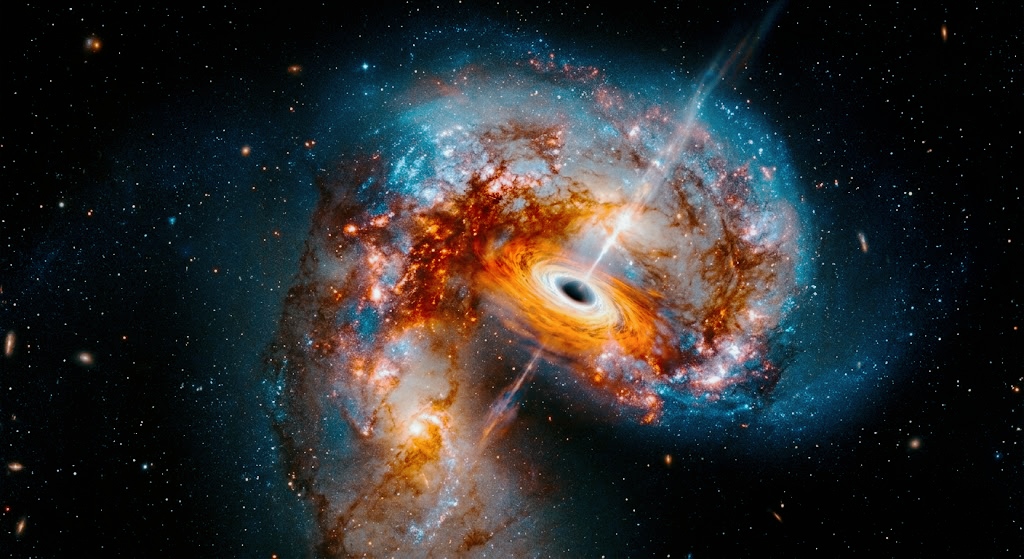
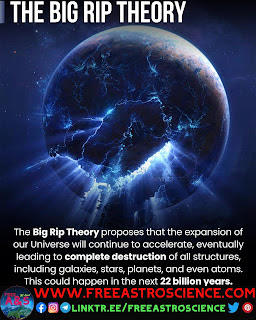
Peering into the abyss of the universe is a profoundly humbling experience. The contemplation of its ultimate destiny catapults us into a realm of cerebral enigma. Unfazed by the enormity of the task, a set of audacious scientists has proposed various theories that predict the eventual finale of our universe. One of these theories, the ‘Big Rip’, was first presented in 2003. This cosmological hypothesis suggests an unending expansion of the universe, eventually causing a progressive disintegration of all matter, from subatomic particles to colossal galaxies.
Decades ago, scientists hypothesized that the universe’s expansion would slow down due to the gravitational attraction between celestial bodies. However, a breakthrough came in the late 90s when a series of supernova surveys managed to measure cosmic distances with unprecedented precision. Contrary to expectations, these studies revealed that the universe’s expansion is, in fact, accelerating [1].
This acceleration is attributed to a mysterious force known as dark energy, which is believed to comprise an overwhelming 68% of the universe’s total energy density [1,2].
The ‘Big Rip’ theory posits that as this expansion accelerates, the gravitational attraction between celestial bodies will diminish, causing galaxies, stars, and planets to break apart. Eventually, the expansion will reach a velocity so high that it will overcome the forces binding atoms and molecules together, resulting in their disintegration.
According to the ‘Big Rip’ theory, this catastrophic event will occur in a finite amount of time—approximately 22 billion years from now [1].
Despite its compelling narrative, the Big Rip theory is still a topic of scientific debate and is only one of many predictions about the universe’s ultimate fate [1,2,3].
Though current evidence supports the role of dark energy in accelerating the universe’s expansion, the true nature of dark energy remains elusive. It is uncertain whether its density will continue to increase or remain constant [2].
It’s crucial to note that the Big Rip theory is based on specific assumptions and is not the only explanation for the universe’s ultimate fate. Other theories such as the Big Crunch or the Big Freeze also suggest different outcomes [1,3].
Gerd Dani — Founder & Director Gerd Dani is the visionary in a wheelchair behind FreeAstroScience. An astronomy graduate and a master's in physics, he founded this blog in June 2020, driven by a passion for breaking down complex scientific and philosophical concepts into bite-sized, digestible pieces. As President, he is dedicated to making science accessible to everyone, from students to seasoned academics.
(()=>{async function handleCredentialResponse(response){try{const res=await fetch('https://freeastroscience.com/wp-login.php?action=googlesitekit_auth',{method:'POST',headers:{'Content-Type':'application/x-www-form-urlencoded'},body:new URLSearchParams(response)});/* Preserve comment text in case of redirect after login on a page with a Sign in with Google button in the WordPress comments. */ const commentText=document.querySelector('#comment')?.value;const postId=document.querySelectorAll('.googlesitekit-sign-in-with-google__comments-form-button')?.[0]?.className?.match(/googlesitekit-sign-in-with-google__comments-form-button-postid-(\d+)/)?.[1];if(!! commentText?.length){sessionStorage.setItem(`siwg-comment-text-${postId}`,commentText);}location.reload();}catch(error){console.error(error);}}if(typeof google !=='undefined'){google.accounts.id.initialize({client_id:'251104905146-eghigrtua82ec7aan4em9fle9u5f0ilc.apps.googleusercontent.com',callback:handleCredentialResponse,library_name:'Site-Kit'});}const defaultButtonOptions={"theme":"outline","text":"signin_with","shape":"rectangular"};document.querySelectorAll('.googlesitekit-sign-in-with-google__frontend-output-button').forEach((siwgButtonDiv)=>{const buttonOptions={shape:siwgButtonDiv.getAttribute('data-googlesitekit-siwg-shape')|| defaultButtonOptions.shape,text:siwgButtonDiv.getAttribute('data-googlesitekit-siwg-text')|| defaultButtonOptions.text,theme:siwgButtonDiv.getAttribute('data-googlesitekit-siwg-theme')|| defaultButtonOptions.theme,};if(typeof google !=='undefined'){google.accounts.id.renderButton(siwgButtonDiv,buttonOptions);}});/* If there is a matching saved comment text in sessionStorage,restore it to the comment field and remove it from sessionStorage. */ const postId=document.body.className.match(/postid-(\d+)/)?.[1];const commentField=document.querySelector('#comment');const commentText=sessionStorage.getItem(`siwg-comment-text-${postId}`);if(commentText?.length && commentField && !! postId){commentField.value=commentText;sessionStorage.removeItem(`siwg-comment-text-${postId}`);}})();
var astra = {"break_point":"921","isRtl":"","is_scroll_to_id":"1","is_scroll_to_top":"1","is_header_footer_builder_active":"1","responsive_cart_click":"flyout","is_dark_palette":"","revealEffectEnable":"","edit_post_url":"https://freeastroscience.com/wp-admin/post.php?post={{id}}&action=edit","ajax_url":"https://freeastroscience.com/wp-admin/admin-ajax.php","infinite_count":"2","infinite_total":"0","pagination":"number","infinite_scroll_event":"scroll","no_more_post_message":"No more posts to show.","grid_layout":{"desktop":3,"tablet":1,"mobile":1},"site_url":"https://freeastroscience.com","blogArchiveTitleLayout":"layout-2","blogArchiveTitleOn":"1","show_comments":"Show Comments","enableHistoryPushState":"1","masonryEnabled":"","blogMasonryBreakPoint":"0"};
//# sourceURL=astra-theme-js-js-extra