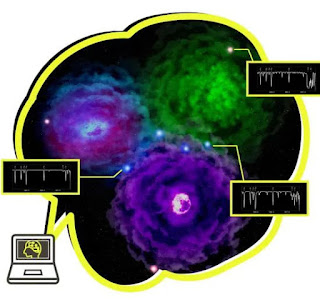

Most second-generation stars were enriched with elements produced by supernovae from first-generation stars, likely born in clusters or binary systems, according to a study led by Tilman Hartwig from the University of Tokyo. Heavy elements like carbon are generated within stars; while first-generation stars formed shortly after the Big Bang lack these elements, second-generation stars contain small amounts of heavy elements created by their predecessors.
Studying second-generation stars, which are present in the Milky Way, helps researchers understand the universe’s early stages. The team investigated these stars’ properties to learn about the physical characteristics of the first stars. They developed a machine learning algorithm to determine if observed stars came from ejections of one or several supernovae based on their elemental spectrum.
The researchers found that nearly 68% of the observed low-metal stars have chemical signatures consistent with enrichment by previous supernovae, suggesting that most first-generation stars formed in small clusters. Chiaki Kobayashi, a professor at the University of Hertfordshire, explained that the first stars were likely more massive than the Sun and born within clouds of gas millions of times the Sun’s mass. As the first stars were likely born in binary or multiple star systems, they may have generated gravitational waves, which could potentially be detected through space missions or on the Moon.
The study’s findings were published in The Astrophysical Journal.