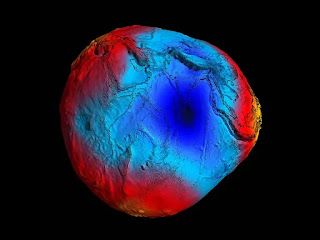

Gravity incessantly exerts its force on our globe, yet Earth’s uneven topography – a hodgepodge of terrains, trenches, and crevices, often referred to as the geoid – disrupts its uniformity. A significant anomaly lies in the depths of the Indian Ocean, where gravity’s grip lessens over an expansive area of three million square kilometers, creating a gravitational “void”. This anomaly is attributed to a substantial depression in the seafloor, making it one of the largest recorded gravitational inconsistencies on Earth. Research conducted via sea expeditions and satellite imaging revealed a drop in sea level near the Indian subcontinent, attributed to this gravitational pull.
Two esteemed researchers from the Indian Institute of Science propose a theory for this intriguing phenomenon. Their explanation points a thousand kilometers beneath the surface, where ancient, dense remnants of a bygone ocean descended into a “slab graveyard” beneath present-day Africa around 30 million years ago. These remnants stirred up a boiling mass of molten rock. However, their computer model-based findings do not completely demystify the origins of this gravitational anomaly, leaving room for further exploration and data collection.
As research persists, this discovery stands as a testament to Earth’s intricate complexity and the immense forces that sculpt its form. In the interim, we can only stand in awe of these vast gravitational anomalies, waiting expectantly for more illuminating data.