Inside Trionda: How a Rechargeable Chip and Clever Aerodynamics Built Football’s Smartest Ball
What if the most important player at the 2026 FIFA World Cup isn’t a player at all, but the ball itself? Welcome, dear friends of FreeAstroScience, wherever you’re reading us from. Whether you’re a die-hard fan counting the hours to kickoff or someone who’s never watched ninety minutes of football in your life, this story belongs to you. It’s a tale of physics, electronics, and human ingenuity squeezed into a sphere that gets kicked, squashed, and smashed at 200 km/h. We wrote this piece specifically for you, in plain words, the way we always do here. Stay with us to the very end, and we promise you’ll watch the World Cup with completely new eyes.
📑 What You’ll Find in This Article
- What Exactly Is the Trionda Ball?
- Why Does a Soccer Ball Need Recharging?
- How Do You Hide a Chip Without Ruining the Balance?
- Blind Tests and 200 km/h Robot Kicks: Did Players Notice?
- Will Trionda Fly Straighter Than Past World Cup Balls?
- What’s the Physics Behind the “Drag Crisis”?
- How Does the Ball’s “Heartbeat” Help VAR and Offside Calls?
- Could the Design Trick Goalkeepers?
- Final Thoughts
- FAQ
What Exactly Is the Trionda Ball?
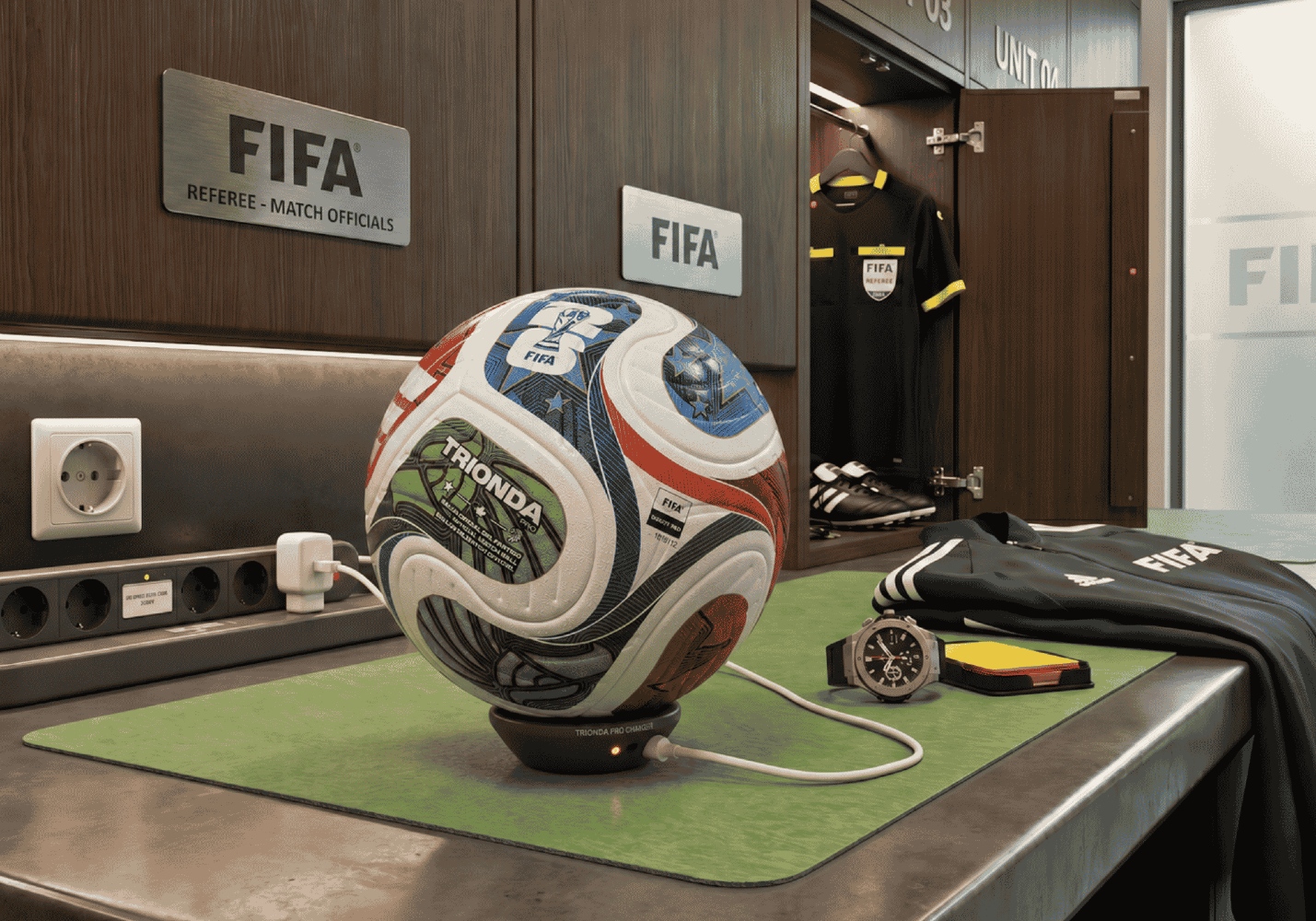
Picture this. June 11, 2026. Hours before the opening whistle of the first 48-team World Cup in history, split across the United States, Canada, and Mexico. Cameras chase the stars. Meanwhile, in a referee’s locker room, something quietly absurd is happening: a football is plugged into a charging base, sitting next to the whistles and the yellow cards.
That ball is Trionda, made by the German company Adidas. Its red, green, and blue waves salute the three host nations. Pretty, sure. But the real story hides under the skin: a motion sensor that talks to the VAR room in real time.
We’ve spent years at FreeAstroScience explaining black holes and quantum spin. Honestly? Fitting precision electronics inside the most abused object in sport is a physics puzzle worthy of the same respect.

Why Does a Soccer Ball Need Recharging?
Trionda is a ball and an electronic device at the same time. According to technical and journalistic reconstructions, its connected module gets charged before use, with enough battery to cover an entire match. Shirts, boots, and… a ball on a charging dock. That’s the 2026 pre-match ritual.
The heart of the system is a 500 Hz inertial measurement unit (IMU). In plain terms, it records data 500 times per second — once every 2 milliseconds. That sounds like overkill until you remember what referees need: the exact instant the ball is touched. That single data point can decide an offside call, reveal a deflection, or expose a sneaky handball.
Quick history check: the Al Rihla ball at Qatar 2022 already carried an IMU, working with the semi-automated offside system. Trionda is the next generation of this connected ball technology, developed by Adidas together with Kinexon, a company specialized in sports tracking.
How Do You Hide a Chip Without Ruining the Balance?
Here’s where the engineering gets spicy. In 2022, the chip sat at the center of the sphere, held by tension cords. In Trionda, the electronics moved sideways, under one of the four panels. Easier to build, yes. But it creates a genuine physics problem.
Think of a washing machine with all the laundry bunched on one side. It wobbles like crazy. A ball with extra mass on one panel would do the same in flight: the center of gravity shifts, and the trajectory goes rogue.
The fix is elegant. The chip lives in one of the 4 panels, while the other 3 panels carry counterweight elements that restore the ball’s balance. Mass distributed, wobble cancelled, physics satisfied.
Blind Tests and 200 km/h Robot Kicks: Did Players Notice?
Could you feel a microchip with your foot? Professional players were asked to find out, without being told. Adidas ran blind tests: some balls had the sensor, some didn’t, and the pros kicked away with no idea which was which.
The result, according to international press reports: players couldn’t reliably tell the chipped ball from the regular one. That matters enormously. Elite footballers feel tiny differences in weight and behavior. Making the technology invisible is just as important as making it work.
The lab tests were brutal, too. Kicking robots fired the ball at speeds reported up to 200 km/h — far beyond most real shots — to stress-test the thermo-bonded seams, the structure, and the flight stability. The ball also went through climate chambers and real-world trials. CBS Sports and ge/Globo report field testing in seven host cities; other sources say six. Either way, the goal was the same: with 16 host cities spanning humid coasts, high-altitude stadiums, and everything in between, the ball had to behave the same everywhere.
Will Trionda Fly Straighter Than Past World Cup Balls?
Now for the part we physicists genuinely love. A study published in the journal Applied Sciences compared Trionda with four of its ancestors in wind-tunnel tests. Here’s the family reunion:
| Ball | World Cup | Claim to Fame | Connected Sensor? |
|---|---|---|---|
| Jabulani | 2010 (South Africa) | Infamous for wild, unpredictable swerves that drove goalkeepers mad | No |
| Brazuca | 2014 (Brazil) | Rougher seams, widely seen as a steadier flyer | No |
| Telstar 18 | 2018 (Russia) | Retro panel look with modern construction | No (NFC tag only, no match tracking) |
| Al Rihla | 2022 (Qatar) | First World Cup ball with a centrally mounted IMU for semi-automated offside | Yes — central chip on tension cords |
| Trionda | 2026 (USA, Canada, Mexico) | 500 Hz IMU under a side panel, counterweights in the other 3 panels, drag crisis at lower speeds | Yes — lateral chip, rechargeable module |
The headline finding: Trionda reaches its drag crisis at lower speeds than its predecessors. Its rougher surface — those raised motifs and grooves you can see up close — triggers the transition earlier, right around the speeds of a typical free kick or goal kick.
The practical translation? Compared with editions from a few years back, we can expect less chaotic trajectories at medium and high speeds. Fewer sudden wobbles. More predictability. If you’re over 40 and ever played with a featherweight “Super Tele” beach ball that swerved like a drunken seagull, you know exactly the effect this design wants to kill.
What’s the Physics Behind the “Drag Crisis”?
Time for a 60-second physics class — FreeAstroScience style, no jargon left unexplained.
As a ball flies, air flows around it. At lower speeds, that flow is laminar: smooth, orderly layers. Push past a certain speed and the flow turns turbulent: messy and chaotic. Here’s the counterintuitive twist. Turbulent air actually clings to the ball’s surface more stubbornly, shrinking the low-pressure wake behind it. Drag drops sharply, and the flight stabilizes. That sudden drop is the drag crisis.
The force we’re talking about obeys a classic equation:
FD = 12 ρ v² CD A
FD = drag force • ρ = air density • v = ball speed • CD = drag coefficient • A = cross-sectional area
Notice the v²: double the speed and drag quadruples. A rough surface lowers the speed at which CD collapses, which is exactly Trionda’s trick.
There’s a small catch, though. The same study suggests Trionda may carry a slightly higher drag coefficient than some recent balls. Simulations point to a possible modest reduction in range on long kicks, especially shots with little or no spin. Goal kicks, long switches of play, and deep launches might need a touch of recalibration from players.
Should we bet on shorter, more “readable” flights across the board? We’d be careful. Almost every kicked ball carries spin, and spin reshapes a trajectory dramatically. Trionda looks built for stability and predictability, but football will keep a little chaos in its back pocket. Frankly, we wouldn’t want it any other way.
How Does the Ball’s “Heartbeat” Help VAR and Offside Calls?
Here’s the genuinely revolutionary part. The internal sensor records accelerations, vibrations, and changes in motion. Every contact produces a signal — a kind of “heartbeat” on the digital timeline of the action.
That pulse helps referees pinpoint every single touch: a deflection, a double contact, a grazed flick, a possible handball. Let’s be precise, though. The ball doesn’t become an automatic referee. The sensor can’t decide whether a handball deserves punishment. It hands officials one extra piece of evidence, synchronized with the video, cutting dead time and shrinking the room for argument.
Semi-automated offside: a two-instrument duet
For offside, the connected ball plays a duet with tracking cameras. The cameras reconstruct where every player stands; the ball’s sensor pins the exact instant of the pass. Cross those two data streams and you can rebuild the whole action — who was where, and precisely when the ball left the passer’s foot. That’s also where the 3D animations on TV and stadium screens come from, replacing the hand-drawn lines and endless replays of just a few years ago.
One thing the chip does NOT do
The chip doesn’t replace Goal-Line Technology. Deciding whether the whole ball crossed the goal line stays the job of dedicated optical systems: high-speed cameras aimed at the goals. The IMU measures movement and contact; it can’t, on its own, locate the entire surface of the sphere relative to that white line. Different questions, different instruments. Good science respects that.
Could the Design Trick Goalkeepers?
One open question is human, not technological: visual perception. Trionda is deliberately loud, with big red, green, and blue panels. Standing still, it’s iconic. Spinning at high speed on a thunderous strike? The picture might blur.
Goalkeepers are the harshest critics of any World Cup ball. They don’t just judge weight, bounce, and flight — they judge how fast they can read the spin and direction of the sphere. If the graphics turn muddy at high velocity, expect grumbles echoing the great ball controversies of the past. We’ll be watching, and so will every keeper from Vancouver to Mexico City.
One last note before you rush to a shop: the ball sold in stores won’t carry the match-day electronics. The retail line, starting from the Trionda Pro model, mimics the materials, texture, and construction of the official ball — minus the chip reserved for the World Cup itself. Your wallet charges; the ball, in this case, doesn’t.
Final Thoughts: A Sphere Full of Questions
So, what have we learned together? Trionda is far more than a colorful sphere. It’s a rechargeable 500 Hz sensor wrapped in counterbalanced panels, hardened by 200 km/h robot kicks and climate chambers, shaped by wind-tunnel science to fly more honestly than the infamous Jabulani, and wired to whisper every touch to the VAR room — while wisely leaving goal-line calls to the optical specialists.
Beyond football, this little ball asks a bigger question: how much technology do we want inside our games, and where does helpful evidence end and over-automation begin? Sit with that thought during the tournament. The answer isn’t settled, and that’s precisely what makes it worth thinking about.
This article was written specifically for you by FreeAstroScience.com, where we break down complex scientific principles into simple, honest language. Our mission has never changed: we want to educate you to never switch off your mind, to keep it awake and questioning at all times — for the sleep of reason breeds monsters. Come back and visit us soon. There’s always another piece of the universe waiting to be understood, together.
❓ Frequently Asked Questions About the Trionda Ball
Does the 2026 World Cup ball really need to be charged before matches?
Yes. According to technical and journalistic reconstructions, Trionda’s connected module is charged before use on a charging base, with enough battery autonomy to cover the entire match activity. What does the 500 Hz sensor inside Trionda actually do?
The 500 Hz inertial measurement unit (IMU) records motion data 500 times per second — once every 2 milliseconds. It detects every contact with the ball and sends that information to the VAR room in real time, helping officials identify touches, deflections, and the exact moment a pass begins for semi-automated offside decisions. Doesn’t a chip on one side unbalance the ball?
It would, if left uncorrected. Adidas placed the electronics under one of the four panels and added compensation elements inside the other three panels, preserving the ball’s center of gravity and flight behavior. In blind tests, professional players couldn’t reliably distinguish chipped balls from chip-free ones. Will Trionda fly differently from previous World Cup balls?
A study in Applied Sciences, comparing Trionda with Jabulani (2010), Brazuca (2014), Telstar 18 (2018), and Al Rihla (2022), found its rougher surface triggers the drag crisis at lower speeds. That should mean steadier, more predictable trajectories — with a possible slight reduction in range on long, low-spin kicks due to a marginally higher drag coefficient. Can I buy the same smart ball used in official matches?
No. The retail version, starting with the Trionda Pro model, replicates the materials, texture, and construction of the match ball but ships without the electronic sensor, which is reserved for official World Cup games.
📚 Sources & References
- Graziosi, R. (June 11, 2026). “Mondiali 2026: dentro Trionda, il pallone hi-tech con un microchip che va ricaricato prima della partita” — Focus.it. Primary source for this article.
- Applied Sciences (MDPI) — wind-tunnel study comparing Trionda with Jabulani 2010, Brazuca 2014, Telstar 18, and Al Rihla 2022, cited in the Focus.it report.
- Adidas — official manufacturer information on Trionda and Connected Ball Technology, as reported by Focus.it.
- Kinexon — sports-tracking technology partner behind the connected ball system, as reported by Focus.it.
- CBS Sports and ge/Globo — field-testing reports across six to seven host cities, as cited in the Focus.it article.