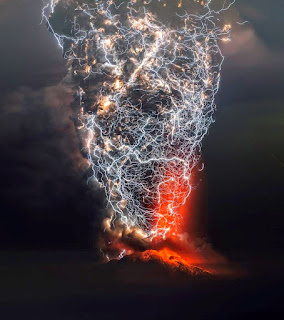

Have you ever had the chance to witness the breathtaking spectacle of a lightning tornado? Just imagine the awe inspiring sight it must be! But in reality what might appear as a captured photograph of a lightning tornado is actually the result of photography techniques.
This remarkable image truly showcases the power of exposure photography. It was meticulously created by combining individual shots taken over a span of approximately 3 to 4 minutes. By doing the photographer was able to capture various instances of lightning strikes that occurred intermittently resulting in the illusion of simultaneous strikes in the final composite image.
In this photograph we are presented with a scene where bolts of lightning seem to envelop a towering column that resembles ash. However this is not actually an ash column; it is an ash plume forcefully expelled from Chiles Calbuco volcano during its eruption in 2015.
The swirling lightning surrounding the ash column creates an awe inspiring effect of a tornado. This view surpasses anything we would consider ordinary and leaves us mesmerized by natures beauty. The striking presence of those lightning bolts adds intensity to the ash column further enhancing its captivating nature.
This enthralling photograph was captured by Francisco Negroni, a photographer known for his skill, in capturing natures most mesmerizing moments.
The photographers skillful blend of timing, patience and technical knowledge has yielded a photograph that goes beyond capturing a moment. Instead it provides viewers with an opportunity to experience the awe inspiring power of nature.
In essence this image of a “lightning tornado” serves as an example of how the convergence of natural phenomena and expert photography can produce something truly extraordinary. It presents a mesmerizing composition that showcases electrifying bolts and volcanic intensity all captured within a frame.