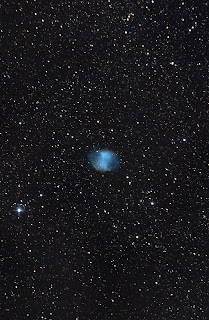
The Dumbbell Nebula is being produced by a very hot white dwarf that has been ejecting gas for thousands of years. That white dwarf is the remaining core of the original red giant.
A Soviet astronomer, O.N. Chudowitchera, estimated that the nebula’s brightest part is expanding 6.8 arc seconds every century which would make it 3,000 to 4,000 years old.
Robert Burnham estimated that the nebula’s brightest part was expanding 1.0 arc seconds every second which would make it around 48,000 years old.
Another name for the Dumbbell Nebula is the “Apple Core Nebula.”
The Dumbbell Nebula has a visual magnitude of 7.5, which means it can be readily seen with a telescope or even binoculars. September is the best month for observing the Dumbbell Nebula.
The Hubble Space Telescope also provided the current estimated distance for the Dumbbell Nebula; earlier estimates had ranged from 490 to 3500 lightyears.
William Herschel (1738 – 1822) thought the nebula looked like an hourglass or dumbbell and thus gave it its best-known name. He was also the first person to identify the Dumbbell Nebula as a planetary nebula.
The Dumbbell Nebula is the second-largest known planetary nebula; only the Helix Nebula is bigger.
Its white dwarf is the largest known with a radius of 0.055 solar radii and 0.56 solar masses. Its temperature is estimated to be 85,000 K (152,540.33 F).
The white dwarf may have a yellow companion star.
The nebula produces infrared light as well as visible light.
The Dumbbell Nebula is much brighter than its star because the star produces mainly non-visible radiation.
The Dumbbell Nebula is about 100 times as bright as the Sun.
Gerd Dani — Founder & Director Gerd Dani is the visionary in a wheelchair behind FreeAstroScience. An astronomy graduate and a master's in physics, he founded this blog in June 2020, driven by a passion for breaking down complex scientific and philosophical concepts into bite-sized, digestible pieces. As President, he is dedicated to making science accessible to everyone, from students to seasoned academics.
(()=>{async function handleCredentialResponse(response){try{const res=await fetch('https://freeastroscience.com/wp-login.php?action=googlesitekit_auth',{method:'POST',headers:{'Content-Type':'application/x-www-form-urlencoded'},body:new URLSearchParams(response)});/* Preserve comment text in case of redirect after login on a page with a Sign in with Google button in the WordPress comments. */ const commentText=document.querySelector('#comment')?.value;const postId=document.querySelectorAll('.googlesitekit-sign-in-with-google__comments-form-button')?.[0]?.className?.match(/googlesitekit-sign-in-with-google__comments-form-button-postid-(\d+)/)?.[1];if(!! commentText?.length){sessionStorage.setItem(`siwg-comment-text-${postId}`,commentText);}location.reload();}catch(error){console.error(error);}}if(typeof google !=='undefined'){google.accounts.id.initialize({client_id:'251104905146-eghigrtua82ec7aan4em9fle9u5f0ilc.apps.googleusercontent.com',callback:handleCredentialResponse,library_name:'Site-Kit'});}const defaultButtonOptions={"theme":"outline","text":"signin_with","shape":"rectangular"};document.querySelectorAll('.googlesitekit-sign-in-with-google__frontend-output-button').forEach((siwgButtonDiv)=>{const buttonOptions={shape:siwgButtonDiv.getAttribute('data-googlesitekit-siwg-shape')|| defaultButtonOptions.shape,text:siwgButtonDiv.getAttribute('data-googlesitekit-siwg-text')|| defaultButtonOptions.text,theme:siwgButtonDiv.getAttribute('data-googlesitekit-siwg-theme')|| defaultButtonOptions.theme,};if(typeof google !=='undefined'){google.accounts.id.renderButton(siwgButtonDiv,buttonOptions);}});/* If there is a matching saved comment text in sessionStorage,restore it to the comment field and remove it from sessionStorage. */ const postId=document.body.className.match(/postid-(\d+)/)?.[1];const commentField=document.querySelector('#comment');const commentText=sessionStorage.getItem(`siwg-comment-text-${postId}`);if(commentText?.length && commentField && !! postId){commentField.value=commentText;sessionStorage.removeItem(`siwg-comment-text-${postId}`);}})();
var astra = {"break_point":"921","isRtl":"","is_scroll_to_id":"1","is_scroll_to_top":"1","is_header_footer_builder_active":"1","responsive_cart_click":"flyout","is_dark_palette":"","revealEffectEnable":"","edit_post_url":"https://freeastroscience.com/wp-admin/post.php?post={{id}}&action=edit","ajax_url":"https://freeastroscience.com/wp-admin/admin-ajax.php","infinite_count":"2","infinite_total":"0","pagination":"number","infinite_scroll_event":"scroll","no_more_post_message":"No more posts to show.","grid_layout":{"desktop":3,"tablet":1,"mobile":1},"site_url":"https://freeastroscience.com","blogArchiveTitleLayout":"layout-2","blogArchiveTitleOn":"1","show_comments":"Show Comments","enableHistoryPushState":"1","masonryEnabled":"","blogMasonryBreakPoint":"0"};
//# sourceURL=astra-theme-js-js-extra