
Skip to content
Skip to content
Wednesday, May 27, 2026
  • Home
  • WHO WE ARE
  • Terms of Use and Disclaimer
  • Our Editorial Policy
  • Privacy Policy
FreeAstroScience logo with a glowing star, open book, and Earth on a space-themed circular badge with the tagline Igniting Curiosity for free astronomy science education

FreeAstroScience

  • Home
  • Astronomy
    • AstroPhysics
    • Cosmology
    • Exploration
  • Physics
  • Hi-Tech
    • A.I.
    • Robots
  • Healh
  • Lifestyle
    • Sport
    • Music
  • Environment
    • ClimateChange
  • Biology
  • Gerd’s
FreeAstroScience logo with a glowing star, open book, and Earth on a space-themed circular badge with the tagline Igniting Curiosity for free astronomy science education

FreeAstroScience

  • Home
  • Astronomy
    • AstroPhysics
    • Cosmology
    • Exploration
  • Physics
  • Hi-Tech
    • A.I.
    • Robots
  • Healh
  • Lifestyle
    • Sport
    • Music
  • Environment
    • ClimateChange
  • Biology
  • Gerd’s
  • Latest
  • Popular

Galaxies shaped by cosmic location just 1.2 billion years after the Big Bang

May 27, 2026May 27, 2026

Mercury’s polar water ice: new models suggest a larger, slower impact source

May 26, 2026May 26, 2026

New Cell Therapy Offers Hope for Advanced Liver Disease Patients

May 25, 2026May 25, 2026

Dark matter investigations: quantum limits and the classical field behavior of axions

May 25, 2026May 25, 2026

Astrophysics

    Hydrogen: The Most Abundant Element in the Universe

    Gerd DaniFebruary 20, 2021March 28, 20260

    Hydrogen reigns supreme as the most abundant element in the universe, constituting a staggering 73% of all visible matter. Helium…
    Read More

      What are Rogue planets?

      Gerd DaniFebruary 19, 2021March 28, 20260

      When we look out into the night sky, we see a cosmos filled with stars. The distances between the stars…
      Read More

        What is the Observable universe?

        Gerd DaniFebruary 15, 2021March 28, 20260

        The observable universe is a spherical region of the universe comprising all matter that can be observed from Earth or…
        Read More

          Quasars – The Brightest objects in the Universe

          Gerd DaniFebruary 14, 2021March 28, 20260

          Shining so brightly these astronomical objects outshine the galaxies they reside in, which makes them visible from a distance of…
          Read More

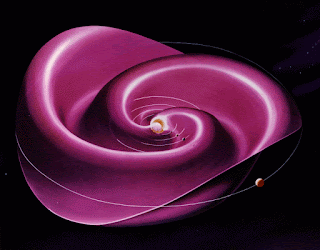
            What is the INTERPLANETARY MAGNETIC FIELD?

            Gerd DaniFebruary 10, 2021March 28, 20260

            The interplanetary magnetic field (IMF), commonly referred to as the heliospheric magnetic field (HMF), is the component of the solar…
            Read More

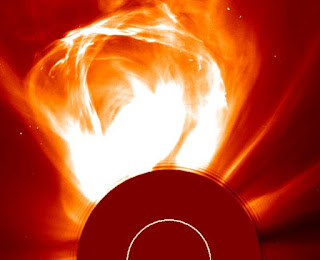
              What is A coronal mass ejection (CME)?

              Gerd DaniFebruary 9, 2021March 28, 20260

              A coronal mass ejection (CME) is a significant release of magnetized plasma consisting primarily of electrons and protons and accompanying…
              Read More

                At Cosmic Noon, Puffy Galaxies form Stars for Longer

                Gerd DaniFebruary 9, 2021March 28, 20260

                ​​​​​​​In a paper published in the Astrophysical Journal, researchers led by Dr Anshu Gupta and Associate Professor Kim-Vy Tran from…

                Read More

                  What is Polchinski’s paradox?

                  Gerd DaniFebruary 7, 2021March 28, 20260

                   The Polchinski paradox provides a succinct representation of the complications surrounding time travel at a macroscopic scale. By proposing a…

                  Read More

                    What are the Cosmic Strings?

                    Gerd DaniFebruary 7, 2021March 28, 20260

                    Cosmic strings are hypothetical 1-dimensional topological defects which may have formed during a symmetry-breaking phase transition in the early universe…

                    Read More

                      50,000 tons of water and the size of a 15-storey building: this is the Super-Kamiokande, the super neutrino observatory

                      Gerd DaniFebruary 4, 2021March 28, 20260

                       “Matter is no obstacle for the neutrino. A neutrino could pass through 100 light years of steel without even braking”….

                      Read More
                      • 1
                      • …
                      • 170
                      • 171
                      • 172
                      • 173
                      • 174
                      FreeAstroScience – Donation Widget (WordPress)
                      Support FreeAstroScience

                      Help us keep astronomy & science education free for everyone. Every contribution fuels open-access knowledge.

                      Donate with PayPal
                      100% goes to free science education & open-access research
                      Secure via PayPal

                      Sports

                      Free AstroScience - All rights Reserved
                      • Privacy Policy
                      • WHO WE ARE
                      • CONSTITUTION OF FREEASTROSCIENCE
                      • Contact Us
                      • Work With Us
                      • Our Editorial Policy
                      • Comprehensive AI Policy for FreeAstroScience.com
                      Back To Top