What Shape Is the Universe — And Why Does the Answer Change Everything?

Have you ever stared up at the night sky and wondered — not just how big the universe is, but what shape it has? Is it a giant sphere? A flat, endless sheet? Something so strange that no human mind has ever truly pictured it? That question isn’t just poetic. It sits at the very heart of modern cosmology, and scientists are still working hard to answer it.

Welcome to FreeAstroScience.com — the place where we take the most mind-bending ideas in science and make them feel like a conversation between friends. We’re Gerd Dani and the whole FreeAstroScience team, and we believe that understanding the universe isn’t a privilege reserved for physicists in ivory towers. It belongs to all of us — to you, sitting on the train, sipping your coffee, wondering what’s out there.

In this article, we’re going to walk you through everything we currently know about the shape of the universe. We’ll cover the geometry, the mathematics, the cosmic microwave background, inflation theory, dark energy, and even the wild idea that our universe might be just one of infinitely many. We’ll be honest about what we don’t know, too — because science is as much about open questions as it is about answers.

Stick with us to the end. We promise it’ll be worth it.

⚡ TL;DR — Quick Answer

Based on the best available data — particularly from the ESA Planck satellite’s 2018 results — the universe appears to be geometrically flat, with a total density parameter of Ωtotal = 1.0007 ± 0.0019, indistinguishable from perfect flatness. This means parallel lines stay parallel, the angles of a triangle add up to exactly 180°, and the universe is likely infinite in extent. Inflation theory explains why it’s so flat, but the ultimate shape (its topology) remains an open question in cosmology.

What Does “Shape” Even Mean for the Universe?

When we ask about the shape of the universe, we’re actually asking two very different questions. Most people don’t realise that. Let’s separate them clearly.

Geometry: The Local Rules of Space

The first question is about geometry — the local curvature of space. Think of it this way: if you draw a triangle on a flat piece of paper, its angles add up to 180°. That’s Euclidean geometry. But if you draw a triangle on the surface of a globe — say, from the North Pole down to the equator and back — the angles add up to more than 180°. And on a saddle-shaped surface, they add up to less. The geometry of the universe tells us which of these rules applies to the fabric of space itself.

Topology: The Global Structure

The second question is about topology — the overall, global structure of space. Topology doesn’t care about local curvature. It asks: is the universe finite or infinite? Does it wrap around on itself? Could you, in principle, travel in a straight line and eventually come back to where you started — like an ant walking around a balloon?

Here’s a great analogy. Imagine you’re an ant living on the surface of a cylinder. Locally, the surface looks flat — your geometry is Euclidean. But globally, if you walk in one direction long enough, you come back to your starting point. The geometry is flat, but the topology is non-trivial. The universe could work exactly like that.

🔑 Key Distinction: Geometry tells us about the curvature of space. Topology tells us about its overall connectivity. A flat universe can still be finite. A curved universe can still be infinite. These are separate questions, and both matter enormously.

When cosmologists talk about the “shape” of the universe, they usually mean geometry first. But the topology question is just as fascinating — and far less settled. We’ll get to both.

The Three Geometric Models: Flat, Open, and Closed

General relativity — Einstein’s masterpiece, published in 1915 — tells us that space can be curved by mass and energy. On the largest scales, the universe’s overall curvature depends on one thing above all: how much stuff (matter + energy) it contains compared to a critical threshold. Cosmologists call this the density parameter, Ω (the Greek letter omega).

There are exactly three possibilities.

1. The Flat Universe (k = 0, Ω = 1)

If the total energy density of the universe exactly equals the critical density, space is perfectly flat. Euclidean geometry rules. Parallel lines stay parallel forever. A triangle’s angles always sum to 180°. The universe extends infinitely in all directions — or at least, it could. This is what the data currently points to.

The critical density today is approximately 9.47 × 10⁻²⁷ kg/m³ — about 5 hydrogen atoms per cubic metre of space. That’s almost nothing. The universe is extraordinarily empty, and yet that tiny amount of stuff is enough to determine its geometry.

2. The Closed Universe (k = +1, Ω > 1)

If there’s more energy than the critical density, space curves positively — like the surface of a sphere. Parallel lines eventually converge. A triangle’s angles sum to more than 180°. Travel far enough in any direction, and you’d come back to where you started. The universe would be finite, with no edge — just like the surface of a sphere has no edge, but is still finite in area.

A closed universe would eventually stop expanding and collapse back on itself in what cosmologists call the Big Crunch. It’s a dramatic ending — the universe imploding back to a singularity.

3. The Open Universe (k = −1, Ω < 1)

If there’s less energy than the critical density, space curves negatively — like a saddle or a Pringle chip. Parallel lines diverge. A triangle’s angles sum to less than 180°. The universe is infinite and expands forever, growing colder and emptier as time goes on — a scenario sometimes called the Big Freeze.

🌍 Real-World Analogy: Think of the three models as three different kinds of surfaces. Flat = a table. Closed = a basketball. Open = a saddle. Now imagine those surfaces extending in three dimensions instead of two, and you’ve got the basic idea of cosmic geometry.
Diagram comparing the three possible geometries of the universe: a positively curved closed sphere where the density parameter Omega is greater than 1, a flat plane where Omega equals 1, and a negatively curved open saddle where Omega is less than 1. Each surface shows a triangle illustrating how its angles sum to more than, exactly, or less than 180 degrees.
The three geometric models of the universe. A closed (spherical) universe has Ω > 1 and triangle angles that sum to more than 180°; a flat (Euclidean) universe has Ω = 1 and angles that sum to exactly 180°; an open (hyperbolic) universe has Ω < 1 and angles that sum to less than 180°. Current data places our universe at, or extremely close to, the flat case.

The key insight is that these aren’t just abstract mathematical possibilities. Each one predicts a different future for the universe, a different behaviour for light travelling across cosmic distances, and different patterns in the cosmic microwave background. The geometry of the universe is physically real and observationally testable.

The Mathematics Behind It All

Don’t worry — we’re not going to lose you here. The maths is beautiful, and we’ll explain every piece of it in plain language. These equations are the grammar of the cosmos.

The FLRW Metric: Describing an Expanding Universe

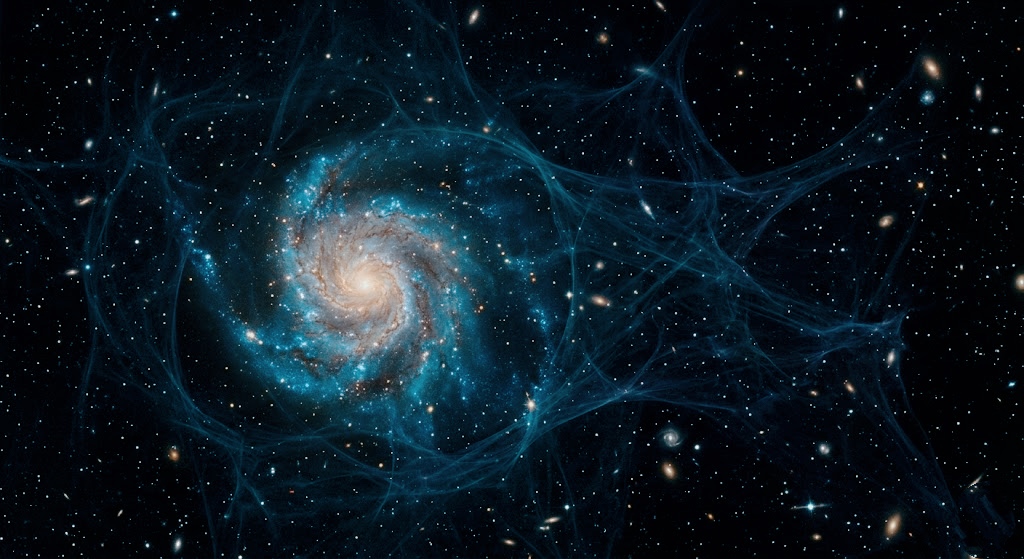
The foundation of modern cosmology is the Friedmann–Lemaître–Robertson–Walker (FLRW) metric. It describes the geometry of a homogeneous, isotropic, expanding universe. In other words, it’s the mathematical description of a universe that looks the same in every direction and at every point — which, on the largest scales, ours does.

The FLRW Metric \[ ds^2 = -c^2\,dt^2 + a(t)^2\!\left[\frac{dr^2}{1 – k r^2} + r^2\,d\Omega^2\right] \]

What this says in plain English: The “distance” between two events in spacetime (ds²) depends on time (dt), the expansion factor a(t) — which tells us how much the universe has stretched since the Big Bang — the radial distance (dr), and the angular part (dΩ²). The curvature constant k is the key: k = 0 means flat, k = +1 means closed (spherical), k = −1 means open (hyperbolic). The function a(t) is called the scale factor — it’s the universe’s “size dial”, and it grows over time as the universe expands.

The Density Parameter Ω

The density parameter Ω is the ratio of the actual energy density of the universe to the critical density needed for flatness. It’s the single most important number in determining cosmic geometry.

The Density Parameter \[ \Omega = \frac{\rho}{\rho_{\text{crit}}} \qquad \text{where} \qquad \rho_{\text{crit}} = \frac{3H^2}{8\pi G} \]

What this says: ρ is the actual energy density of the universe (matter + radiation + dark energy). ρcrit is the critical density — the exact amount needed for a flat universe. H is the Hubble constant (the current expansion rate), and G is Newton’s gravitational constant. If Ω = 1 exactly, the universe is flat. If Ω > 1, it’s closed. If Ω < 1, it’s open. The Planck 2018 data gives us Ωtotal = 1.0007 ± 0.0019 — tantalisingly close to 1.

The Friedmann Equations: The Universe’s Equations of Motion

Alexander Friedmann derived these equations in 1922, years before Hubble confirmed that the universe was expanding. They describe how the scale factor a(t) evolves over time — essentially, how the universe grows.

The First Friedmann Equation \[ \left(\frac{\dot{a}}{a}\right)^2 = \frac{8\pi G}{3}\rho – \frac{kc^2}{a^2} + \frac{\Lambda c^2}{3} \]

What this says: The left side is the square of the Hubble parameter H = ȧ/a — the expansion rate. The right side has three terms: the contribution from matter and energy density (ρ), the curvature term (k), and the cosmological constant Λ (dark energy). This single equation encodes the entire expansion history of the universe. Change any one of those three terms, and you get a completely different cosmic story.

These equations aren’t just theoretical toys. They’re the engine behind every cosmological simulation, every prediction about the universe’s past and future, and every interpretation of the data we collect from telescopes. When we say the universe is flat, we mean that the solutions to these equations, fitted to the best observational data, consistently return k = 0.

What the CMB Tells Us About the Shape of the Universe

If you want to measure the shape of the universe, you need a ruler that spans cosmic distances. The Cosmic Microwave Background (CMB) is that ruler — and it’s the most powerful cosmological tool we have.

What Is the CMB?

About 380,000 years after the Big Bang, the universe cooled enough for electrons and protons to combine into neutral hydrogen atoms. Before that moment, the universe was a hot, opaque plasma — light couldn’t travel freely. When atoms formed, the universe became transparent, and light streamed out in all directions. That ancient light is the CMB. We detect it today as a faint glow of microwave radiation coming from every direction in the sky, with a temperature of just 2.725 Kelvin — about −270°C.

The CMB isn’t perfectly uniform. It has tiny temperature fluctuations — variations of about 1 part in 100,000. Those fluctuations are the seeds of all the structure in the universe: galaxies, galaxy clusters, the cosmic web. And they carry a direct imprint of the universe’s geometry.

The Acoustic Oscillations: A Cosmic Tuning Fork

Before the CMB was released, the primordial plasma was oscillating — sound waves were bouncing through it, driven by the competition between gravity (pulling matter together) and radiation pressure (pushing it apart). These are called baryon acoustic oscillations (BAO). They left a characteristic pattern of hot and cold spots in the CMB, with a preferred angular scale.

Here’s the key: the apparent size of those hot and cold spots on the sky depends on the geometry of the universe. In a flat universe, the largest spots appear at an angular scale of about 1 degree. In a closed universe, they’d appear larger. In an open universe, smaller. It’s like looking at a known-size object from a distance — the apparent size tells you about the geometry of the space between you and the object.

The Planck Satellite: Our Best Measurement

The European Space Agency’s Planck satellite, launched in May 2009, gave us the most precise map of the CMB ever made. Its final cosmological results, published in 2018 and 2020, are the gold standard of modern cosmology.

The verdict? The universe is flat — or so close to flat that we can’t tell the difference. The Planck 2018 data gives:

📊 Planck 2018 Key Result:
Ωtotal = 1.0007 ± 0.0019
This means the universe’s total energy density is within 0.2% of the critical density. The geometry is flat to extraordinary precision.

The Planck team also measured the CMB power spectrum — a graph showing how much temperature variation exists at different angular scales. The positions and heights of the peaks in this spectrum encode the values of all the major cosmological parameters: the density of ordinary matter, dark matter, dark energy, and the curvature of space.

The CMB Cold Spot: A Hint of Something Stranger?

There’s one anomaly in the CMB that has puzzled cosmologists for years: the CMB Cold Spot. It’s a region in the southern sky, about 10 degrees across, that is significantly colder than the surrounding CMB. It was first identified in WMAP data in 2004 and confirmed by Planck.

Some researchers have proposed that it’s caused by a supervoid — a giant region of space with less matter than average, about 1.8 billion light-years across. Others have suggested more exotic explanations, including a collision with a parallel universe (yes, really). The most likely explanation is still statistical — it could just be a rare fluctuation. But it remains an open question, and it keeps cosmologists up at night.

The Observable vs. The Total Universe: How Much Can We Actually See?

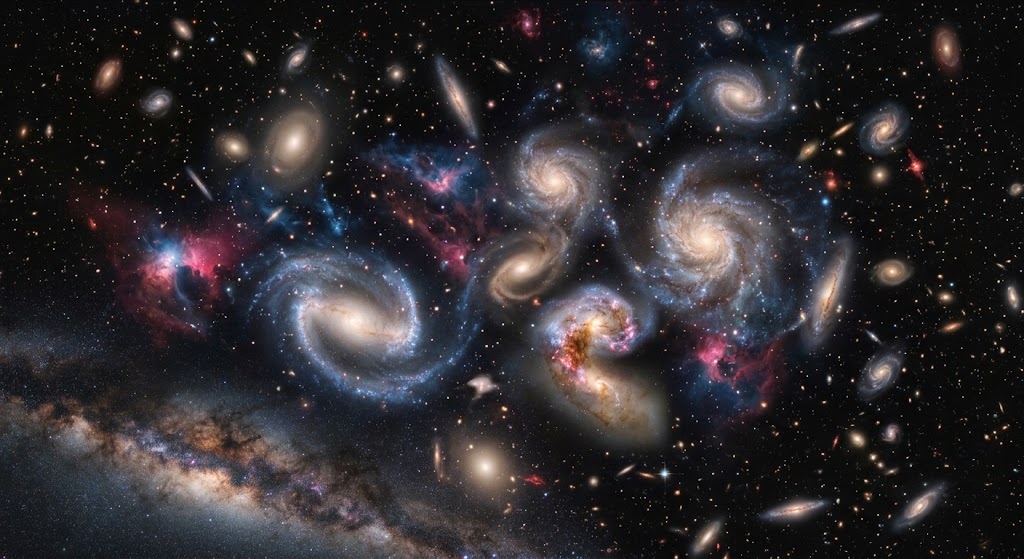
Here’s something that stops most people in their tracks. The universe is 13.8 billion years old. You might think that means we can see 13.8 billion light-years in any direction. But that’s not right — and the reason why is one of the most mind-expanding ideas in all of cosmology.

The Observable Universe: 93 Billion Light-Years Across

While light has been travelling for 13.8 billion years, the universe has been expanding the whole time. The regions of space that emitted the light we’re now receiving have moved much farther away since they emitted it. When we account for this expansion, the observable universe — the sphere of space from which light has had time to reach us — has a diameter of about 93 billion light-years. That’s roughly 8.8 × 10²⁶ metres. A number so large it’s essentially meaningless to human intuition.

The edge of the observable universe is called the cosmic horizon or the particle horizon. Beyond it, light simply hasn’t had time to reach us yet. Those regions exist — we just can’t see them.

The Total Universe: Vastly Larger, Possibly Infinite

The total universe — everything that exists, not just what we can observe — is almost certainly much larger than the observable universe. How much larger? We don’t know. If the universe is truly flat and infinite, it extends forever in all directions. If it’s flat but finite (with a non-trivial topology), it could be many times larger than our observable patch.

Some inflationary models predict that the total universe is at least 10²³ times larger than the observable universe. Others predict it’s infinite. The honest answer is: we can’t measure what we can’t see. The observable universe is our cosmic horizon, and everything beyond it is, for now, beyond our reach.

🔭 Think of it this way: You’re standing in the middle of a vast ocean in a thick fog. You can see about a mile in every direction — that’s your “observable ocean”. But the ocean itself might extend for thousands of miles beyond the fog. The fog isn’t a wall. It’s just the limit of your vision. The cosmic horizon works the same way.

This distinction matters enormously for the shape question. When we say the universe appears flat, we mean our observable patch appears flat. The total universe could have a different global geometry — one that only becomes apparent on scales far beyond what we can ever observe.

Why Is the Universe So Flat? The Answer Is Inflation

Here’s a puzzle that kept cosmologists awake for decades. The universe is flat to within 0.2%. But in the standard Big Bang model, without any additional physics, there’s no reason for it to be flat. In fact, the equations show that any tiny deviation from flatness in the early universe would have grown enormously over time. For the universe to be as flat as it is today, it would have had to be flat to one part in 10⁶⁰ at the Planck time (10⁻⁴³ seconds after the Big Bang). That’s not a coincidence. That’s a problem — the flatness problem.

Alan Guth’s Revolutionary Idea

In 1980, a young physicist named Alan Guth proposed a solution that changed cosmology forever. His idea was cosmic inflation: a period of extraordinarily rapid, exponential expansion that occurred in the first tiny fraction of a second after the Big Bang — between roughly 10⁻³⁶ and 10⁻³² seconds.

During inflation, the universe expanded by a factor of at least 10²⁶ — possibly much more. To put that in perspective: if a single proton expanded by the same factor, it would become larger than the observable universe today.

Guth published his landmark paper in 1981 in Physical Review D, titled “Inflationary universe: A possible solution to the horizon and flatness problems.” It’s one of the most cited papers in the history of cosmology.

How Inflation Solves the Flatness Problem

The balloon analogy is perfect here. Imagine you’re an ant on the surface of a small, wrinkled balloon. The surface looks curved and bumpy. Now inflate that balloon to the size of the Earth. Suddenly, the surface looks flat to you. Any curvature that existed before has been stretched out to scales far larger than you can see.

Inflation does exactly this to the universe. Whatever curvature existed before inflation — positive, negative, or zero — gets stretched to scales far beyond our observable horizon. What we’re left with is a universe that looks perfectly flat on all observable scales, regardless of what the initial conditions were.

Modern Variants of Inflation

Guth’s original model had some technical problems, which were solved by Andrei Linde (chaotic inflation, 1983) and others. Today, there are dozens of inflationary models, including:

  • Slow-roll inflation: The inflaton field rolls slowly down a potential energy hill, driving exponential expansion.
  • Starobinsky inflation (R² inflation): Proposed by Alexei Starobinsky in 1980, this model modifies gravity itself and is currently one of the best-fitting models to CMB data.
  • Eternal inflation: In some models, inflation never fully stops — it keeps going in different regions of space, producing an endless series of “bubble universes”. We’ll come back to this when we talk about the multiverse.

The Planck 2018 data strongly supports the inflationary paradigm. The CMB power spectrum is consistent with the predictions of slow-roll inflation, including a nearly scale-invariant spectrum of primordial fluctuations with a spectral index of ns = 0.9649 ± 0.0042 — slightly less than 1, exactly as inflation predicts.

Cosmic Topology: Could the Universe Have a Weird Shape?

We’ve established that the universe appears geometrically flat. But flat doesn’t mean simple. A flat universe can still have a fascinating global topology — a shape that wraps around on itself in unexpected ways.

The Video Game Universe

Remember old video games like Pac-Man or Asteroids? When Pac-Man exits the right side of the screen, he reappears on the left. When he exits the top, he reappears at the bottom. The screen is flat, but it’s topologically a torus — a donut shape. A toroidal universe would work the same way: travel far enough in one direction, and you’d come back to where you started, even though space is locally flat.

In a toroidal universe, you’d see multiple images of the same galaxy in different directions — “ghost images” created by light that has travelled around the universe more than once. Cosmologists have searched for these ghost images in the CMB and in galaxy surveys. So far, they haven’t found convincing evidence for them, which puts lower limits on the size of any such topology.

Jean-Pierre Luminet and the Dodecahedral Universe

In 2003, French cosmologist Jean-Pierre Luminet and his colleagues published a remarkable paper in Nature. They proposed that the universe might have the topology of a Poincaré dodecahedral space — a finite, positively curved space with the shape of a soccer ball (a dodecahedron) whose opposite faces are identified (glued together with a twist).

Their motivation was an anomaly in the CMB: the power spectrum showed less power at large angular scales than the standard infinite flat model predicted. Luminet’s team argued that a finite universe with a dodecahedral topology would naturally suppress large-scale fluctuations, matching the data.

It was a beautiful idea. But subsequent analysis, particularly with Planck data, didn’t confirm it. The anomaly is real, but the dodecahedral model doesn’t fit the full CMB data well enough to be convincing. The idea isn’t dead — it’s just not supported by current evidence.

What Planck Tells Us About Topology

The Planck team specifically searched for signs of a multiply-connected topology in the CMB. Their 2013 and 2015 analyses found no evidence for any topology with a characteristic scale smaller than about 0.97 times the diameter of the last scattering surface (roughly 26 billion light-years). In plain terms: if the universe does wrap around on itself, it does so on scales larger than we can currently observe.

This doesn’t rule out a finite universe. It just means that if the universe is finite, it’s big enough that we can’t see the “seams” where it wraps around. The topology question remains genuinely open.

🎯 The Bottom Line on Topology: The universe could be infinite and flat. It could be finite and flat (like a torus or a more exotic shape). It could even be finite and slightly curved. Current data can’t distinguish between these possibilities on scales larger than our observable horizon. This is one of the deepest open questions in cosmology.

Dark Energy and the Fate of the Universe

In 1998, two independent teams of astronomers — led by Saul Perlmutter, Brian Schmidt, and Adam Riess — made a discovery so shocking it earned them the 2011 Nobel Prize in Physics. The universe isn’t just expanding. It’s expanding faster and faster. Something is pushing space apart, overcoming gravity on the largest scales. We call it dark energy.

What Is Dark Energy?

Honestly? We don’t know. Dark energy is the name we give to whatever is causing the accelerated expansion. The simplest explanation is Einstein’s cosmological constant Λ — a constant energy density that fills all of space uniformly. In the Friedmann equation, it appears as the Λc²/3 term. Einstein originally introduced it in 1917 to make the universe static (before Hubble showed it was expanding), then famously called it his “greatest blunder”. Turns out, it wasn’t a blunder at all — just premature.

According to the Planck 2018 results, dark energy makes up about 68.3% of the total energy content of the universe. Dark matter accounts for about 26.8%. Ordinary matter — everything we can see, touch, and measure — is just 4.9%. We are, in a very real sense, the minority.

The Equation of State: Is Dark Energy Constant?

The behaviour of dark energy is described by its equation of state parameter w, defined as the ratio of pressure to energy density: w = p/ρc². For a cosmological constant, w = −1 exactly. This is the simplest possibility and the one most consistent with current data.

But what if w ≠ −1? What if dark energy evolves over time? This is where things get very interesting — and where the latest data is starting to hint at something new.

DESI 2024: A Hint of Evolving Dark Energy

The Dark Energy Spectroscopic Instrument (DESI) survey, which began full operations in 2021, released its first major cosmological results in April 2024. By measuring baryon acoustic oscillations in the distribution of millions of galaxies, DESI can track how the expansion rate of the universe has changed over time.

The DESI 2024 results (arXiv:2404.03002) found a hint — at about 2.5σ significance — that dark energy might not be constant. The data slightly favours a model where w evolves over time, with w₀ ≈ −0.99 today but wa ≈ −0.4 in the past. This is not yet a definitive detection, but it’s intriguing. If confirmed, it would mean the cosmological constant is not the right description of dark energy, and we’d need new physics.

The Ultimate Fate: Big Freeze, Big Rip, or Something Else?

The fate of the universe depends critically on the nature of dark energy.

  • Big Freeze (Heat Death): If dark energy is a cosmological constant (w = −1), the universe expands forever, galaxies drift apart, stars burn out, and the universe approaches a state of maximum entropy — cold, dark, and still. This is the most likely scenario based on current data.
  • Big Rip: If dark energy grows stronger over time (w < −1, called “phantom energy”), the expansion accelerates without limit. Eventually, even atoms are torn apart. The Big Rip would occur in a finite time — some models predict about 22 billion years from now.
  • Big Crunch: If dark energy weakens and reverses (w > −1 and changing), the expansion could slow, stop, and reverse. The universe collapses back to a singularity. Current data makes this very unlikely.

The DESI results, if they hold up with more data, could shift the odds between these scenarios. We’re watching this space very closely.

The Hubble Tension: A Crack in the Standard Model?

There’s a problem in cosmology that has been growing louder for the past decade. It’s called the Hubble tension, and it might be the most important unsolved problem in the field right now.

Two Ways to Measure the Expansion Rate

The Hubble constant H₀ measures how fast the universe is expanding today — specifically, how fast galaxies are receding from us per unit distance. There are two main ways to measure it, and they give different answers.

Method 1 — The Distance Ladder: Astronomers measure distances to nearby objects using Cepheid variable stars and Type Ia supernovae, then use those distances to calibrate the expansion rate. The most precise measurement using this method comes from the SH0ES team (Riess et al. 2022), which gives:

📏 Local Measurement (Distance Ladder):
H₀ = 73.04 ± 1.04 km/s/Mpc (Riess et al. 2022)

Method 2 — The CMB: The Planck satellite measures the CMB and fits the standard cosmological model (ΛCDM) to the data. This gives a prediction for H₀ based on the early universe:

🌌 CMB Measurement (Planck 2018):
H₀ = 67.4 ± 0.5 km/s/Mpc

The discrepancy is about 5 km/s/Mpc — roughly 8%. That might sound small, but statistically it’s a 5 sigma discrepancy. In physics, 5 sigma is the threshold for a “discovery”. This isn’t a measurement error. Both teams have checked their work exhaustively. Something is genuinely wrong — either with one of the measurements, or with the standard cosmological model itself.

What Could Explain the Tension?

The possibilities range from mundane to revolutionary:

  • Systematic errors: Maybe there’s an unidentified bias in the distance ladder or the CMB analysis. Possible, but increasingly unlikely given how many independent checks have been done.
  • Early dark energy: A component of dark energy that was significant in the early universe could change the sound horizon scale and shift the CMB-derived H₀ upward.
  • New physics: Modifications to general relativity, new particles, or changes to the dark matter model could all affect the expansion history.
  • Interacting dark energy: If dark energy and dark matter interact with each other, the expansion history changes in ways that could resolve the tension.

The Hubble tension is a genuine challenge to the standard ΛCDM model. If it’s confirmed as a real discrepancy — not a systematic error — it would be the first clear evidence for physics beyond the standard cosmological model. That’s exciting. And a little unsettling.

Could We Live in a Multiverse?

If inflation is real — and the evidence strongly suggests it is — then it opens a door to one of the most mind-bending ideas in all of science: the multiverse.

Eternal Inflation and Bubble Universes

In many inflationary models, inflation doesn’t stop everywhere at once. Instead, it stops in some regions (creating “bubble universes” like ours) while continuing in others. This is eternal inflation, first proposed by Andrei Linde and Alexander Vilenkin in the 1980s.

In eternal inflation, our universe is just one bubble in an infinite sea of bubbles. Each bubble nucleates when inflation ends in that region, and each one could have different physical constants, different laws of physics, different geometries. The multiverse isn’t a single universe with a single shape — it’s an infinite collection of universes, each with its own properties.

The String Theory Landscape

String theory adds another layer to this picture. String theory predicts an enormous number of possible vacuum states — estimates range from 10⁵⁰⁰ to 10¹⁰⁰⁰ — each corresponding to a different set of physical constants and a different universe. This is called the string theory landscape. In the context of eternal inflation, each bubble universe could settle into a different vacuum state, giving it different properties.

This is philosophically profound and scientifically controversial. If there are infinitely many universes with all possible properties, then the fact that our universe has the right constants for life to exist isn’t surprising — it’s inevitable. This is the anthropic principle: we observe the universe we do because we couldn’t exist in any other kind.

Is the Multiverse Science?

Here’s the honest answer: the multiverse is currently at the edge of what we can call science. Other bubble universes, by definition, are beyond our cosmic horizon. We can’t observe them directly. Some physicists argue that this makes the multiverse untestable and therefore unscientific. Others argue that it’s a legitimate prediction of well-tested theories (inflation + string theory) and that indirect evidence — like the CMB Cold Spot, or the specific values of physical constants — could provide circumstantial support.

At FreeAstroScience, we think the multiverse is a fascinating idea worth taking seriously — while being honest that it’s not yet confirmed science. The boundary between physics and metaphysics is blurry here, and that’s okay. Science is allowed to ask questions it can’t yet answer.

What New Telescopes Will Tell Us About the Universe’s Shape

We’re living in a golden age of cosmology. The instruments coming online right now — and in the next decade — will transform our understanding of the universe’s geometry, topology, and fate.

The Euclid Space Telescope

The ESA’s Euclid space telescope, launched in July 2023, is designed specifically to map the geometry of the dark universe. Over its six-year mission, it will survey more than one-third of the sky, mapping the shapes and positions of over 1.5 billion galaxies out to a redshift of z ≈ 2 (about 10 billion light-years away).

Euclid’s primary tools are weak gravitational lensing (measuring how dark matter distorts the shapes of background galaxies) and baryon acoustic oscillations (using the clustering of galaxies as a standard ruler). Together, these will constrain the equation of state of dark energy to better than 1% precision and measure the growth of cosmic structure with unprecedented accuracy.

Euclid released its first science results in 2024, including stunning images of galaxy clusters and early weak lensing measurements. The full cosmological analysis is unfolding through 2025 and beyond.

DESI: Mapping the Universe in 3D

The Dark Energy Spectroscopic Instrument (DESI), mounted on the 4-metre Mayall Telescope at Kitt Peak National Observatory in Arizona, is conducting the largest 3D map of the universe ever made. By 2026, it will have measured precise redshifts for over 40 million galaxies and quasars, tracing the expansion history of the universe over the past 11 billion years.

DESI’s 2024 results already hinted at evolving dark energy. The full five-year dataset will either confirm or refute this hint with much higher statistical power. If dark energy is evolving, DESI will tell us how.

CMB-S4: The Next Generation CMB Experiment

CMB-S4 is a next-generation ground-based CMB experiment, planned for deployment at the South Pole and in the Chilean Atacama Desert. With 500,000 detectors (compared to Planck’s ~10,000), it will map the CMB with 10 times better sensitivity than any previous experiment.

CMB-S4’s primary targets include the detection of primordial gravitational waves — the “smoking gun” of inflation — and precise measurements of the sum of neutrino masses. It will also search for signatures of cosmic topology with unprecedented sensitivity.

The James Webb Space Telescope’s Cosmological Role

The James Webb Space Telescope (JWST), launched in December 2021, wasn’t primarily designed for cosmology — but it’s already making cosmological waves. JWST has observed galaxies at redshifts above z = 13, just 300 million years after the Big Bang, and found some that are surprisingly massive and well-formed. These “too-big-too-soon” galaxies challenge our models of early galaxy formation and could have implications for our understanding of the early universe.

JWST is also contributing to the Hubble tension by providing independent distance measurements using Cepheid stars and other standard candles. Its results so far support the higher local value of H₀, deepening the tension with the CMB-derived value.

The Three Universe Models: A Side-by-Side Comparison

Let’s put everything we’ve covered into one clear, visual comparison. The table below summarises the key properties of the three possible geometric models of the universe.

Comparison of the Three Geometric Models of the Universe — Flat, Open, and Closed
Property 🟡 Flat Universe 🔵 Open Universe 🔴 Closed Universe
Geometry Euclidean (flat) Hyperbolic (saddle-shaped) Spherical (positively curved)
Curvature constant k k = 0 k = −1 k = +1
Density parameter Ω Ω = 1 (exactly) Ω < 1 Ω > 1
Parallel lines behaviour Stay parallel forever Diverge (spread apart) Converge (meet eventually)
Triangle angles sum Exactly 180° Less than 180° More than 180°
Finite or infinite? Infinite (or finite with topology) Infinite Finite (no edge)
Ultimate fate Big Freeze (likely) Big Freeze Big Crunch (or Big Freeze with Λ)
CMB acoustic peak position ~1° angular scale Smaller than 1° Larger than 1°
Observational status Strongly favoured by Planck 2018 Disfavoured by current data Disfavoured by current data

The verdict of the table is clear: every line of evidence we have points to a flat, or very nearly flat, universe. The open and closed models aren’t logically impossible — they’re just not what the data shows. And that single fact, Ω ≈ 1, is one of the most precisely measured and profound results in all of physics.

Conclusion: A Flat Universe, and a Universe of Open Questions

So — what shape is the universe? The honest, evidence-based answer is that its geometry is flat, to within a fraction of a percent. Parallel lines stay parallel. Triangles close at 180°. The total density sits astonishingly close to the critical value, exactly as inflation predicts. On this, the data from Planck, from the distance ladder, and from large galaxy surveys all agree.

But “flat” is not the end of the story — it’s the beginning of a better set of questions. Is the universe finite or infinite? Does it wrap around on itself in some subtle topology we haven’t yet detected? Is dark energy truly constant, or is it evolving in a way that will rewrite our picture of cosmic history? Why do two excellent measurements of the expansion rate stubbornly disagree? And could our flat, expanding cosmos be just one bubble among countless others?

We don’t have all the answers yet. That’s not a failure of science — it’s the frontier. Over the next decade, Euclid, DESI, CMB-S4, and JWST will sharpen every one of these questions, and some of them may finally get answered. If you’d like to keep exploring these ideas with us, come back to FreeAstroScience.com, where we translate the deepest science into something you can hold in your mind and carry with you.

The universe is flat. And it is still, gloriously, full of mystery.

— Gerd Dani, for FreeAstroScience.com
Never let your Mind sleep.

Frequently Asked Questions

What shape is the universe according to the latest data?

The universe is geometrically flat. Measurements from the ESA Planck satellite place the total density parameter within about 0.2% of the critical density needed for perfect flatness. In a flat universe, parallel lines stay parallel, and the angles of a triangle sum to exactly 180°. The open (saddle-shaped) and closed (spherical) models are both disfavoured by current data.

Is the universe finite or infinite?

We don’t know for certain. A flat geometry is consistent with an infinite universe, but it can also be finite if space has a non-trivial topology — wrapping around on itself like a cosmic version of a Pac-Man screen. Current observations rule out any wrap-around on scales smaller than our observable universe, so if the cosmos is finite, it’s larger than the roughly 93-billion-light-year patch we can see.

What is the difference between the universe’s geometry and its topology?

Geometry describes the local curvature of space — whether it’s flat, spherical, or saddle-shaped. Topology describes the global structure — whether space is finite or infinite and whether it connects back on itself. A flat universe can still be finite, and a curved universe can still be infinite, so the two questions are genuinely independent.

How do scientists measure the shape of the universe?

The most powerful method uses the Cosmic Microwave Background (CMB) — the afterglow of the Big Bang. The characteristic size of hot and cold spots in the CMB acts as a cosmic ruler: in a flat universe the largest spots appear at about a 1° angular scale, larger in a closed universe and smaller in an open one. The Planck satellite mapped these patterns in exquisite detail, and the result is a flat geometry. Galaxy surveys and gravitational lensing provide independent cross-checks.

Could the universe still be slightly curved?

Yes, slightly. “Flat” in cosmology means flat to within measurement error, and current data pins the curvature down to a fraction of a percent rather than to exactly zero. A very small curvature — too small for present instruments to detect — has not been completely ruled out. Upcoming experiments such as CMB-S4 and the Euclid mission aim to tighten these limits further.

What is the Hubble tension, and does it change the shape of the universe?

The Hubble tension is a persistent disagreement between two ways of measuring the universe’s expansion rate: the local distance-ladder method gives about 73 km/s/Mpc, while the CMB-based method gives about 67 km/s/Mpc — a roughly 5-sigma difference. It doesn’t overturn the flat geometry, but it may signal that something is missing from the standard cosmological model, such as new physics in the early universe or an evolving form of dark energy.

Will the universe expand forever?

Based on current data, yes. If dark energy behaves like a cosmological constant, the universe will keep expanding and cooling forever, ending in a “Big Freeze” or heat death. Alternative fates — a “Big Rip” if dark energy strengthens, or a “Big Crunch” if it reverses — remain possible but are disfavoured. The DESI survey’s hint of evolving dark energy is one reason cosmologists are watching this question closely.

Sources & Further Reading

  1. Planck Collaboration (Aghanim, N., et al.), “Planck 2018 results. VI. Cosmological parameters,” Astronomy & Astrophysics, 641, A6 (2020). DOI: 10.1051/0004-6361/201833910 · arXiv:1807.06209
  2. Riess, A. G., et al., “A Comprehensive Measurement of the Local Value of the Hubble Constant with 1 km s⁻¹ Mpc⁻¹ Uncertainty from HST and the SH0ES Team,” The Astrophysical Journal Letters, 934, L7 (2022). DOI: 10.3847/2041-8213/ac5c5b · arXiv:2112.04510
  3. DESI Collaboration (Adame, A. G., et al.), “DESI 2024 VI: Cosmological Constraints from the Measurements of Baryon Acoustic Oscillations,” Journal of Cosmology and Astroparticle Physics, 02, 021 (2025). DOI: 10.1088/1475-7516/2025/02/021 · arXiv:2404.03002
  4. Guth, A. H., “Inflationary universe: A possible solution to the horizon and flatness problems,” Physical Review D, 23, 347 (1981). DOI: 10.1103/PhysRevD.23.347
  5. Linde, A. D., “Chaotic inflation,” Physics Letters B, 129, 177 (1983). DOI: 10.1016/0370-2693(83)90837-7
  6. Starobinsky, A. A., “A new type of isotropic cosmological models without singularity,” Physics Letters B, 91, 99 (1980). DOI: 10.1016/0370-2693(80)90670-X
  7. Friedmann, A., “Über die Krümmung des Raumes,” Zeitschrift für Physik, 10, 377 (1922). DOI: 10.1007/BF01332580
  8. Luminet, J.-P., Weeks, J., Riazuelo, A., Lehoucq, R., & Uzan, J.-P., “Dodecahedral space topology as an explanation for weak wide-angle temperature correlations in the cosmic microwave background,” Nature, 425, 593 (2003). DOI: 10.1038/nature01944 · arXiv:astro-ph/0310253
  9. Perlmutter, S., et al., “Measurements of Ω and Λ from 42 High-Redshift Supernovae,” The Astrophysical Journal, 517, 565 (1999). DOI: 10.1086/307221
  10. Riess, A. G., et al., “Observational Evidence from Supernovae for an Accelerating Universe and a Cosmological Constant,” The Astronomical Journal, 116, 1009 (1998). DOI: 10.1086/300499