
Over a decade-long study, scientists have cracked an enigma embedded in Einstein’s Theory of General Relativity, demonstrating that the early universe operated at a pace five times slower than our present era. This breakthrough was made possible by utilizing quasars as cosmic timekeepers, providing evidence that the primordial universe indeed moved at a slower pace.
The research, led by Professor Geraint Lewis from the School of Physics and the Sydney Institute for Astronomy at the University of Sydney, employed data from nearly 200 quasars to examine this time dilation. Quasars, hyperactive supermassive black holes within early galaxies, served as the perfect tool for this exploration.
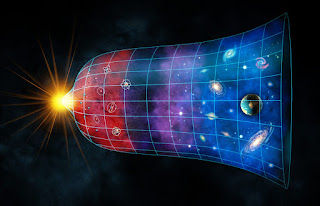
Imagine being in the nascent universe where a second feels like a second. However, from our vantage point 12 billion years later, this time seems to move at a sloth’s pace. This phenomenon is attributed to the expansion of the universe since the Big Bang, which caused space to expand and time to appear slower.
While previous studies attempted to confirm this theory using supernovae as standard clocks, their brightness made it challenging to observe at the required distances to explore the early universe. However, by turning their focus to quasars, researchers were able to push back this time horizon to just one-tenth of the universe’s age, affirming that the universe indeed appears to accelerate with age.
Working in collaboration with astro-statistician Dr. Brewer, Professor Lewis analyzed data from 190 quasars observed over two decades. By harmonizing observations made at varying wavelengths, they managed to standardize the “ticking” of each quasar. Applying Bayesian analysis, they observed the expansion of the universe reflected in each quasar’s ticking.
Their findings, which contradicted previous studies that failed to discern time dilation in distant quasars, further confirm Einstein’s depiction of an expanding universe. This significant research proves once again that the primordial universe behaves in line with predictions made by Einstein’s General Relativity.
Sources: EurekAlert, Nature Astronomy