How big is the Pleiades star cluster?

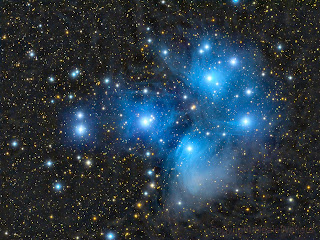
The Pleiades star cluster glows among blue reflection nebulae in Taurus.

How can seven bright stars hide thousands of members and a stellar family nearly 2,000 light-years wide?

Glad you found us at FreeAstroScience. This page is for anyone who has counted the Pleiades and stopped at six, and it explains why the naked-eye count was never the number that mattered.

Seven is the misleading number: the Pleiades star cluster holds 2,109 high-probability members in the 2015 census by Hervé Bouy and colleagues. TESS and Gaia data trace a related family of groups spread across more than 600 parsecs. M45 itself lies 136.2 parsecs from Earth, about 445 light-years, and is roughly 125 million years old.

Updated August 2026. The Chronos citation now points to the published journal version rather than the preprint, and the JWST turbulence result is stated as firmly as its authors state it.

The Pleiades star cluster is bigger than it looks

Hervé Bouy and colleagues counted 2,109 high-probability members in 2015, and 812 of them had never been listed before. Their census reaches down to about 0.025 times the Sun’s mass, well below anything an eye registers. What you catch from a dark field is only the compact, gravitationally bound core.

Hot blue stars dominate the naked-eye view, while surveys reach far below them to red dwarfs and brown dwarfs, objects too light to ever ignite hydrogen fusion.

Did the Pleiades suddenly become a 600-parsec cluster? Not quite. Andrew Boyle, Luke Bouma, and Andrew Mann found a bound core sitting inside a much larger coeval structure, one whose groups share ages, motions, chemical abundances, and traceback histories. They named it the Greater Pleiades Complex. Calling the entire structure one bound cluster would erase the paper’s central point.

Boyle’s team paired TESS rotation periods with Gaia kinematics. TESS light curves can carry useful timing information beyond planet transits, as our account of TESS’s first microlensing planet also shows.

One parsec equals about 3.26 light-years. Six hundred parsecs converts to about 1,960 light-years — more than four times the distance from Earth to M45.

Common birth does not make every star part of the compact cluster. The scale shows how far a stellar family can disperse before its ties become hard to recognize.

Distance and age are no longer round guesses

Distance sets the luminosity assigned to every member and tests the stellar models built from that luminosity. Hipparcos placed the cluster at 120.2 ± 1.5 parsecs, while other techniques favored roughly 133.5 ± 1.2 parsecs. That gap was large enough to make young-star models look wrong.

Very long baseline radio interferometry, which links widely separated dishes into one telescope-sized array, settled the argument in 2014. Carl Melis and colleagues measured 136.2 ± 1.2 parsecs, about 444 light-years, incompatible with the Hipparcos value. NASA’s rounded 445-light-year figure is a fair public number, and the uncertainty belongs beside the research value.

Age required a different clock. Low-mass stars destroy lithium at rates tied to their internal temperature.

That gives astronomers the lithium depletion boundary, the temperature where lithium survives in some stars and burns away in others. The boundary can date a young population without relying only on its brightest members.

Chronos did not fit one lithium curve to every star. Luis González-Ramírez and colleagues used a temperature-dependent transition between ultracool dwarfs and warmer FGKM stars, then added a two-component mixture for rotation-enhanced lithium among FGK stars. Rotation matters because it can make some stars look too lithium-rich for their true age. Their posterior age was 124.53 million years, with an upper uncertainty of 3.34 million years and a lower uncertainty of 2.70 million years.

We regard about 125 million years as the best current shorthand in this source set, rather than the older unqualified 100 million years. Chronos is now published in Astronomy and Astrophysics and is a careful validation on the Pleiades, though one successful cluster test does not make its age scale final for every young association.

The blue veil is passing interstellar dust

Long exposures surround Merope and neighboring stars with blue reflection nebulosity, starlight bouncing off dust grains rather than gas glowing by itself. Pleiades members are no longer wrapped in their birth cloud. Their blue light scatters from an unrelated dusty region the cluster is crossing, while radiation pressure sorts smaller grains from larger ones near Merope.

Orion provides the opposite case, a nursery still being reshaped by newborn stars. In our analysis of the neutral-hydrogen shell around Orion, the young Trapezium cluster is actively pushing gas outward. Around the older Pleiades, the dust is a foreground encounter.

What Webb resolved

JWST turned that blue veil into a study of cold interstellar turbulence. Guillaume Vigoureux and colleagues used NIRCam to resolve structure down to 40 astronomical units, where one astronomical unit is the Earth-Sun distance. They then filtered stars and galaxies from the maps and subtracted a residual near-infrared background in Fourier space. Visually the image looks soft. Its statistical structure is not.

Near Merope the power spectrum followed a slope of −3.5. In the more distant field it was −3. Planck polarization put the magnetic field along the dust pattern, and the anisotropy held constant across every scale the team measured.

Two fields cannot map the whole veil

Two pointings are not a nebula. Vigoureux and colleagues analyzed regions near and farther from Merope rather than the entire reflection nebula. They also had to remove stars, galaxies, and an inferred cosmic-background residual before measuring the dust statistics. Those cleaning choices are reported, which is exactly why the paper deserves confidence without being treated as a complete map.

Their paper does not establish whether the Pleiades stars drive the turbulence. On the cascade itself the authors do not hedge: they conclude that the turbulent energy cascade in the cold neutral medium is anisotropic. These 40-au maps are a microscope rather than a survey of every cloud around M45.

How many sisters can you actually see?

M45 has an apparent magnitude of 1.6 and is easy to find in Taurus from a reasonably dark site. NASA names December as the best month to observe it, though the cluster rewards the whole cooler-season evening sky. Your unaided-eye count depends on darkness and eyesight, plus a little patience.

  • Start without optics and look for the small dipper-shaped patch.
  • Give your eyes at least 15 minutes away from bright screens.
  • Use 7×50 or 10×50 binoculars to separate dozens of stars while keeping the cluster in one field.
  • Choose low magnification in a telescope, because a narrow view can lose the shape that makes M45 recognizable.

Six is the usual answer. Our July 2026 Pleiades conjunction guide used M45 as a fixed sky marker, and this page adds the cluster physics that the event guide only sketched.

We are leaving the many cultural traditions around the Pleiades out of this rewrite because a one-paragraph survey would flatten distinct histories. Astronomy and observing remain the scope here.

The cluster and the complex are two different objects

Bouy’s census reaches 2,109 members down to 0.025 solar masses, and 812 of those were new in 2015. Melis put the distance at 136.2 parsecs by radio interferometry in 2014, which retired the 120.2-parsec Hipparcos value. Chronos dates the cluster to 124.53 million years, and one validated cluster does not validate an age scale. Vigoureux mapped two fields near Merope and said so plainly.

We built this page in Rimini for the reader who counted six stars, was told there are seven, and wanted to know who was wrong. Curiosity that goes quiet stops noticing the gap. Push back on our reading of the Greater Pleiades Complex if you think the boundary belongs somewhere else. In December, the month NASA names best for M45, bring these numbers outside and check them against a pair of 10×50 binoculars.

Written by Gerd Dani, President of FreeAstroScience.

Sources

  1. Boyle, A. W., Bouma, L. G., and Mann, A. W. (2025). Lost Sisters Found: TESS and Gaia Reveal a Dissolving Pleiades Complex. The Astrophysical Journal 994, 24. Published November 2025. https://doi.org/10.3847/1538-4357/ae0724
  2. González-Ramírez, L., Barrado, D., Olivares, J., Berihuete, A., Sarro, L. M., and Palmero, F. J. (2026). Chronos: Towards a self-consistent and absolute stellar age scale. I. A Bayesian hierarchical lithium-age model: Validation on the Pleiades cluster. Astronomy and Astrophysics 710, A407. Published June 2026. https://doi.org/10.1051/0004-6361/202659708
  3. Vigoureux, G., Flagey, N., Boulanger, F., Noriega-Crespo, A., Guillet, V., et al. (2026). JWST imaging of the Pleiades: anisotropy of turbulence in the cold neutral medium. Astronomy and Astrophysics 707, A374. Published March 2026. https://doi.org/10.1051/0004-6361/202557000
  4. Melis, C., Reid, M. J., Mioduszewski, A. J., Stauffer, J. R., and Bower, G. C. (2014). A VLBI resolution of the Pleiades distance controversy. Science 345, 1029-1032. Published August 29, 2014. https://doi.org/10.1126/science.1256101
  5. Bouy, H., Bertin, E., Sarro, L. M., Barrado, D., Moraux, E., et al. (2015). The Seven Sisters DANCe. I. Empirical isochrones, luminosity, and mass functions of the Pleiades cluster. Astronomy and Astrophysics 577, A148. Published May 2015. https://doi.org/10.1051/0004-6361/201425019
  6. NASA Science (2026). Messier 45, the Pleiades. NASA. Accessed August 9, 2026. https://science.nasa.gov/mission/hubble/science/explore-the-night-sky/hubble-messier-catalog/messier-45/
Scroll to Top