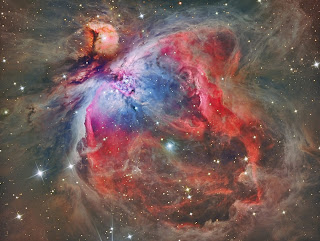

Orion’s Veil, a dust and gas shell behind the massive cluster of stars in the Orion Nebula, may be breaking, according to the Stratospheric Observatory for Infrared Astronomy (SOFIA).
There is a massive group of stars called the Trapezium stars within the Orion Nebula. Orion’s Veil is formed by the winds blowing from the Trapezium stars. Most of the gas in Orion’s Veil lies in its wall, where it is sparse.
In recent observations by SOFIA’s German REceiver for Astronomy at Terahertz Frequency (GREAT), some unexpected features in Orion’s Veil have been found. It measures about one light-year thick and is expanding toward us.
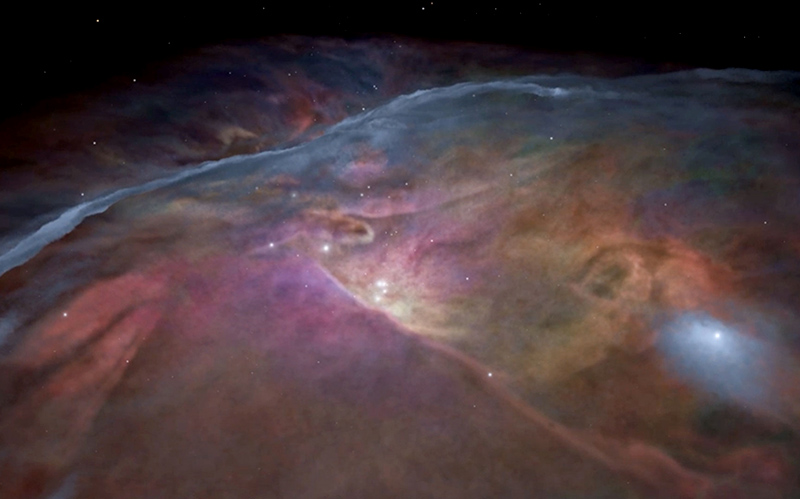 3D models of the Orion Nebula show Orion’s Veil shell as a bluish gas surrounding the glowing red and yellow nebula. Researchers used SOFIA to find a protrusion in the shell that may facilitate the escape of gases and dust from the shell. Credit: NASA, ESA, Frank Summers (STScI), Greg T. Bacon (STScI), Lisa Frattare (STScI), Zolt G. Levay (STScI), K. Litaker (STScI)
“The bubble – with a diameter of approximately seven light-years – should be an almost sphere-like structure, but we found a protrusion in its northwestern part,” explained Ümit Kavak, a postdoctoral researcher at SOFIA based out of NASA’s Ames Research Center in California’s Silicon Valley, who is the lead author on a recent paper in Astronomy & Astrophysics describing the studies.
According to the SOFIA observations, this protrusion emits ionized carbon, which Kavak used to determine its size, structure, and the rate at which it is growing in order to gain insight into its origins and future.
The protrusion extends far beyond Orion’s Veil, resembling a “U” lying on its side. Considering the chimney-like top of the protrusion, it is likely that the shell has already penetrated there.
“When you breach the Veil shell, you effectively start stirring a cosmic soup of gas and dust by adding turbulence,” Kavak said.
“This isn’t the most appetizing soup, but it’s one of the ways to form new stars or limit future star formation,” added Alexander Tielens, a researcher at Leiden University and a co-author of the paper.
Turbulence can, in turn, affect the density, temperature, and chemistry of the surrounding region, which, in turn, affects star formation.
They also discovered a second protrusion that will be investigated further in a future paper. They have a profound effect on the overall morphology of the Orion Nebula as a whole.
Developed by NASA and the German Space Agency at DLR, SOFIA is a joint project of both agencies. DLR provides maintenance services for the aircraft, telescope maintenance, and other mission support. With the Universities Space Research Association, based in Columbia, Maryland, and the German SOFIA Institute at the University of Stuttgart, NASA’s Ames Research Center in California’s Silicon Valley manages the SOFIA program, science, and mission operations.