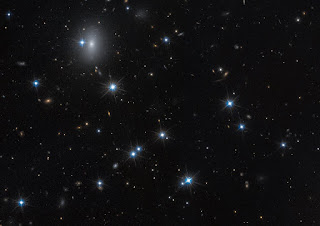

The low-surface-brightness galaxy CDG-2, shown in this image from the NASA/ESA Hubble Space Telescope, is dominated by dark matter and contains only a sparse scattering of stars. This galaxy is nearly invisible, but by using advanced statistical techniques, scientists identified it by searching for tight groupings of stars called globular clusters at the centre of this image. The Hubble observations include those from programme 15235 (W. Harris).
What if entire galaxies are hiding right before our eyes — so ghostly, so stripped of light, that even Hubble almost missed them?
Welcome, dear reader. Here at FreeAstroScience.com, we’ve always believed that the universe deserves an honest, enthusiastic guide — someone who won’t drown you in jargon or leave you more confused than when you started. I’m Gerd Dani, president of the Free AstroScience – Science and Cultural Group, and today we’re walking through one of the most astonishing astronomical announcements of 2026.
A galaxy called CDG-2 — Candidate Dark Galaxy-2 — was just revealed to the world on February 18, 2026. It lives 300 million light-years away, nestled inside the Perseus galaxy cluster. And it’s made of at least 99.94% dark matter.
We at FreeAstroScience exist to make sure your mind never stops asking questions — because as we always say, the sleep of reason breeds monsters. So don’t click away. Read every word below. The universe has something remarkable to show you today.
A Ghost Galaxy Hidden for Billions of Years {#ghost-galaxy}
There’s something almost poetic about CDG-2. A whole galaxy — born from the same cosmic recipe as the Milky Way, roughly 13 billion years ago — quietly drifting through the Perseus cluster, essentially invisible. Not because it was small or far away, but because the universe stripped it nearly bare.
We’ve known for decades that “dark galaxies” might exist — objects where dark matter forms a halo but stars never really got a foothold. CDG-2 is the most compelling evidence yet that this isn’t just theory. It’s real, and it’s sitting 300 million light-years from Earth.
What Is CDG-2, Exactly? {#meet-cdg2}
CDG-2 stands for Candidate Dark Galaxy-2. It belongs to the Perseus galaxy cluster, one of the most massive and densely packed galaxy groups in the nearby universe.
Here’s what makes CDG-2 extraordinary:
- It contains only 4 globular star clusters — dense, ancient balls of stars. For comparison, our Milky Way hosts 150 or more
- Its total luminosity is just 6.2 ± 3.0 × 10⁶ solar luminosities — roughly six million times the brightness of our Sun, spread across an entire galaxy
- Its dark matter mass fraction sits between 99.94% and 99.98% under conservative assumptions — and possibly as high as ≥99.99% arxiv
- It’s the first galaxy ever detected purely through its globular cluster population
CDG-2 was first identified by Dayi Li of the University of Toronto and formally validated in a paper published in The Astrophysical Journal Letters in June 2025 (Vol. 986, Issue 2, L18). The formal public announcement followed on February 18, 2026.
The Numbers Behind the Ghost {#numbers}
Let’s put the luminosity in perspective. The Sun alone puts out about 3.85 × 10²⁶ watts of energy. Six million times that sounds like a lot — until you realize the Milky Way shines with the combined light of roughly 20,000 million Suns. CDG-2 is about 3,000 times dimmer than our own galaxy, by a conservative estimate.
That dimness isn’t a flaw. It’s a fingerprint. It tells us something profound about where all the “stuff” went.
How Do You Find an Invisible Galaxy? {#how-found}
You don’t look for the galaxy itself. You look for what it left behind.
Think of it like finding a ghost not by seeing it directly, but by noticing the frost on the window where it stood. Astronomers searched for unusual clumps of globular clusters — those tight, ancient star balls — using a Hubble Space Telescope (HST) survey targeting the Perseus cluster. Where globular clusters cluster together unusually, a hidden galaxy might be lurking underneath. esahubble
Three telescopes collaborated to nail the confirmation:
- NASA/ESA Hubble Space Telescope — provided high-resolution imaging of the four globular clusters
- ESA’s Euclid space observatory — detected the extremely faint diffuse glow of the underlying galaxy
- NAOJ’s Subaru Telescope (Mauna Kea, Hawaii) — provided additional ground-based confirmation data
Together, they revealed a ghostly halo of diffuse light wrapped around those four clusters. That faint glow — barely distinguishable from background noise — is the galaxy.
The Statistical Genius Behind the Discovery {#statistics}
What makes CDG-2’s discovery different from most astronomical finds is the method itself. Dayi Li and his colleagues didn’t just point a telescope and spot something bright. They built a sophisticated statistical framework to detect overdensities — unusual concentration peaks — in the distribution of globular clusters across the Perseus cluster field.
This approach let the team identify 10 previously confirmed low-surface-brightness galaxies and 2 new dark galaxy candidates from a single Hubble survey. CDG-2 was one of those candidates, and it turned out to be the real deal.
“This is the first galaxy detected solely through its globular cluster population,” Li said. “Under conservative assumptions, the four clusters represent the entire globular cluster population of CDG-2.”
)
Statistics, traditionally a tool for economists and social scientists, just found a ghost galaxy. That’s worth pausing on.
CDG-2 vs. The Milky Way: By the Numbers {#comparison}
🌌 CDG-2 vs. The Milky Way vs. a Typical Ultra-Diffuse Galaxy
| Property | CDG-2 (Dark Galaxy) | Milky Way (Our Galaxy) | Typical UDG (Reference) |
|---|---|---|---|
| Distance from Earth | ~300 million light-years | ~26,000 ly (galactic center) | Millions of light-years (varies) |
| Globular Clusters | 4 Record Low | 150–180 | ~20–50+ |
| Total Luminosity | ~6.2 × 10⁶ L☉ | ~2 × 10¹⁰ L☉ | ~107–108 L☉ |
| GC Fraction of Light | ≥16.6% Highest Known | <0.1% | ~1–5% |
| Dark Matter Fraction | ≥99.94% Near Total | ~80–90% | ~95–99% |
| Detection Method | GC overdensity (statistics) Novel | Direct imaging | Direct imaging / photometry |
| Galaxy Type | Dark galaxy / ultra-diffuse | Barred spiral (SBbc) | Ultra-diffuse (UDG) |
| Normal Matter (stars/gas) | Mostly stripped Extreme Loss | ~10–20% of total mass | ~1–5% of total mass |
| Reference Telescope | Hubble + Euclid + Subaru | Multiple surveys | Varies by galaxy |
Table 1 — Comparison of CDG-2 with the Milky Way and a typical ultra-diffuse galaxy (UDG). Sources: Li et al. (2025), ESA Hubble, NASA Science. FreeAstroScience.com
What Does 99% Dark Matter Actually Mean? {#dark-matter}
Dark matter is one of the most fascinating unsolved puzzles in all of physics. It doesn’t glow. It doesn’t reflect. It doesn’t absorb light. We can’t see it directly — not with Hubble, not with Euclid, not with any instrument yet built. And yet, it makes up roughly 85% of all matter in the universe.
In most galaxies, dark matter forms an invisible “halo” that gravity-holds the visible stars and gas together. The Milky Way is about 80–90% dark matter by mass. That’s already a lot. But CDG-2 takes this to a completely different extreme.
At CDG-2, the dark matter fraction is at least 99.94% — and possibly higher than 99.99% if the galaxy’s full globular cluster population follows standard patterns. Put simply: for every gram of star, gas, or dust in CDG-2, there are roughly 1,667 grams of dark matter. It’s a galaxy in name only — a dark matter halo wearing the thinnest possible costume of stars.
🧮 Key Equations: CDG-2 by the Numbers
[
f_{mathrm{GC}} = frac{L_{V,,mathrm{GC}}}{L_{V,,mathrm{gal}}}
= frac{(1.03 pm 0.20)times 10^6,L_{odot}}{(6.2 pm 3.0)times 10^6,L_{odot}}
approx 16.6%
]
At least 16.6% of CDG-2’s total visual light comes from its 4 globular clusters alone —
an unprecedented ratio. By comparison, the Milky Way’s globular clusters contribute
less than 0.1% of its total light.
[
f_{mathrm{DM}} = frac{M_{mathrm{DM}}}{M_{mathrm{total}}} geq 99.94%
quad text{(conservative)}
]
[
f_{mathrm{DM}} gtrsim 99.99%
quad text{(canonical GC luminosity function)}
]
Under the most conservative assumptions (treating CDG-2’s 4 GCs as its entire
globular cluster population), the dark matter fraction already exceeds 99.94%.
If CDG-2 follows a standard GC luminosity function, this fraction climbs to
≥ 99.99% — making CDG-2 potentially the most dark-matter-dominated galaxy ever found.
[
frac{M_{mathrm{DM}}}{M_{star}} geq frac{0.9994}{1 – 0.9994}
approx 1{,}667!:!1
]
For every unit of visible (stellar) mass in CDG-2, there are at least 1,667 equivalent
units of dark matter — a ratio that dwarfs even the most dark-matter-rich galaxies
previously catalogued.
Why Did CDG-2 Lose Its Stars? {#lost-stars}
This is the question that keeps astrophysicists up at night. How does a galaxy exist with almost no stars?
The leading explanation ties directly to CDG-2’s neighbourhood. The Perseus cluster is a brutal environment. Hundreds of galaxies pack into a region of space, all pulling and tugging at each other gravitationally. Smaller galaxies that drift too close to larger ones can have their normal matter — their hydrogen gas, the very fuel for star formation — ripped away through a process called tidal stripping.
Gravitational Stripping in the Perseus Cluster {#stripping}
Without hydrogen gas, a galaxy can’t form new stars. Without new stars, the old ones die off and aren’t replaced. What’s left is the dark matter halo — the gravitational “skeleton” that held everything together — but almost none of the luminous flesh.
CDG-2’s four surviving globular clusters are thought to have persisted precisely because they’re so gravitationally compact and tightly bound. Tidal forces shred loose, fluffy structures first — but a dense, ancient star cluster holds on. So, in a strange twist, the only witnesses to CDG-2’s original existence are those four stubborn stellar fossils.
“Much of its normal matter to enable star formation (primarily hydrogen gas) was likely stripped away by gravitational interactions with other galaxies inside the Perseus cluster,” the research team concluded.
A New Era of Cosmic Discovery {#new-era}
CDG-2’s discovery isn’t just about one strange galaxy. It opens a door — it points to an entirely new way of mapping the universe’s most hidden structures.
The statistical method Li and colleagues developed can scan large Hubble survey fields for GC overdensities, acting as a net that catches ghost galaxies we’d never find through direct imaging alone. Their single survey of Perseus already identified 10 confirmed low-surface-brightness galaxies and 2 new dark galaxy candidates. Scale that approach to the full sky and you begin to sense the scale of what we might have been missing.
Future observatories are perfectly suited to continue this work:
- ESA’s Euclid — already proving its power, it detected CDG-2’s diffuse glow from space
- NASA’s Nancy Grace Roman Space Telescope — scheduled to survey the sky with Hubble-quality resolution but a field of view 100 times larger
- Vera C. Rubin Observatory (LSST) — expected to map billions of faint objects from the Chilean Andes, reshaping our census of the universe
“The Euclid images of the Perseus cluster demonstrate the mission’s unique capability to detect new low-surface-brightness galaxies, including extremely faint ones,” said Francine Marleau, Institute for Astro- and Particle Physics, University of Innsbruck, who first spotted CDG-2 in Euclid data.
Machine learning and Bayesian statistical methods, paired with the raw power of these next-generation telescopes, may soon reveal dozens — perhaps hundreds — of CDG-2’s dark siblings hiding across the cosmos.
Conclusion: The Universe Keeps Surprising Us {#conclusion}
CDG-2 teaches us something quiet but profound. The universe doesn’t always announce its secrets with a blinding flash of light. Sometimes it whispers. Four ancient star clusters drifting in the dark, 300 million light-years away — and only now, with the right statistical tools, the right telescopes, and the right collaboration, do we hear what they’re saying.
What they’re saying is this: galaxies can form where there are almost no stars at all. Dark matter halos can live as galaxies in their own right. And that rewriting our understanding of galaxy formation isn’t a future project — it’s happening right now, in papers published in the Astrophysical Journal Letters, in data streaming down from Hubble and Euclid, in the minds of researchers like Dayi Li and Francine Marleau.
We at FreeAstroScience always say: keep your mind active, because the sleep of reason breeds monsters. And the greatest monster we can face in science is incuriosity — the quiet assumption that we already understand everything.
We don’t. CDG-2 just proved it.
Come back to FreeAstroScience.com to keep widening that horizon. Every week, we bring you stories like this one — stories that remind you why looking up at the sky is one of the most human things you can do.
📚 Sources & References
- ESA Hubble News Release — “Hubble identifies one of darkest known galaxies”, heic2605, February 18, 2026. esahubble.org/news/heic2605/ esahubble
- Li, D. et al. (2025) — “Candidate Dark Galaxy-2: Validation and Analysis of an Almost Dark Galaxy in the Perseus Cluster”, The Astrophysical Journal Letters, 986 (2), L18. DOI: 10.3847/2041-8213/adddab · arXiv: 2506.15644 arxiv
- NASA Science — “Dark Galaxy CDG-2 Near Perseus Cluster”, February 17, 2026. science.nasa.gov science.nasa
- ESA Science — “Hubble, Euclid & Subaru uncover dark galaxy”, 2026. esa.int esa
- Sci.News — “Evidence Found for Dark Galaxy in Perseus Cluster”, February 17, 2026. sci.news/astronomy/candidate-dark-galaxy-2 sci
- AAS Nova — “Finding Galaxies in the Dark: Using Globular Clusters to Identify Ultra-Diffuse Galaxies”, June 2025. aasnova.org aasnova
- Wikipedia — “Ultra-diffuse galaxy”, last updated 2024. en.wikipedia.org/wiki/Ultra_diffuse_galaxy [en.wikipedia](https://en.wikipedia.org/wiki/Ult
- ra_diffuse_galaxy)
Written for FreeAstroScience.com — where complex scientific principles are explained in simple, human terms. © 2026 FreeAstroScience – Science and Cultural Group. All rights reserved.