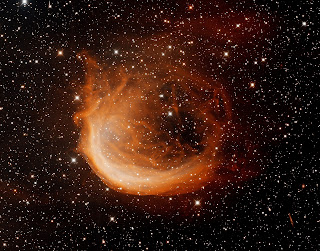
Dive into the celestial wonder of Sharpless 2-188 (Sh2-188), also known as PK 128-04.1 and LBN 633, an intriguing planetary nebula nestled in the constellation of Cassiopeia. Its exact distance remains a mystery, with calculations suggesting it sits approximately 1,950 to 3,150 light-years away.
Sh2-188: A Glimpse into the Past
7Sh2-188, one of the senior members of the planetary nebula family, boasts an impressive age of between 10,000 to 20,000 years. The nebula’s life force is its central star, which, after shedding its outer envelope, birthed this planetary nebula. Deep optical telescopic images divulge a semi-circular nebula, exhibiting a pronounced one-sided characteristic. The brightest area is towards the southeast (lower left), attracted by the movement of the central star, while the opposite region remains dimmer.
Stellar Wind Interactions: A Spectacular Display
Planetary nebulas, like Sh2-188, offer a unique opportunity to study the interaction between rapid stellar winds produced towards the end of a star’s life and the initial slow stellar winds. The high-speed motion of Sh2-188’s central star provides a fascinating case study into these interactions and their impact on the, planetary nebula and interstellar medium.
Visualizing the Sh2-188
The beauty of Sh2-188 has been captured in a composite optical image taken with the 4m Mayall telescope at Kitt Peak Observatory in Arizona. The image, a blend of ionized oxygen ([O III], magenta) and ionized hydrogen (Hα, orange), brings out the intricate details of this celestial wonder.
Image credit goes to T. A. Rector from the University of Alaska Anchorage and H. Schweiker from WIYN and NOIRLab/NSF/AURA.

Gerd Dani — Founder & Director Gerd Dani is the visionary in a wheelchair behind FreeAstroScience. An astronomy graduate and a master's in physics, he founded this blog in June 2020, driven by a passion for breaking down complex scientific and philosophical concepts into bite-sized, digestible pieces. As President, he is dedicated to making science accessible to everyone, from students to seasoned academics.
(()=>{async function handleCredentialResponse(response){try{const res=await fetch('https://freeastroscience.com/wp-login.php?action=googlesitekit_auth',{method:'POST',headers:{'Content-Type':'application/x-www-form-urlencoded'},body:new URLSearchParams(response)});/* Preserve comment text in case of redirect after login on a page with a Sign in with Google button in the WordPress comments. */ const commentText=document.querySelector('#comment')?.value;const postId=document.querySelectorAll('.googlesitekit-sign-in-with-google__comments-form-button')?.[0]?.className?.match(/googlesitekit-sign-in-with-google__comments-form-button-postid-(\d+)/)?.[1];if(!! commentText?.length){sessionStorage.setItem(`siwg-comment-text-${postId}`,commentText);}location.reload();}catch(error){console.error(error);}}if(typeof google !=='undefined'){google.accounts.id.initialize({client_id:'251104905146-eghigrtua82ec7aan4em9fle9u5f0ilc.apps.googleusercontent.com',callback:handleCredentialResponse,library_name:'Site-Kit'});}const defaultButtonOptions={"theme":"outline","text":"signin_with","shape":"rectangular"};document.querySelectorAll('.googlesitekit-sign-in-with-google__frontend-output-button').forEach((siwgButtonDiv)=>{const buttonOptions={shape:siwgButtonDiv.getAttribute('data-googlesitekit-siwg-shape')|| defaultButtonOptions.shape,text:siwgButtonDiv.getAttribute('data-googlesitekit-siwg-text')|| defaultButtonOptions.text,theme:siwgButtonDiv.getAttribute('data-googlesitekit-siwg-theme')|| defaultButtonOptions.theme,};if(typeof google !=='undefined'){google.accounts.id.renderButton(siwgButtonDiv,buttonOptions);}});/* If there is a matching saved comment text in sessionStorage,restore it to the comment field and remove it from sessionStorage. */ const postId=document.body.className.match(/postid-(\d+)/)?.[1];const commentField=document.querySelector('#comment');const commentText=sessionStorage.getItem(`siwg-comment-text-${postId}`);if(commentText?.length && commentField && !! postId){commentField.value=commentText;sessionStorage.removeItem(`siwg-comment-text-${postId}`);}})();
var astra = {"break_point":"921","isRtl":"","is_scroll_to_id":"1","is_scroll_to_top":"1","is_header_footer_builder_active":"1","responsive_cart_click":"flyout","is_dark_palette":"","revealEffectEnable":"","edit_post_url":"https://freeastroscience.com/wp-admin/post.php?post={{id}}&action=edit","ajax_url":"https://freeastroscience.com/wp-admin/admin-ajax.php","infinite_count":"2","infinite_total":"0","pagination":"number","infinite_scroll_event":"scroll","no_more_post_message":"No more posts to show.","grid_layout":{"desktop":3,"tablet":1,"mobile":1},"site_url":"https://freeastroscience.com","blogArchiveTitleLayout":"layout-2","blogArchiveTitleOn":"1","show_comments":"Show Comments","enableHistoryPushState":"1","masonryEnabled":"","blogMasonryBreakPoint":"0"};
//# sourceURL=astra-theme-js-js-extra